
Engine troubles overshadow Aston Martin’s big winter – Aston Martin’s much-anticipated new era with Honda got off to a rocky start after a challenging Formula 1 test in Bahrain. The green cars repeatedly stalled, lost valuable track time, and failed to provide any clear answers in the desert heat.
However, given the introduction of brand new technical regulations for the season, some initial issues were always anticipated across the board. New power units, revised aerodynamics, and updated electronics rarely behave perfectly from the outset. However, it was less expected that Aston Martin, buoyed by significant investment from team owner Lawrence Stroll and armed with a new Honda power unit, would be among the most visibly troubled.
Rather than making a statement of intent, the Silverstone-based team spent much of the testing period in the garage.
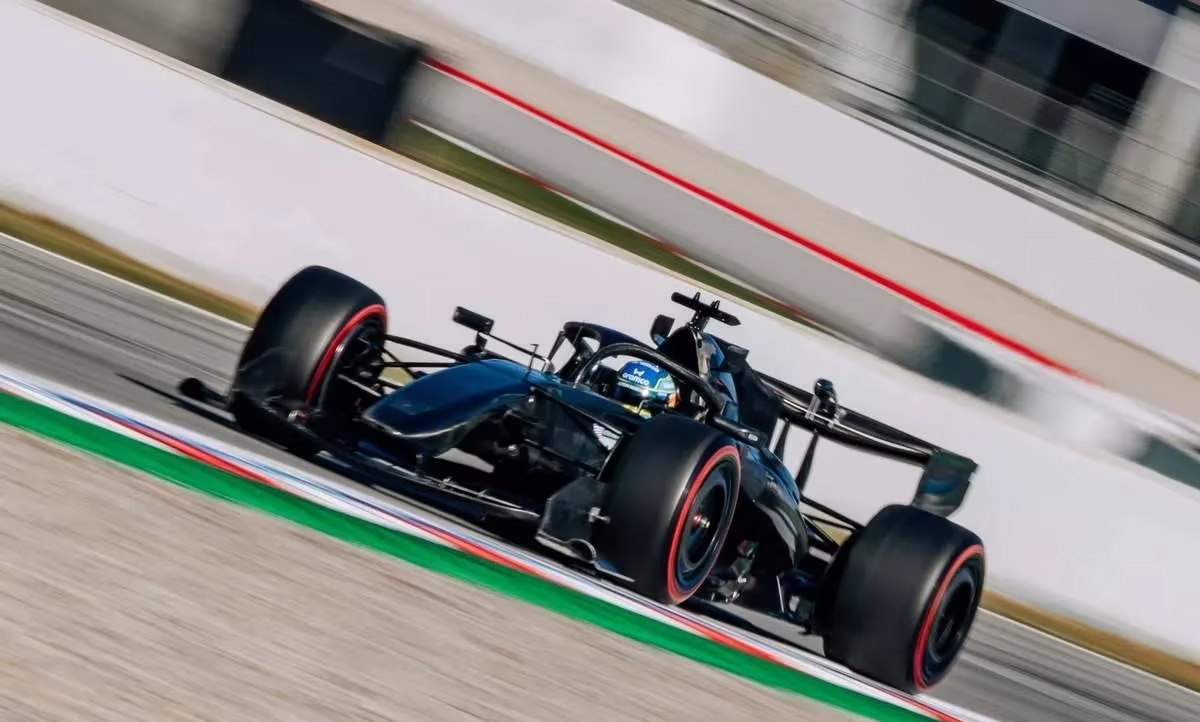
The mileage deficit paints a bleak picture
The numbers alone underline the scale of the issue. After a shakedown in Barcelona and two official testing phases in Bahrain, Aston Martin had only managed to log 2,115 kilometres. In the context of modern Formula 1 testing, that is alarmingly modest.
For comparison, new arrival Audi racked up 4,942 kilometres, more than double Aston Martin’s total. Even more striking is the fact that former Honda partner Red Bull Racing, now running its own engines for the first time, amassed an impressive 10,506 kilometres.
Mileage is not everything, but in pre-season testing it is important. Every lap generates data and requires correlation checks and reliability validation. By contrast, Aston Martin often appeared to be conducting extended garage-based simulations.
The low point came on the final day in Bahrain, when the team completed just six installation laps. The reason? Honda reportedly did not have enough usable batteries at the circuit, which would sound implausible if it were not so consequential.
Vibrations are at the heart of the problem
According to Honda, the root cause lies in severe vibrations from the V6 internal combustion engine. These vibrations have repeatedly damaged the battery system within the hybrid power unit.
In an interview with the Japanese edition of Autosport, Honda’s Ikuo Takeuchi explained that ‘abnormal vibrations’ during testing had caused battery damage, forcing the team to stop on the fifth day. This was the session during which two-time world champion Fernando Alonso experienced multiple stalls on the track.
Takeishi stressed that the decision to stop the car was precautionary.
“It wasn’t as if an accident was imminent,” he said, “but the condition was considered unsafe enough to warrant shutting the programme down.”
In modern Formula 1, where hybrid systems operate at extremely high voltages, caution is non-negotiable. Nevertheless, the debut of a works partnership under the spotlight of a new regulation cycle should not be defined by repeated red flags and the gentle hum of cooling fans in the garage.

It’s a complex puzzle, not a single faulty part
Perhaps most concerning is Honda’s admission that they do not yet fully understand the cause of the vibrations. Although the damage has been concentrated in the battery, engineers cannot definitively say whether the battery itself is fundamentally at fault.
“It is likely not a single component,” admitted Takeishi, describing the situation as ‘challenging’.
In other words, the issue may be systemic, potentially involving the engine mountings, the energy recovery systems, or the integration of the chassis and the power unit.
Such problems rarely have quick fixes. Addressing vibrations may require structural changes, revised damping solutions, or internal modifications that affect the entire vehicle. In a cost-capped era, this is neither simple nor inexpensive.
A very mild satirical suggestion is that Aston Martin’s state-of-the-art new facilities are currently producing more vibration analysis reports than lap times.
Pressure is building ahead of Suzuka
The early races of the season may now become damage-limitation exercises. Rather than focusing purely on performance and development, Aston Martin and Honda may need to concentrate on achieving consistent race distances.
There is also a symbolic deadline looming. The third Grand Prix of the year is taking place at Suzuka, Honda’s home circuit and one of the most iconic venues in the sport. A disappointing performance there would be particularly embarrassing.
Takeishi has made it clear that reducing vibrations before the season opener is a priority, but his stated goal is to have the car in competitive condition in time for Suzuka. This suggests a sense of realism rather than bravado.
Aston Martin’s Challenges for 2026
Aston Martin faces a dual challenge: resolving the reliability issues swiftly and ensuring that the mileage deficit does not translate into a performance gap once the racing begins. Lost testing time means lost development time, and rivals have already racked up thousands of additional kilometres.
The season is long, and pre-season struggles do not automatically dictate championship outcomes. However, as Bahrain demonstrated, bold new projects can sometimes begin not with a roar, but with a judder.
For now, Aston Martin’s immediate goal is simple: stop shaking, start running and ensure that the next time the car turns heads, it’s because of its speed.
NEXT ARTICLE – Christian Horner reveals what message Toto Wolff sent him after his dismissal from Red Bull Racing
For years, the rivalry between Christian Horner and Toto Wolff has been one of Formula 1’s most reliable subplots. While the drivers battled it out on the track, their respective team bosses provided the drama in the paddock, sometimes subtle, often not.
So, when Horner was dismissed from Red Bull Racing shortly after last year’s British Grand Prix, many wondered whether Wolff would raise a quiet toast or send a quiet message.
As it turns out, he chose the latter.
In the latest season of Formula 1: Drive to Survive, Horner reveals exactly what his long-time rival sent him in the aftermath of his exit. In true Wolff fashion, it was equal parts sharp and sincere, and just self-aware enough to be dangerous.

When ‘porpoising’ nearly caused a diplomatic incident
To understand the tone of that message, it helps to revisit one of their more combustible flashpoints.
Three years ago, amid the chaos of Formula 1’s ground-effect return, several teams were battling severe ‘porpoising’, the high-speed bouncing that turned multimillion-pound race cars into mechanical pogo sticks. Wolff, whose driver Lewis Hamilton was visibly suffering from back pain, pushed hard at a meeting of the team principals for regulatory changes.
The problem? Sympathy was in short supply.
Horner, never one to miss an opportunity for mischief, suggested the discussion might be better held away from the ever-present Netflix cameras. Wolff did not appreciate the meta-commentary. Tempers flared. Tempers flared. Subtlety left the room.
Horner eventually snapped: ‘Then adjust your bloody car!’
Wolff countered by invoking Sergio Pérez, claiming that even the Red Bull driver had complained. Horner flatly denied it. Wolff, with theatrical precision, declared: “I have it printed out.”
It was peak Drive to Survive. Shakespeare, but with data sheets…CONTINUE READING THIS ARTICLE

Alex Stanton is a Formula 1 journalist at TJ13 with a focus on the financial and commercial dynamics that underpin the sport. Alex contributes reporting and analysis on team ownership structures, sponsorship trends, and the evolving business model of Formula 1.
At TJ13, Alex covers topics including manufacturer investment, cost cap implications, and the strategic direction of teams navigating an increasingly complex financial environment. Alex’s work often examines how commercial decisions translate into on-track performance and long-term competitiveness.
With a strong interest in the intersection of sport and business, Alex provides context around Formula 1’s global growth, including media rights, expansion markets, and manufacturer influence.
Alex’s reporting aims to explain the financial realities behind headline stories, helping readers understand how money, governance, and strategy shape the competitive order in Formula 1.

Craig Alderson is Senior Editor at TJ13, where Craig oversees newsroom operations and coordinates editorial output across the site. With a background in online sports reporting and motorsport magazine editing, he plays a key role in maintaining consistency, speed, and accuracy in TJ13’s coverage.
During race weekends, Craig acts as desk lead, directing contributors, prioritising breaking stories, and ensuring timely publication across a fast-moving news cycle.
Craig’s work focuses heavily on real-time developments in the paddock, including team updates, regulatory decisions, and emerging controversies. This role requires a detailed understanding of Formula 1’s operational flow, from practice sessions through to race-day strategy and post-race fallout.
With experience managing editorial teams, Craig ensures that TJ13 delivers structured, reliable coverage while maintaining the site’s distinctive voice.
Craig has a particular interest in how information moves within the paddock environment, and how rapidly developing stories can be accurately translated into clear, accessible reporting for readers.
