
Ferrari and Leclerc complete laps at Monza with new features ahead of the Miami Grand Prix as FIA-sanctioned filming day becomes crucial test session – Scuderia Ferrari transformed its scheduled filming day at the Autodromo Nazionale Monza into a vital development opportunity in preparation for the Miami Grand Prix.
Although regulations limit teams to 200 kilometres of promotional running, Ferrari used the session to carry out an initial on-track validation of a significant upgrade package.
With only one free practice session scheduled in Miami due to the Sprint format, the importance of this early test cannot be overstated. It effectively serves as a substitute for valuable track time that would otherwise be unavailable during the race weekend.
Would you like to see more TJ13 Formula 1 coverage? Add us to your favourites list on Google to receive trusted F1 news.
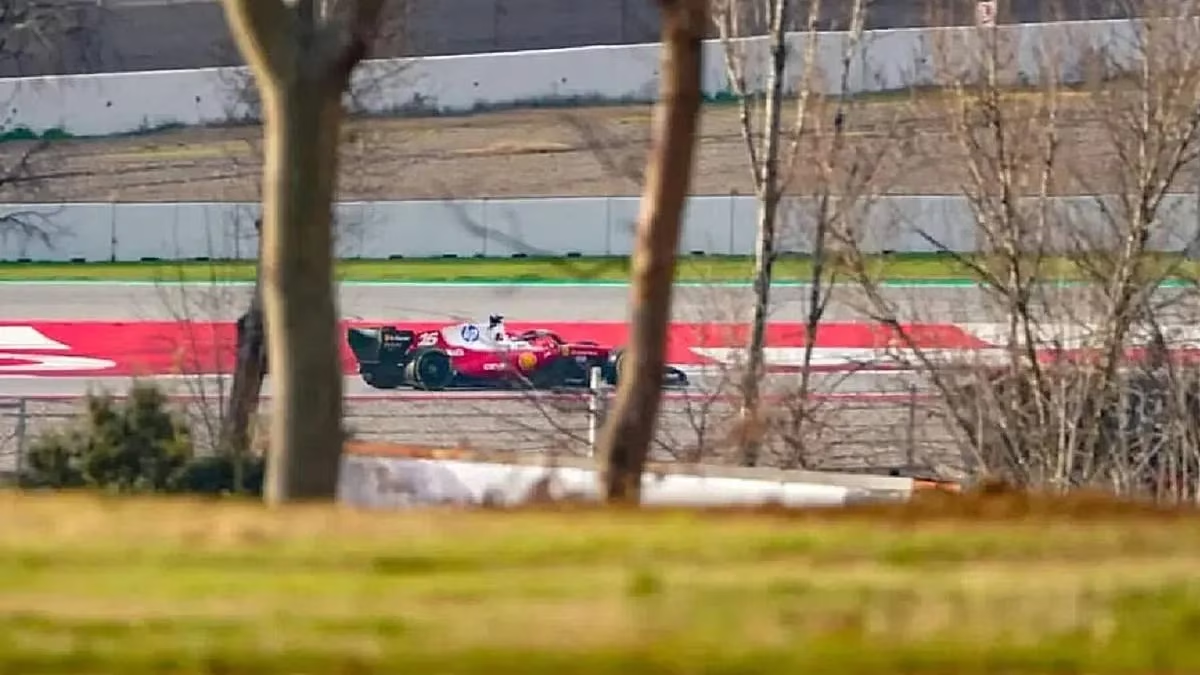
Leclerc and Hamilton share limited mileage
Charles Leclerc took to the track shortly before 11:00, beginning the evaluation process before handing over to his teammate, Lewis Hamilton. With a maximum of around 34 laps permitted, Ferrari must carefully divide the driving time between the two drivers while gathering as much data as possible.
Each lap is therefore highly structured, focusing on gathering precise feedback rather than outright performance. Despite these constraints, the session provides valuable insight into how the updates perform in real-world conditions.
MORE NEWS – Honda steps up AMR26 recovery effort
WATCH FERRARI TESTING IN MONZA FROM TODAY (22 April 2026)
SF-26 debuts revised configuration
The Ferrari SF-26 made its debut at Monza in a significantly updated form compared to the opening races of the season. Ferrari has been working intensively at Maranello to address early inconsistencies, and this package represents the first major step in the recovery plan. Insiders previously reported by this website a few days ago state that 50% of the car has been changed.
The goal is not just to improve pace, but also to deliver a car that is more predictable and adaptable across different circuits — something that has been lacking so far.
MORE NEWS – F1 driver and dozens of footballers linked to Milan human trafficking network
‘Macarena wing’ headlines upgrade package
One of the most eye-catching innovations is the so-called ‘Macarena wing’, a rotating aerodynamic device designed to reduce drag on straights while maintaining stability in corners. Early footage circulating online suggests that Ferrari has already begun assessing its functionality during the Monza runs.
Circuits such as Miami and Montreal, where straight-line speed is crucial, could benefit significantly from this concept. If it performs as intended, it could give Ferrari a valuable efficiency boost without compromising cornering performance.
Floor evolution and aerodynamic refinements
Alongside the wing, Ferrari is introducing an updated floor, which is one of the most influential performance areas on a modern Formula 1 car. Improvements here can significantly boost downforce and consistency, especially over longer runs.
The team has also refined smaller aerodynamic details, including adjustments to the stepped airscope cover. While these micro-changes are subtle, they play an important role in optimising airflow and the car’s overall balance.
READ MORE – McLaren IndyCar star Pato O’Ward Delivers Devastating verdict on F1
Focus on reliability and system performance
Ferrari’s development work has also focused on reliability and operational precision. Data gathered from earlier races in China and Japan highlighted the need to improve transitions between aerodynamic modes, particularly when switching from high-downforce cornering setups to low-drag straight-line configurations.
To support this, the actuators controlling the rotating wing have been strengthened and made lighter. It is essential to ensure both durability and responsiveness, especially given the extreme loads experienced at high speeds.
MORE NEWS – Drivers to be Gagged on F1 Rule Changes
Miami arrives at a critical moment
This Monza outing ultimately acts as a dress rehearsal before the Miami weekend. With limited practice time available, Ferrari needs to arrive in Miami with confidence in the performance and reliability of its new components.
If the data gathered here is positive, the team could become much more competitive. After a challenging start to the season, Miami could provide the first real indication of whether Ferrari’s development strategy is beginning to pay off.
Would you like to see more TJ13 Formula 1 coverage? Add us to your favourites list on Google to receive trusted F1 news.
NEXT ARTICLE – The obsession behind F1’s rule ‘tweaks’
Formula One claims it has acted swiftly and decisively to change the 2026 rules which have proven so far to be a farce. Firstly, as a matter of safety, F1 and the FIA needed to act to prevent the horrendous closing speeds which have been visible between cars who are deploying electrical boost and others who are harvesting energy.
Last time out in Japan, Haas F1 driver Oliver Bearman was blasting through the right-hander on the approach to Spoon when he came upon the dawdling Alpine of Franco Colapinto who was storing up electrical energy. The result being the Haas F1 driver ended up in the wall and suffered a massive 50g impact. While he was helped away limping, fortunately the British driver suffered no broken bones.
To prevent this, it has been agreed that in ‘non-hard’ accelerating zones, the maximum deployment from the car will be cut from 350kW to 250kW. Where the full amount of power will be available is out of a corner onto a straight, but in the case of Bearman in Suzuka on the entrance to Spoon corner, he would have had just under a third less electrical boost which may have mitigated the incident.

The obsession with absolute speed
The headline number which will disappoint some of the engine manufacturers is that the maximum charge which can be recovered across a single lap is being reduced from 8MJ to 7MJ. This will add around a second of lap time, a matter which F1 appears pretty concerned about for some reason. A far safer and better solution would have been to cut this number by another 1MJ to 6MJ, which would see the drivers run for most of the lap without resorting to strange energy recovery tactics.
Yet despite no TV viewer or most spectators at the circuit being able to detect a two-second-a-lap slower F1 car, F1 stats appear important to the commercial rights holder and the regulator of the sport. At the recent Goodwood event some of the most exciting racing was between Mini’s and Escort 2000’s. It’s not the matter of absolute speed that F1 should obsess about, but the excitement in the racing. That said, the new 7MJ will mean less lift and coast from the drivers and more attacking into the apex of the turns.
One of the most farcical elements of the current set of regulations is the sight of a car hurtling down the straight, only to seem to lose power with hundreds of metres to go. This is not merely due to…CONTINUE READING THIS STORY

Craig Alderson is Senior Editor at TJ13, where Craig oversees newsroom operations and coordinates editorial output across the site. With a background in online sports reporting and motorsport magazine editing, he plays a key role in maintaining consistency, speed, and accuracy in TJ13’s coverage.
During race weekends, Craig acts as desk lead, directing contributors, prioritising breaking stories, and ensuring timely publication across a fast-moving news cycle.
Craig’s work focuses heavily on real-time developments in the paddock, including team updates, regulatory decisions, and emerging controversies. This role requires a detailed understanding of Formula 1’s operational flow, from practice sessions through to race-day strategy and post-race fallout.
With experience managing editorial teams, Craig ensures that TJ13 delivers structured, reliable coverage while maintaining the site’s distinctive voice.
Craig has a particular interest in how information moves within the paddock environment, and how rapidly developing stories can be accurately translated into clear, accessible reporting for readers.
