
The internal turmoil at the Alpine F1 Team has begun to extend far beyond basic questions of ownership. What began as a disagreement over the sale of a 24% stake has evolved into a wider conflict that could transform the team’s sporting strategy.
At the heart of the matter lies a dispute between Renault and the investment firm Otro Capital. This disagreement has created a tense internal environment at a time when stability is crucial, especially as Alpine seeks to gain momentum on the track.
As ownership uncertainty bleeds into decision-making, the consequences may extend well beyond the boardroom.
Would you like to see more TJ13 Formula 1 coverage? Add us to your favourites list on Google to receive trusted F1 news.
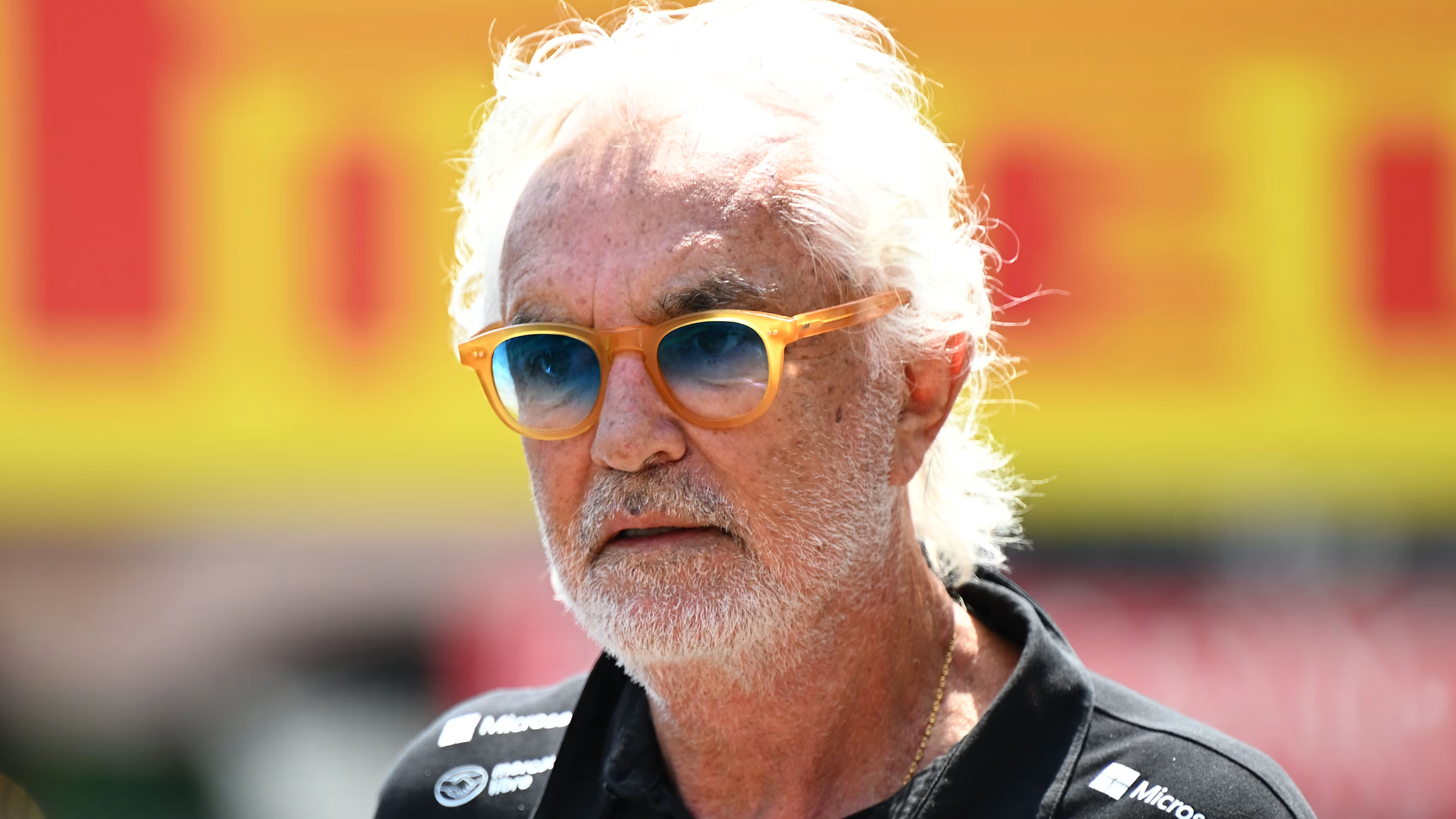
The 24% stake at the heart of the conflict
The origins of the dispute lie in Alpine’s rapid valuation increase. When Otro Capital invested in 2023, the team was valued at around $900 million. Since then, the commercial boom of Formula 1, combined with Alpine’s improving competitiveness, has significantly increased that figure.
Now, the American fund is seeking to sell its 24% stake under more favourable conditions. However, Renault, which still holds a decisive contractual advantage, has resisted this plan.
Under the terms of their agreement, Renault has the right to veto any sale of the minority stake until 13 September 2026. This means that, for now, no transaction can be completed without the majority shareholder’s approval.
This has effectively stalled negotiations and intensified tensions between the two parties.
A blocked Horner deal and rising tensions
Renault’s veto has already had tangible consequences. One notable proposal that failed to progress involved Christian Horner, who is supported by Flavio Briatore, the latter of whom currently plays an advisory role within Alpine.
The offer reportedly valued the entire team at approximately $2.5 billion, a substantial increase compared to its valuation just a few years ago. Despite the financial upside, Renault chose to block the deal.
The decision was not purely financial. According to sources close to the negotiations, Renault CEO François Provost prioritised stability over immediate profit, viewing continuity as essential for long-term success in Formula 1.
However, this stance has exacerbated the rift with Otro Capital. Reports suggest that a key meeting in Paris became highly confrontational, with relations between senior figures deteriorating sharply in the aftermath.
MORE NEWS – Audi’s F1 Identity Crisis: A Corporate Giant in a Racing World
Date set for September: a decisive turning point
The situation is set to change significantly later this year. Once Renault’s veto expires in September, Otro Capital will be free to pursue a sale without requiring the majority shareholder’s approval.
This is expected to lead to a more competitive and potentially aggressive bidding process.
The investment firm is reportedly preparing to launch an auction towards the end of the summer in order to maximise the value of its stake. With strong financial backing, including a recent $1.2 billion capital raise, Otro Capital can afford to wait for optimal market conditions.
Opportunities to acquire even a minority share in Formula 1 are rare given the limited number of teams. This scarcity is likely to attract significant interest from multiple parties.
An Apple a Day: The FIA’s Questionable Cure for F1’s 2026 chronic illness
A crowded field of potential buyers
Several names have already emerged as potential investors, but one stands out above the rest:
Mercedes is understood to be the preferred option within Renault, offering both financial strength and strategic alignment. Other figures involved in the process include Otmar Szafnauer and Steve Cohen, though neither appears to carry the same weight as the German manufacturer.
Speaking during the Chinese Grand Prix weekend, Briatore confirmed that discussions are ongoing and substantial. He clarified that negotiations are being conducted directly with Mercedes as a company, rather than through team principal Toto Wolff.
He also revealed that there are ‘three or four’ serious candidates interested in acquiring the stake, highlighting the level of demand for Alpine’s position in the sport.
MORE NEWS – Ferrari Miami Upgrade Package Explained as Key Monza Test Approaches
The sporting impact
While the financial and political dimensions of the dispute dominate headlines, the potential sporting consequences should not be overlooked.
Uncertainty at the ownership level often translates into instability in team strategy. Decisions regarding driver line-ups, long-term planning and investment priorities can all be affected when control is unclear.
As the situation develops, the outcome of this internal battle could determine not only the team’s shareholder structure, but also the trajectory of careers and the future direction of Alpine itself.
NEXT ARTICLE – Fans ditching F1 as viewer numbers collapse
As predicted by the independent F1 press before the season opener, the all-new 2026 era is rapidly descending into farce. A huge plunge in viewer numbers following the Japanese Grand Prix makes plain the fans are voting with their feet.
The fundamental architecture of the 50/50 power units was flawed from its inception. As Stefano Domenicali, F1 supremo, admitted in 2025, the resulting regulations were a “political” decision based on attracting more manufacturers into the sport.
Whilst the FIA working party on the next generation of F1 engines was formed in 2017, it was in 2020 that the first mention of the all-new 50/50 power unit was made. As the name suggests, the power contribution from the internal combustion engine would be 50%, as it would be from the battery.

F1 manufacturers mis-read the future of road cars
A bold new step into greater efficiency and the electrified future was the intention, yet increasing the current electrical output by three times was always going to be ambitious. For many auto manufacturers who did not believe in the coming of the EV revolution, hybrids would be the bulk of the future road cars they produced.
And whilst hybrids have become a transitional technology in the auto industry, they have significant disadvantages compared to either the internal combustion engine or full electric cars. They contain the bulk of both an internal combustion engine along with the weight of a battery and, given the average person is…CONTINUE TO READ THIS STORY

Alex Stanton is a Formula 1 journalist at TJ13 with a focus on the financial and commercial dynamics that underpin the sport. Alex contributes reporting and analysis on team ownership structures, sponsorship trends, and the evolving business model of Formula 1.
At TJ13, Alex covers topics including manufacturer investment, cost cap implications, and the strategic direction of teams navigating an increasingly complex financial environment. Alex’s work often examines how commercial decisions translate into on-track performance and long-term competitiveness.
With a strong interest in the intersection of sport and business, Alex provides context around Formula 1’s global growth, including media rights, expansion markets, and manufacturer influence.
Alex’s reporting aims to explain the financial realities behind headline stories, helping readers understand how money, governance, and strategy shape the competitive order in Formula 1.
