
Ferrari delay key Hamilton call as Miami return looms – With Formula 1 preparing to resume in Miami after its enforced April break, Scuderia Ferrari has quietly put one of its most important internal decisions on hold. According to reports from the Italian outlet Corriere della Sera, the team has decided to maintain the current setup around Lewis Hamilton rather than making a hasty long-term change.
At the heart of this decision is race engineer Carlo Santi, who initially took on the role on a temporary basis but is now expected to remain in the pit lane for the foreseeable future. The upcoming Miami Grand Prix will therefore see continuity rather than experimentation on Hamilton’s side of the garage, something that Ferrari appears to value at this stage of the season.
Would you like to see more TJ13 Formula 1 coverage? Add us to your favourites list on Google to receive trusted F1 news.
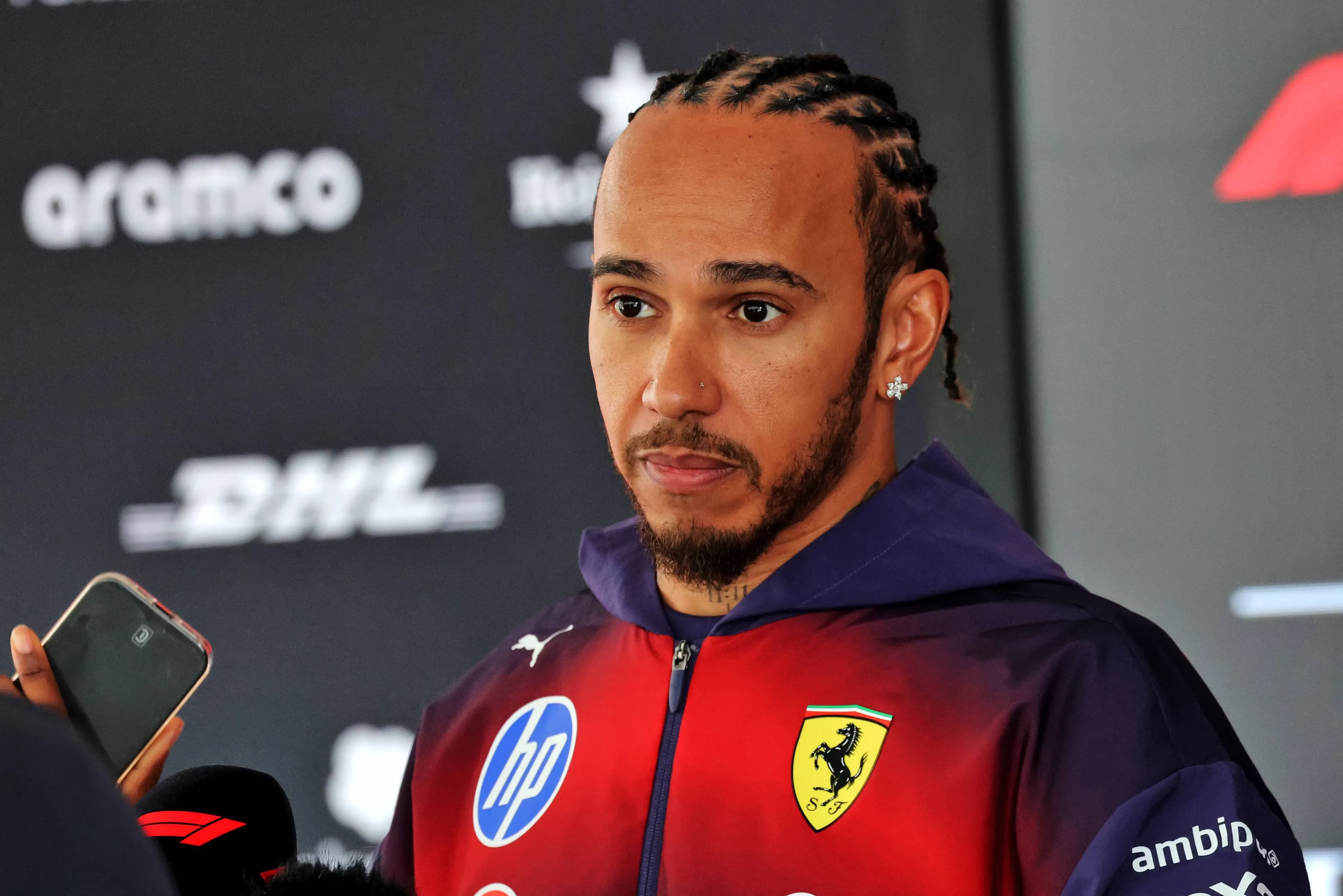
Growing trust between Hamilton and Santi
Despite initially being a stopgap solution, Santi has quickly established a “significant connection” with Hamilton. The early signs of this relationship have been encouraging enough for Ferrari to delay any immediate restructuring, and the current pairing is set to continue ‘for a while longer’.
This stability is notable given the intense scrutiny that comes with managing a driver of Hamilton’s stature. The seven-time world champion is known for his detailed feedback and high standards, making the role of race engineer particularly critical. So far, however, communication between the two has been smooth, notably free of the kind of tension that sometimes spills onto the team radio.
While Ferrari is believed to be evaluating alternative options behind the scenes, there is no sense of urgency. For now, the team sees little reason to disrupt a working dynamic that is delivering results.
From Adami’s exit to Santi’s promotion
Santi’s current position is the result of a reshuffle that began at the start of the season. Riccardo Adami, who had worked closely with Hamilton, was removed from his role and given a new one following a series of noticeable communication issues on the track during the 2025 campaign.
These radio exchanges were sometimes tense and public, ultimately leading Ferrari to make a decisive change. By mid-January, Adami had officially stepped away from his pit wall duties, marking the end of a partnership that never quite worked out.
During the early pre-season, Hamilton initially worked with Bryan Bozzi, who is best known as Charles Leclerc’s race engineer. However, even then, Santi was already being integrated into the role, notably taking over radio duties during testing in Bahrain.
Interestingly, Santi has experience of working with Kimi Räikkönen, another world champion known for his direct communication style. This background may have helped him adapt quickly to Hamilton’s approach.
MORE NEWS – Honda steps up AMR26 recovery effort
Improved results ease the pressure
One of the key reasons Ferrari can afford patience is performance. The 2026 season has started far more positively than the previous year, alleviating the pressure on the drivers and team personnel.
After three races, Ferrari has emerged as the second-strongest team on the grid, currently behind only the Mercedes-AMG Petronas Formula One Team. Leclerc sits third in the drivers’ standings, with Hamilton close behind in fourth — an early indication that the Scuderia has taken a significant step forward.
For Hamilton personally, the improvement is already tangible. He secured a podium finish in China, ending a frustrating run in 2025 when he failed to reach the podium at all — a first in his otherwise remarkable career.
This upward trajectory has likely contributed to the calmer atmosphere within the team. When results are strong, internal experimentation becomes less urgent and maintaining stability often takes priority.
MORE NEWS – F1 driver and dozens of footballers linked to Milan human trafficking network
What does this mean for Ferrari’s next move?
By postponing a definitive decision on Hamilton’s race engineer, Ferrari is effectively buying time. The team can continue to assess its options without risking disruption during a crucial phase of the championship.
If the current momentum continues, Santi’s “temporary” role could gradually become permanent by default. Conversely, any dip in performance or communication issues could quickly bring alternative candidates back into consideration.
For now, though, Ferrari appears content to prioritise consistency over change. As the season resumes in Miami, attention will not only be focused on lap times, but also on whether this evolving partnership can continue to deliver, and whether Ferrari’s patience will ultimately pay off.
Would you like to see more TJ13 Formula 1 coverage? Add us to your favourites list on Google to receive trusted F1 news.
NEXT ARTICLE – The obsession behind F1’s rule ‘tweaks’
Formula One claims it has acted swiftly and decisively to change the 2026 rules which have proven so far to be a farce. Firstly, as a matter of safety, F1 and the FIA needed to act to prevent the horrendous closing speeds which have been visible between cars who are deploying electrical boost and others who are harvesting energy.
Last time out in Japan, Haas F1 driver Oliver Bearman was blasting through the right-hander on the approach to Spoon when he came upon the dawdling Alpine of Franco Colapinto who was storing up electrical energy. The result being the Haas F1 driver ended up in the wall and suffered a massive 50g impact. While he was helped away limping, fortunately the British driver suffered no broken bones.
To prevent this, it has been agreed that in ‘non-hard’ accelerating zones, the maximum deployment from the car will be cut from 350kW to 250kW. Where the full amount of power will be available is out of a corner onto a straight, but in the case of Bearman in Suzuka on the entrance to Spoon corner, he would have had just under a third less electrical boost which may have mitigated the incident.

The obsession with absolute speed
The headline number which will disappoint some of the engine manufacturers is that the maximum charge which can be recovered across a single lap is being reduced from 8MJ to 7MJ. This will add around a second of lap time, a matter which F1 appears pretty concerned about for some reason. A far safer and better solution would have been to cut this number by another 1MJ to 6MJ, which would see the drivers run for most of the lap without resorting to strange energy recovery tactics.
Yet despite no TV viewer or most spectators at the circuit being able to detect a two-second-a-lap slower F1 car, F1 stats appear important to the commercial rights holder and the regulator of the sport. At the recent Goodwood event some of the most exciting racing was between Mini’s and Escort 2000’s. It’s not the matter of absolute speed that F1 should obsess about, but the excitement in the racing. That said, the new 7MJ will mean less lift and coast from the drivers and more attacking into the apex of the turns.
One of the most farcical elements of the current set of regulations is the sight of a car hurtling down the straight, only to seem to lose power with hundreds of metres to go. This is not merely due to…CONTINUE READING THIS STORY

Alex Stanton is a Formula 1 journalist at TJ13 with a focus on the financial and commercial dynamics that underpin the sport. Alex contributes reporting and analysis on team ownership structures, sponsorship trends, and the evolving business model of Formula 1.
At TJ13, Alex covers topics including manufacturer investment, cost cap implications, and the strategic direction of teams navigating an increasingly complex financial environment. Alex’s work often examines how commercial decisions translate into on-track performance and long-term competitiveness.
With a strong interest in the intersection of sport and business, Alex provides context around Formula 1’s global growth, including media rights, expansion markets, and manufacturer influence.
Alex’s reporting aims to explain the financial realities behind headline stories, helping readers understand how money, governance, and strategy shape the competitive order in Formula 1.
