


Mexico City 2025, the Mexican Grand Prix: The air was thick with anticipation, the kind that made every commentator pause mid-sentence and every fan hold their breath. One wrong move, one misjudged corner, and the stewards’ screens would light up like Christmas. It wasn’t just about speed anymore; it was about control, precision and the fine art of staying within the invisible boundaries that determine the outcome of a race before the chequered flag is waved. Amidst the chaos, you could sense that a verdict was imminent.
By the sixth lap, the tension had ripened into inevitability. The opening corners had already turned into a battleground, and the drama showed no sign of abating. Tyres screeched, tempers flared and a few daring drivers tested the limits of physics and patience. As the cars lunged and twisted through the first sector, the audience waited for the inevitable announcement from race control: a penalty that seemed as certain as the Mexican sun. But when it didn’t come, confusion set in and the whispers began.
Windsor Calls Out F1’s Selective Stewarding
Peter Windsor’s analysis of the Mexican Grand Prix was less a race review and more a theatrical performance, complete with finger-pointing, conspiratorial undertones, and a hint of wistful nostalgia for the days when stewards actually handed out penalties to the sport’s biggest star.
According to Windsor, Max Verstappen should have faced consequences for his lap-six antics against Lewis Hamilton and George Russell. Instead, the Red Bull driver escaped unscathed, while Hamilton’s Ferrari team somehow managed to shoot itself in both feet, and then blamed the pistol.
Opening laps of chaos
The first six laps in Mexico City were enough to make any team pitwall strategist sweat through their fireproofs. The opening corner alone looked like a scene from a demolition derby, with four cars charging side by side, each seemingly convinced the other three would disappear.
Five laps later, Verstappen decided to have another go at Hamilton, diving down the inside like a man possessed. It didn’t end well. Verstappen ran wide, Hamilton took to the escape road, and the stewards reached for their collective coffee rather than their penalty book.
Both drivers came out of the melee worse off. Verstappen lost a position and momentum, while Hamilton, who apparently forgot the existence of track limits, held onto third place. The race control screens lit up, the fans roared, and Windsor’s eyebrows reportedly reached new heights of disapproval.
Mexican GP: Verstappen furious as Norris takes lead of championship
Max’s self-policing moment
On his YouTube channel, Windsor dissected the moment with forensic intensity. According to him, Verstappen was the only driver starting on the medium compound tyres, which had warmed up nicely by lap six.
“He had a good amount of grip,” Windsor admitted, before swiftly accusing Max of going full kamikaze. “He went way too fast and went wide. He hit Lewis, and Lewis had to go off track, which caused even more chaos.”
Then, in a rare twist, Windsor suggested Verstappen might have tried to do the decent thing.
“We didn’t hear the radios,” he said, “but I think Max tried to give up the position himself after Turn 3. He knew otherwise he’d get a penalty.”
The problem, Windsor speculated, was that Hamilton also misjudged his braking and went lawnmowing across the grass at Turn 5, gaining a few seconds in the process. Formula 1’s version of “after you, no, after you” had turned into a comedy of errors.
Red Bull confusion and Bearman’s big moment
The ensuing chaos looked like a chess match played by toddlers. Verstappen, unsure of Hamilton’s trajectory, veered left and inadvertently squeezed George Russell, triggering a fresh round of evasive manoeuvres.
In the mayhem, Oliver Bearman and Kimi Antonelli took advantage, sweeping past like opportunistic hyenas. “Bearman’s dad went absolutely nuts in the garage,” Windsor chuckled, painting a mental image of the Ferrari garage as a mix between jubilation and disbelief.
By the end of that lap, Bearman had climbed to fourth, Antonelli was making waves in his rookie season. Windsor couldn’t resist noting the irony of Verstappen, usually the hunter, suddenly being surrounded by teenagers.
Update on Red Bull driver decision
Ferrari’s strategic meltdown
If Verstappen had been lucky, Hamilton had been cursed or, more accurately, mismanaged. Windsor, once a Ferrari man himself, didn’t mince words when blaming the Scuderia for its latest self-inflicted disaster.
“Lewis received a ten-second penalty, not for the collision, but because he didn’t slow down after cutting the track,” he explained. “Normally the race engineer tells you to do that, but Ferrari didn’t. That’s truly unforgivable.”
Hamilton’s promising start evaporated into thin air. After his pit stop, he dropped from third to eighth, his Sunday unraveling faster than a Ferrari pit wall plan under pressure.
“I really felt for Lewis,” Windsor said, sounding almost paternal. “He was strong in qualifying and solid at the start, but his race was ruined by a communication failure. This was 100 percent the pit wall’s fault.”
Hamilton’s frustration was visible as he pushed too hard on worn tires, trying to rebuild the gap he once had over Bearman. The result? Overheated rubber, underwhelming pace, and yet another example of Ferrari turning strategy into farce. It’s almost become their signature brand.
Should Verstappen have been punished?
For Windsor, the real crime was that Verstappen walked away penalty-free.
“Max should have gotten a penalty for what he did to George,” he insisted. “George had to swerve heavily to avoid him, but nothing happened.”
In Windsor’s view, that leniency set an uncomfortable precedent. If Verstappen’s brush with Russell wasn’t punishable, what was?
However, the regulations might have backed Verstappen this time. When he rejoined the track at Turn 4, Russell was on the outside, and by the apex of Turn 5, Verstappen had the inside line, technically giving him the right to the corner. The Mercedes driver was left with no room, both literally and figuratively, and ultimately finished a disappointing seventh, sandwiched between Antonelli and his own frustration.
Double standards and selective justice
Windsor’s broader point was less about Verstappen’s specific move and more about the stewards’ apparent inconsistency.
“It’s bizarre that Charles didn’t get a penalty before the race, and then Max didn’t either,” he said. “The only driver who did get punished didn’t deserve it at all, Lewis Hamilton.”
His summary was a masterpiece of Windsorian irony: “He wasn’t the one who should have received a penalty, but he did receive one.”
In essence, Windsor painted a picture of a Formula 1 where accountability depends more on the colour of your car and the size of your trophy cabinet than the letter of the law. Verstappen, as usual, was the golden child who could do no wrong. Hamilton, meanwhile, was the scapegoat of Ferrari’s continuing comedy of errors, and Russell was left wondering if next week’s stewards might actually have their eyes open.
The moral of Windsor’s story was clear: F1’s rule enforcement remains as flexible as a Red Bull front wing. Verstappen continues to test its limits and, much to Windsor’s dismay, seems to have friends in high places every time he does.
For fans, it was another Sunday of drama, debate, and déjà vu. For Windsor, it was proof that even in 2025, some drivers race under a slightly more forgiving flag.
And for the rest of us? Just another week in Formula 1, where the only consistent thing about the stewards is their inconsistency. The jury, as always, is invited to deliberate in the comments below.
Pirelli gamble works despite widespread paddock criticism in Mexico
MORE F1 NEWS – Piastri mystery leads to conspiracy theories
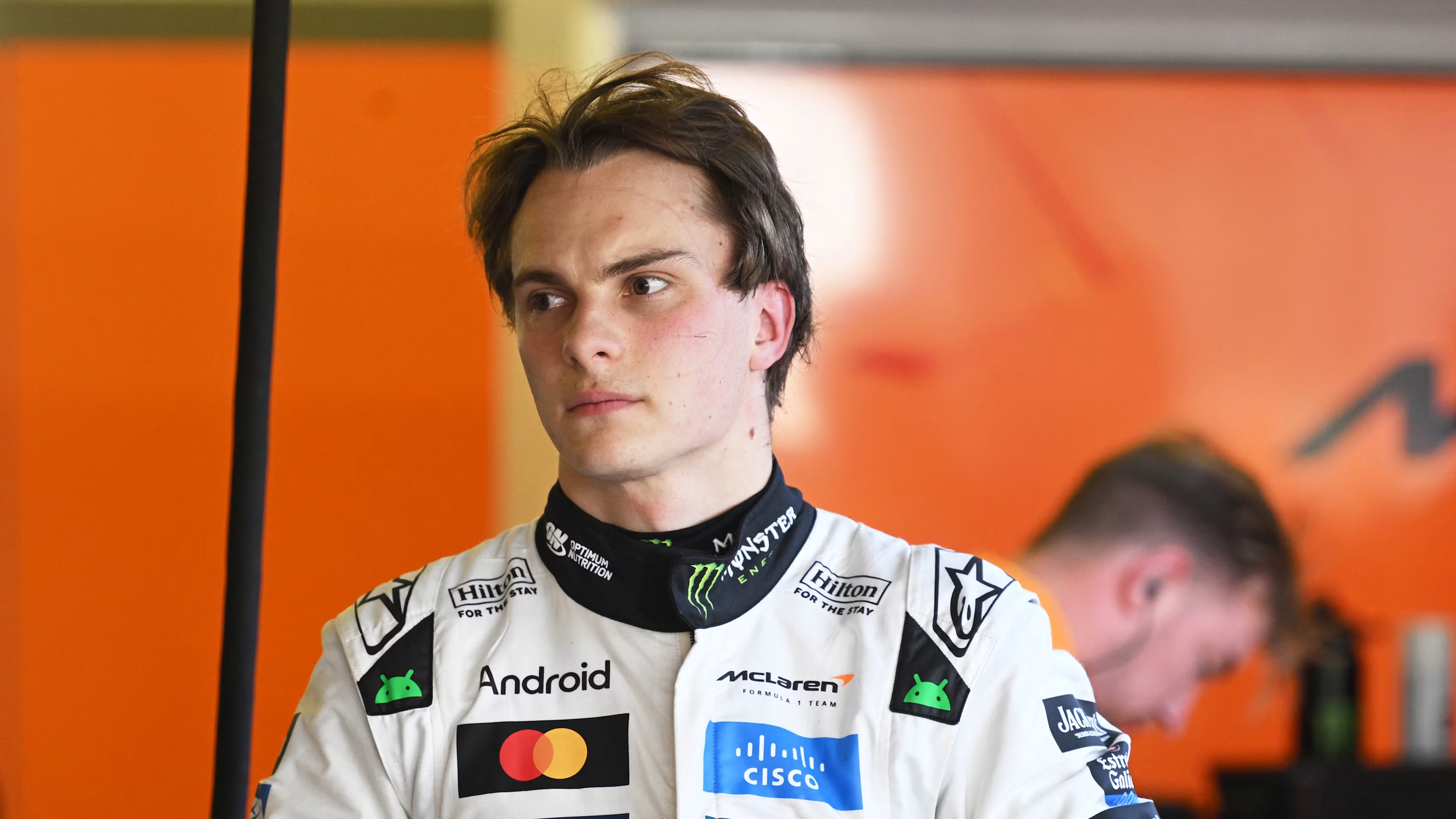
One race after the summer break, Oscar Piastri was on top of the Formula One world. He had broken the resistance of the current world champion and his team mate’s DNF in Zandvoort left him an almost unassailable 34 points clear of Lando Norris.
Given that McLaren had won twelve of the first fifteen Grand Prix, it was expected this form would continue with both drivers trading 1-2’s to the end of the season,. Meaning without a DNF for Piastri it would be the Australian who claimed his maiden F1 drivers’ championship.
Just four races later and the wheels have fallen from Oscar’s racing wagon. Crashes and false starts in Baku began his demise then in Singapore he was dominated by his team mate and failed to make the podium.
Piastri scrapes through to Q3
The US GP which is a low grip circuit proved tough for Piastri, again with him trailing Norris for most of there weekend finishing just fifth. Now in Mexica, where the grip is also low, the young McLaren driver has had a nightmare in qualifying and will start the race in seventh place, due to a one position promotion due to Carlos Sainz grid drop.
His only saving grace is Verstappen who looked the most dangerous in terms of the title challenge – and was the bookies favourite – is having a tough weekend of his own. He and the team failed to nail the ride height of his RB21 and he is set for a long and difficult afternoon trying to keep his tyres alive.
TJ13 predicted this would be a rough weekend for Oscar, although the gap to his team mate is remarkably large. Oscar had an extra practice session over Verstappen and Norris who gave their cars in FP1 to junior drivers. Yet despite the extra time to fine tune his setup, Piastri was 6/10ths behind his team mate in FP2 and roughly the same margin behind in FP3.
Come qualifying, Oscar almost missed out on Q3 such was his lack of performance, but he pipped Yuki Tsunoda by 0.079 seconds to survive although Q3 was to prove little better. His P8 classification (before grid drops) was again 0.6 seconds behind his pole…READ MORE ON THIS STORY

Craig Alderson is Senior Editor at TJ13, where Craig oversees newsroom operations and coordinates editorial output across the site. With a background in online sports reporting and motorsport magazine editing, he plays a key role in maintaining consistency, speed, and accuracy in TJ13’s coverage.
During race weekends, Craig acts as desk lead, directing contributors, prioritising breaking stories, and ensuring timely publication across a fast-moving news cycle.
Craig’s work focuses heavily on real-time developments in the paddock, including team updates, regulatory decisions, and emerging controversies. This role requires a detailed understanding of Formula 1’s operational flow, from practice sessions through to race-day strategy and post-race fallout.
With experience managing editorial teams, Craig ensures that TJ13 delivers structured, reliable coverage while maintaining the site’s distinctive voice.
Craig has a particular interest in how information moves within the paddock environment, and how rapidly developing stories can be accurately translated into clear, accessible reporting for readers.

The Judge, a nom de plume of an experienced F1 journalist and site founder with long-standing sources across the paddock. With over 30 years of experience in Formula 1 as an insider journalist, I have built trusted connections across the paddock, from race engineers and mechanics to senior team figures. At The Judge 13, I and a handful of trusted colleagues share exclusive Formula 1 news, expert analysis and behind-the-scenes stories you will not find in mainstream motorsport media.

Yep. Says it all. And just where Max thought he’d go when he kamikazed into 4 abreast on the first corner is anyone’s guess. If he’d followed the others he might have lucked into 6th. As it was he came out from his gardening in 4th place and smelling of roses. Unbelievable.
I’m really not sure what Peter Windsor was watching! I AM sure that Russell would have been bleating across the radio if he thought for one moment that MV should receive a penalty.
I did feel for Hamilton. If it weren’t for the bad, he’d have no luck at all.
10 second penalties are killing F1.
The VSR at the end of the race was THE most ridiculous thing ever seen and the stewards officiating should be released from all future duties … send them back to Marinello where they must surely come from!!