
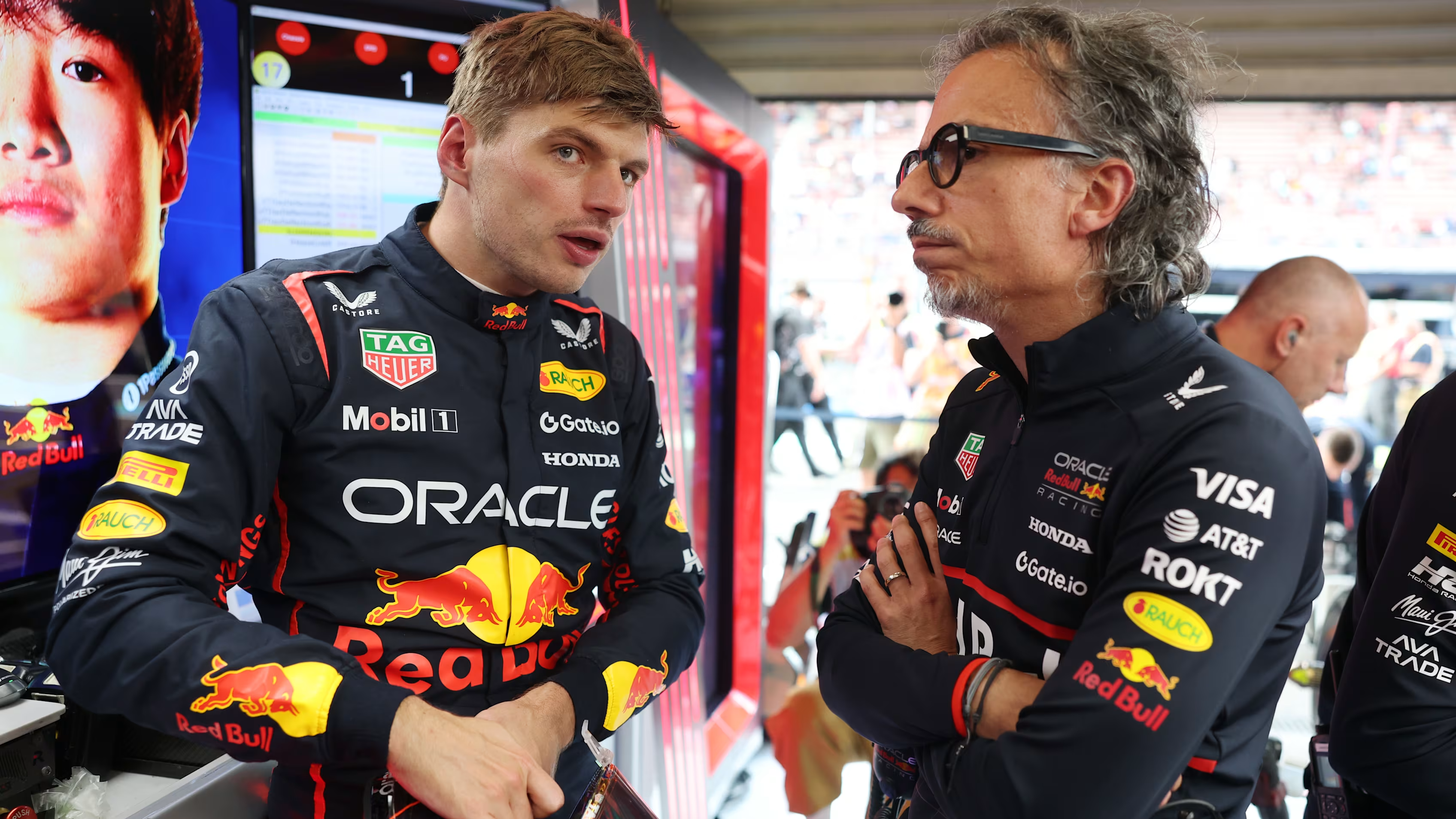
Red Bull team principal Laurent Mekies has defended the squad’s willingness to experiment with aggressive setup choices, insisting that moments of disagreement with Max Verstappen are essential to driving the team’s development forward in Formula 1.
The Milton Keynes-based outfit entered last weekend’s Canadian Grand Prix under intense pressure to prove that its recent upgrade package had genuinely moved the team up the grid. While Verstappen’s sixth-place qualifying effort at the Circuit Gilles Villeneuve initially appeared to reinforce concerns about the car’s ultimate competitiveness, Sunday’s race told a far more encouraging story as the Dutchman recovered brilliantly to secure the team’s first podium of the season.
Even so, Verstappen remained cautious about reading too much into the sudden turnaround.
“To be honest, I was feeling better in Miami with the car,” Verstappen admitted. “So I’m a little bit surprised with being on the podium here. But you also have to look at it with George [Russell] retiring, and with the McLarens making a mess of the strategy.”
A Misleading Deficit on the Time Sheets
Mekies, however, believes the Montreal weekend provided definitive proof that the team’s latest aerodynamic and mechanical updates are beginning to deliver meaningful gains.
“The big picture is that we have at the very least confirmed the Miami step,” the Frenchman said, as quoted by Motorsport.com. “I think we’ve done a bit more than the Miami step, in the way that I think we have managed to take a bit of performance away from the top guys.”
Whilst finishing 11 seconds behind winner Kimi Antonelli, the apparent 0.15-second a lap deficit for Verstappen is misleading. Given the safety car was deployed to cover the removal of George Russell’s stricken car halfway through the race, the final time deficit at the chequered flag does not include that.
Assessing the Three-Tenths Deficit to Mercedes
However, a three-tenths of a second deficit to Mercedes does resemble progress for the Red Bull team, which is also reflected in the gap to pole-sitter George Russell when Verstappen qualified for the Grand Prix in P6.
The weekend also highlighted the natural tension that emerges when a driver’s track instincts and an engineering team’s data-driven decisions point in completely opposite directions.
Red Bull Defends Radical Setup Gambles
After qualifying, Verstappen revealed he had serious reservations about the engineering setup route chosen for his car, suggesting he ultimately relented and accepted the direction simply so the engineering wall could experience the shortcomings firsthand.
“I’ve pointed it out so many times already, but sometimes you just have to let them feel for themselves that it doesn’t work,” Verstappen noted bluntly.
Mekies acknowledged that such friction is inevitable for a midfield team aggressively trying to unlock the maximum potential of the current generation of ground-effect Formula 1 machinery.
“We take risks every time we don’t feel that we are at the right balance or at the right gap to the competition,” Mekies explained. “And when you take risks like that, you do explore extreme setup directions.”
The Frenchman stressed that the team has no intention of becoming conservative in its development philosophy, especially while still trying to establish itself at the front of the midfield.
“It’s only the beginning of the year, and it’s the beginning with this generation of cars. We are going to try things with our drivers to unlock something, even if it’s costing us something in the short term,” he said. “And then you learn. You learn for the qualifying condition and you learn for the race condition. There has been a lot of learning this weekend. How far were we from the ultimate potential of the car? Nobody really knows.”
Embracing the “I Told You So” Moments
Despite Verstappen’s public frustration, Mekies flatly rejected any suggestion that the driver’s direct feedback is being sidelined or ignored during closed-door debriefs.
“Absolutely not,” Mekies replied firmly. “As much as it may have felt different from the outside, the reality is that our drivers are completely integrated in the choices we make. It doesn’t mean that we don’t have our own little games at saying ‘what do you think and what do you think’. But, at the end of the day, we agree on what to try. And then sometimes there is a bit of ‘I told you’ games going on.”
Rather than viewing those post-session disagreements as toxic or problematic, Mekies argued that healthy friction is actually a vital catalyst for refining the car and pushing the organisation forward.
“We still learn together. And what is clear is that both sides are very conscious that you need that dynamic—you need that ‘I told you’ feeling sometimes in order to progress.”
The Philosophy of High-Risk Development
The Red Bull boss added that a willingness to constantly push boundaries will inevitably produce occasional setbacks, but he sees that as far preferable to standing still in an increasingly cutthroat F1 field.
“If you take risks, you will get the pain. And it’s to get these sort of driver feelings, to get our drivers pushing us to say, ‘Look, it may be only four or five tenths to the best cars, but it felt like it could be much better.’ It’s only an invitation for us to keep taking risks and keep exploring.”
Verstappen Issues Quit Ultimatum Over Engine Dispute
In Montreal, Verstappen did confirm he is serious about quitting F1 next season should the manufacturer fail to agree to the proposed engine changes made by the FIA.
“I think it’s the minimum — the minimum I was hoping for,” said Max when asked about his thoughts on the split of power from the 2027 engines becoming 60/40 in favour of the internal combustion engine.
Currently, Honda, Audi and Ferrari are resisting such a change and it requires at least one of them to change their view for the regulations to be amended.
Would you like to see more TJ13 Formula 1 coverage? Add us to your favourites list on Google to receive trusted F1 news.

The Judge, a nom de plume of an experienced F1 journalist and site founder with long-standing sources across the paddock. With over 30 years of experience in Formula 1 as an insider journalist, I have built trusted connections across the paddock, from race engineers and mechanics to senior team figures. At The Judge 13, I and a handful of trusted colleagues share exclusive Formula 1 news, expert analysis and behind-the-scenes stories you will not find in mainstream motorsport media.

A.J. Hunt is Senior Editor at TJ13, where Andrew oversees editorial standards and contributes to the site’s Formula 1 coverage. A career journalist with experience in both print and digital sports media, Andrew trained in investigative journalism and has written for a range of European sports outlets.
At TJ13, Andrew plays a central role in shaping the site’s output, working across breaking news, analysis, and long-form features. Andrew’s responsibilities include fact-checking, refining editorial structure, and ensuring consistency in reporting across a fast-moving news cycle.
Andrew’s work focuses particularly on the intersection of Formula 1 politics, regulation, and team strategy. Andrew closely follows developments involving the FIA, team leadership, and driver market dynamics, helping to provide context behind the sport’s biggest stories.
With experience covering multiple seasons of Formula 1’s modern hybrid era, Andrew has developed a detailed understanding of how regulatory changes and competitive shifts influence the grid. Andrew’s editorial approach prioritises clarity and context, aiming to help readers navigate complex developments within the sport.
In addition to editorial duties, Andrew is particularly interested in how media narratives shape fan perception of Formula 1, and how reporting can balance speed with accuracy in an increasingly digital news environment.
