


Some racing teams are probably in trouble – Uncertainty is spreading through the Formula 1 paddock amid growing speculation about which teams may have breached the sport’s financial regulations last season. The FIA has yet to publish its annual cost cap compliance report, and the delay has led to rumours that at least one team may have exceeded the limit.
Sauber team principal Jonathan Wheatley has voiced what many are thinking: ‘The delay in announcing it has made it very clear to all of us that some teams are in trouble, or perhaps just one.’
The official report, which is usually released in September, is still pending, leaving teams and fans alike in suspense.
Balancing competitiveness and compliance
Wheatley was quick to clarify that he wasn’t accusing anyone of deliberate wrongdoing.
“From experience, I can say that it’s very difficult to balance those two factors. You want to be competitive. You want to spend every last dollar up to the cost limit,” he said. Formula 1 is a sport driven by fine margins, and in an era where spending is tightly monitored, teams often operate on the edge.
“Of course you want to. That’s what our business is about. We’re in racing, a competitive sport,” Wheatley added. ‘The first thing I would say is that nobody does this intentionally. These things happen sometimes.”
His words reflect a wider sentiment in the paddock: that breaching the budget cap is often the result of administrative or technical oversights rather than outright cheating.
The challenge of managing finances in such a complex environment cannot be overstated. Every team must track thousands of cost items across multiple departments, including car development, logistics, hospitality, and marketing. Even minor miscalculations can have significant consequences when the FIA’s auditors review the accounts.
Rumours and realities among the teams
Peter Bayer, the Racing Bulls’ managing director, suggested that the issue might not be isolated.
“There are one or two teams that have struggled with it,” he told Sky. However, Bayer pointed out an important distinction: not all teams face the same challenges when it comes to staying within the cap.
“You have to fundamentally differentiate between teams that started out small and those that started out large,” he explained.
Smaller outfits, such as Sauber and Haas, have traditionally operated with tighter budgets. For them, reaching the cost cap represents an opportunity to invest more and close the performance gap. Larger teams, on the other hand, have had to significantly scale down their operations to comply with the new financial limits.
“The small teams all stretched to the cost cap, while the large teams had to work hard using all sorts of, I don’t want to call them tricks, but creative, accounting measures to respect that cost cap,” Bayer admitted.
Update on Red Bull driver decision
Complex accounting and potential pitfalls
Bayer described how complex financial management has become in modern Formula 1.
“This involves allocating workers who have to complete timesheets for every two hours spent working on the Formula 1 project or every six hours spent working on the America’s Cup boat,” he said with a grin. “This has to be recorded precisely and presented accordingly.”
He called this “an incredible amount of discipline”. With hundreds of employees working across multiple programmes and projects, even minor administrative errors can distort a team’s financial reporting. “A small slip-up can mean that you’re pushing yourself beyond that,” he explained. ‘But I believe that, fundamentally, the difficulties will always lie with the larger teams because they just cram in instead of pushing themselves upwards.”
Mexican GP: Verstappen furious as Norris takes lead of championship
Unexpected expenses and external factors
Wheatley also acknowledged that smaller teams aren’t immune to cost control issues. “It can just get a little out of control,” he noted, referring to unforeseen expenses such as crashes or component failures.
“That could result in unexpected costs in the final metres. But I don’t want to speculate on the cause.”
The nature of Formula 1 means that costs can fluctuate dramatically from one race to another. A single major crash late in the season, for example, can disrupt financial planning and push a team dangerously close to breaching the limit. In previous seasons, some teams have reported that repairing or rebuilding cars after high-impact accidents has added millions to their budgets.
Trust in the FIA’s investigation process
Ferrari team principal Frédéric Vasseur has urged caution before drawing any conclusions
. “We must avoid speculating on rumours. That would be a mistake,” he said. “In this respect, we have to trust the FIA to do its job. And I honestly think that’s not an easy task.”
Vasseur pointed out that administrative oversights do not necessarily indicate intentional cheating. He reminded the media of Aston Martin’s situation last year, when the team missed a submission deadline due to an external auditor falling ill.
“It doesn’t provide a sporting advantage,” he said. “We have to distinguish between a sporting advantage or penalty and a technical error or administrative problem. Let’s wait and see how it plays out.”
The FIA’s annual cost cap report has become one of the most highly anticipated documents in the Formula 1 calendar. Since the introduction of the financial regulations, they have transformed how teams manage their operations, creating a fairer playing field but also introducing new administrative burdens.
The 2021 season demonstrated the severity of violations, with Red Bull being penalised for exceeding the cap by a small margin, resulting in a fine and reduced aerodynamic testing time. Ever since, teams have been under greater scrutiny, and the FIA’s auditing process has become more rigorous.
MORE F1 NEWS – Piastri mystery leads to conspiracy theories
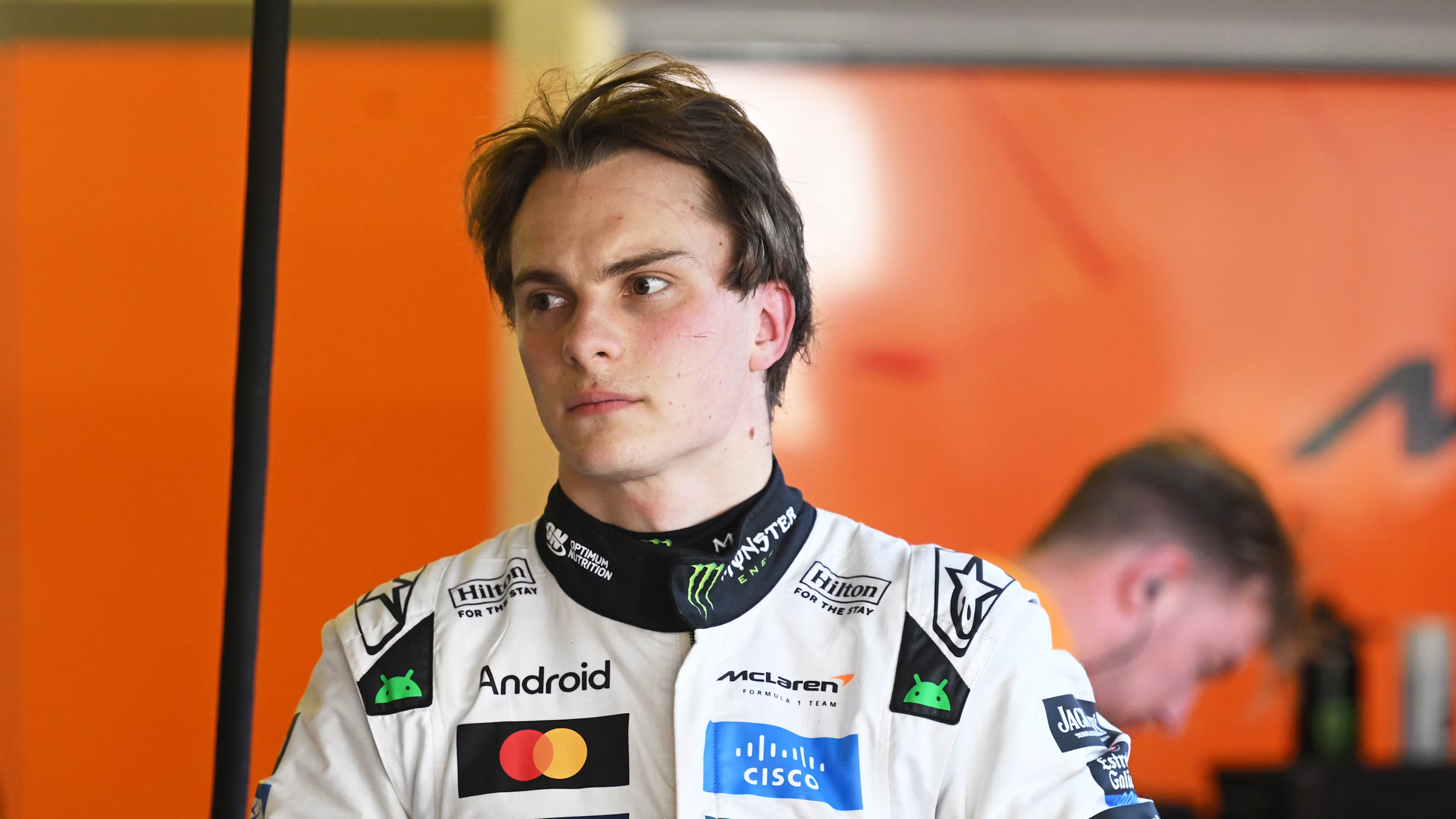
One race after the summer break, Oscar Piastri was on top of the Formula One world. He had broken the resistance of the current world champion and his team mate’s DNF in Zandvoort left him an almost unassailable 34 points clear of Lando Norris.
Given that McLaren had won twelve of the first fifteen Grand Prix, it was expected this form would continue with both drivers trading 1-2’s to the end of the season,. Meaning without a DNF for Piastri it would be the Australian who claimed his maiden F1 drivers’ championship.
Just four races later and the wheels have fallen from Oscar’s racing wagon. Crashes and false starts in Baku began his demise then in Singapore he was dominated by his team mate and failed to make the podium.
Piastri scrapes through to Q3
The US GP which is a low grip circuit proved tough for Piastri, again with him trailing Norris for most of there weekend finishing just fifth. Now in Mexica, where the grip is also low, the young McLaren driver has had a nightmare in qualifying and will start the race in seventh place, due to a one position promotion due to Carlos Sainz grid drop.
His only saving grace is Verstappen who looked the most dangerous in terms of the title challenge – and was the bookies favourite – is having a tough weekend of his own. He and the team failed to nail the ride height of his RB21 and he is set for a long and difficult afternoon trying to keep his tyres alive.
TJ13 predicted this would be a rough weekend for Oscar, although the gap to his team mate is remarkably large. Oscar had an extra practice session over Verstappen and Norris who gave their cars in FP1 to junior drivers. Yet despite the extra time to fine tune his setup, Piastri was 6/10ths behind his team mate in FP2 and roughly the same margin behind in FP3.
Come qualifying, Oscar almost missed out on Q3 such was his lack of performance, but he pipped Yuki Tsunoda by 0.079 seconds to survive although Q3 was to prove little better. His P8 classification (before grid drops) was again 0.6 seconds behind his pole…READ MORE ON THIS STORY

Alex Stanton is a Formula 1 journalist at TJ13 with a focus on the financial and commercial dynamics that underpin the sport. Alex contributes reporting and analysis on team ownership structures, sponsorship trends, and the evolving business model of Formula 1.
At TJ13, Alex covers topics including manufacturer investment, cost cap implications, and the strategic direction of teams navigating an increasingly complex financial environment. Alex’s work often examines how commercial decisions translate into on-track performance and long-term competitiveness.
With a strong interest in the intersection of sport and business, Alex provides context around Formula 1’s global growth, including media rights, expansion markets, and manufacturer influence.
Alex’s reporting aims to explain the financial realities behind headline stories, helping readers understand how money, governance, and strategy shape the competitive order in Formula 1.
