
Mercedes are sweeping the board as Formula One starts its next era of regulation changes. Eight races in (including the Sprints) and Mercedes have claimed seven victories, with Kimi Antonelli eclipsing his teammate now by 43 points.
In the latest outing in Canada, George Russell and Kimi Antonelli duelled hard for the win in both the Sprint and the Grand Prix. The tone for their weekend was set during Saturday’s Sprint. Russell started on pole but found himself under immediate pressure from the rapid Antonelli, who took the lead until relinquishing it to his teammate on lap 5.
Their battle was hard but mostly clean. Antonelli showed zero fear against the senior driver, tracking Russell’s defensive lines closely through the tricky Turn 1 and 2 complex. While Russell used all of his experience and battery deployment to hold the position on the long back straight, Antonelli’s relentless pressure forced Russell to drive completely in his mirrors.
A Lost 1-2 Finish in the Montreal Sprint
The young Italian pressed time and again, locking up at times and complaining over team radio that his teammate failed to leave him room when trying a move into Turn 1. Yet when attempting another overtake in Turn 4, Antonelli hit a bump in the circuit, locked up, and surrendered his place to Lando Norris, who subsequently came home in second.
A Mercedes 1-2 was forfeited, but in the Sprint it meant just a loss of one point to McLaren—hardly a matter of consequence given Mercedes’ big lead in the Constructors’ Championship.
A Blockbuster Rematch on Sunday
Come the Grand Prix on Sunday, the battle royale was resumed between the pair. The lead of the race chopped and changed between the Mercedes duo, with lock-ups and mistakes allowing the other to take advantage and lead the race. Their battles through the final chicane (the “Wall of Champions” entry) were breathtaking, with both drivers flirting with the concrete barriers to carry maximum speed onto the pit straight.
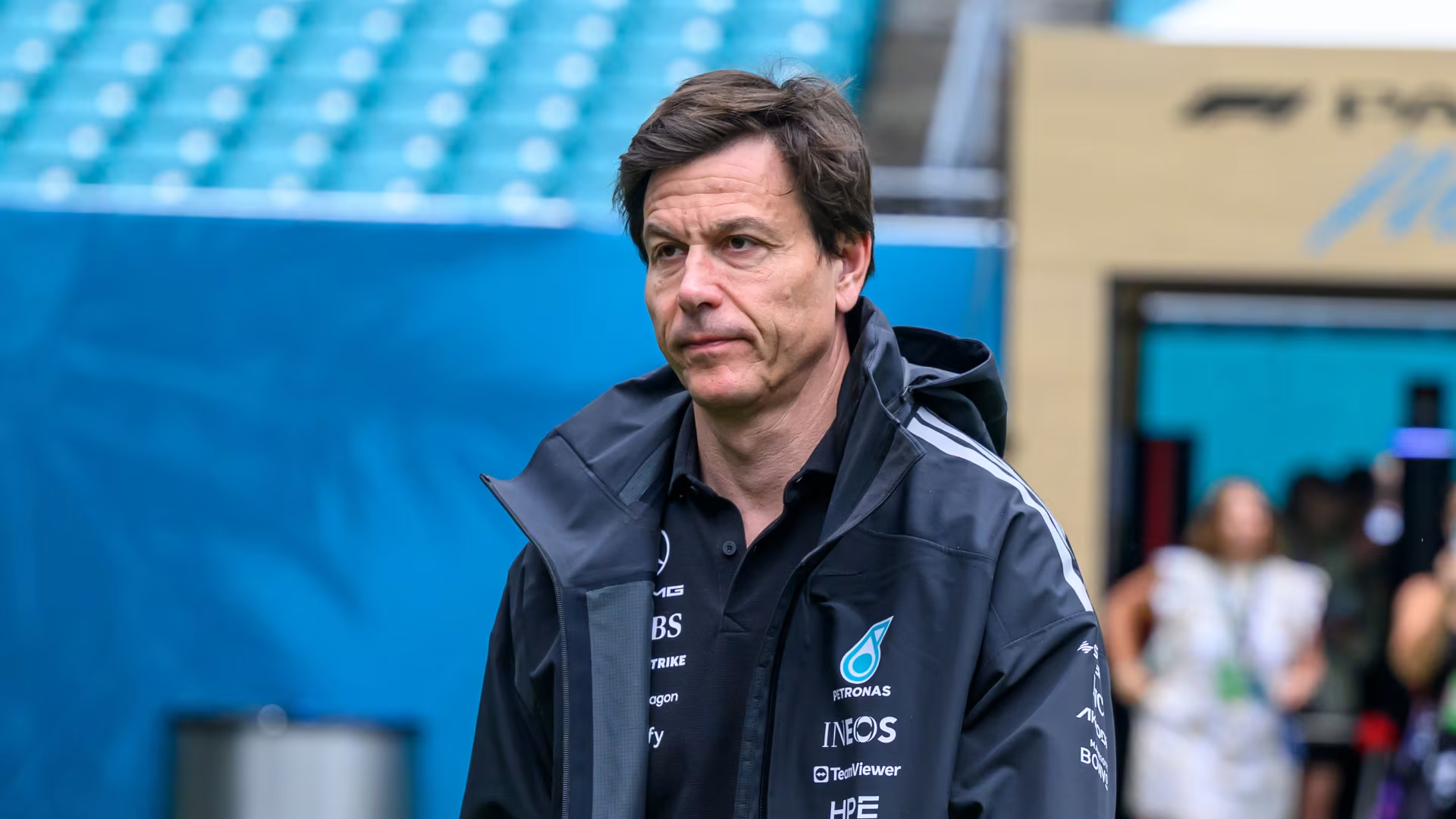
The Mercedes pit wall, at the behest of Toto Wolff, decided to intervene. The threat came that should the drivers not “tidy up” their racing, an order would be issued to hold station to the end of the Grand Prix. Yet this intervention never came as on lap 44, Russell’s powertrains gave up the ghost and his race ended with him parked up against the barrier at Turn 3.
Wolff Threatens to Pull the Handbrake
While Russell eulogised over the fight he’d had with his teammate, saying “I loved it,” the Mercedes team boss had a different point of view. “As uncomfortable as the ride is sometimes, you have to accept that this is the fight they’ve been trained for,” Toto Wolff reported to Sky F1.
“But equally, if there was a situation where we believe the team’s points are at risk of being lost, or there was a situation where we were losing so much time to our competitors behind, then we would not be a millimetre hesitant in putting the handbrake on,” concluded the Mercedes team boss.
The Ghost of the Hamilton-Rosberg Era
The implication was clear: Mercedes have been here before with Lewis Hamilton and Nico Rosberg during their time together as teammates for the Brackley-based team between 2014 and 2016. Following a series of disastrous collisions—most notably a double retirement on lap one at the 2016 Spanish Grand Prix—Wolff famously introduced a formal “Rules of Engagement” document.
While the exact text remains a closely guarded team secret, Toto Wolff, Paddy Lowe, and the drivers have openly detailed the core directives that made up these orders. The first was ‘no contact under any circumstances.’ Next came a more insidious regulation: the lead driver had priority on strategy at the pit stops, but before the race, no alternative strategy was allowed for the driver starting behind their teammate.
The Extreme Elements of Brackley’s Old Playbook
Complete transparency of data was enforced at all times, and neither driver was allowed a custom engine mode to be used to attack their teammate ahead. On the occasions there was an offset on tyre usage, the pit wall would direct one or other of the pair to yield.
There were detailed rules of who ‘owned the corner’ depending on which driver was attacking, and the threat of huge financial consequences was put in place—even a race suspension if either Lewis or Nico was deemed at fault were they to collide.
Then there was another unspoken rule that whoever led after the final round of pit stops would retain their place unchallenged by their teammate. The most drastic of these measures was never enforced, although the fans became disillusioned with Mercedes given their intra-team battle was the only one of consequence for several seasons.
Why the Old Rules Fail with Antonelli
Wolff has now again threatened to implement team orders, but under the new 2026 regulations, it is difficult to see how this can be enforced. Yes, the drivers can be ordered from the pit wall to hold station—or else—but in the case of Kimi Antonelli, would this really concern him?
Firstly, Antonelli is the hottest property in the paddock. Could Toto really bench him for a Grand Prix weekend without massive PR consequences? Should the young Italian repeatedly defy team orders and overtake Russell, would Wolff really sack him? A rival team would surely snap him up in the blink of an eye.
How 2026 Tyres and Rules Change the Game
Further, the new F1 regulations have handed some advantages to the cars following closely behind another. For decades, this problem has meant the turbulent air usually destroys the tyres of the driver too close behind. Yet with Pirelli building their tyres half a step harder for the 2026 season, tyre degradation has been minimal across the variety of circuits and weather conditions seen to date.
And the Grand Prix in Montreal proved that, for lap after lap, one car can follow another as closely as ever seen in modern F1. What has also been noticeable is that the 2026 replacement for DRS—the new overtaking aid—has been remarkably effective. This has led critics to describe the racing as a ‘yo-yo’ style, as the car behind repeatedly has sufficient energy to overtake the other before losing the place later in the lap.
In Montreal, this was less evident due to the nature of the circuit, but for identical cars with identical capabilities—and little tyre degradation—the opportunity to overtake is almost infinitely more frequent. It is during overtaking and defending where the greatest risk of a coming together lies. So, unfortunately, there’s little Toto can do to prevent these instances from occurring.
A Power Struggle Headed for the Streets of Monaco
Finally, it does appear that whilst George Russell has served his apprenticeship and is the senior driver in a car that should win both championships, he is the one who believes it is he who should be World Champion. Yet the problem is, his teammate is lightning-quick—and probably, on average, quicker than Russell.
Next time out in Monaco, Mercedes and Wolff should receive some respite from the ongoing issue. Given that even with the monster amounts of electrical boost the drivers now have, the tight and twisting streets of the Principality should make overtaking impossible once again.
Would you like to see more TJ13 Formula 1 coverage? Add us to your favourites list on Google to receive trusted F1 news.

A.J. Hunt is Senior Editor at TJ13, where Andrew oversees editorial standards and contributes to the site’s Formula 1 coverage. A career journalist with experience in both print and digital sports media, Andrew trained in investigative journalism and has written for a range of European sports outlets.
At TJ13, Andrew plays a central role in shaping the site’s output, working across breaking news, analysis, and long-form features. Andrew’s responsibilities include fact-checking, refining editorial structure, and ensuring consistency in reporting across a fast-moving news cycle.
Andrew’s work focuses particularly on the intersection of Formula 1 politics, regulation, and team strategy. Andrew closely follows developments involving the FIA, team leadership, and driver market dynamics, helping to provide context behind the sport’s biggest stories.
With experience covering multiple seasons of Formula 1’s modern hybrid era, Andrew has developed a detailed understanding of how regulatory changes and competitive shifts influence the grid. Andrew’s editorial approach prioritises clarity and context, aiming to help readers navigate complex developments within the sport.
In addition to editorial duties, Andrew is particularly interested in how media narratives shape fan perception of Formula 1, and how reporting can balance speed with accuracy in an increasingly digital news environment.
