
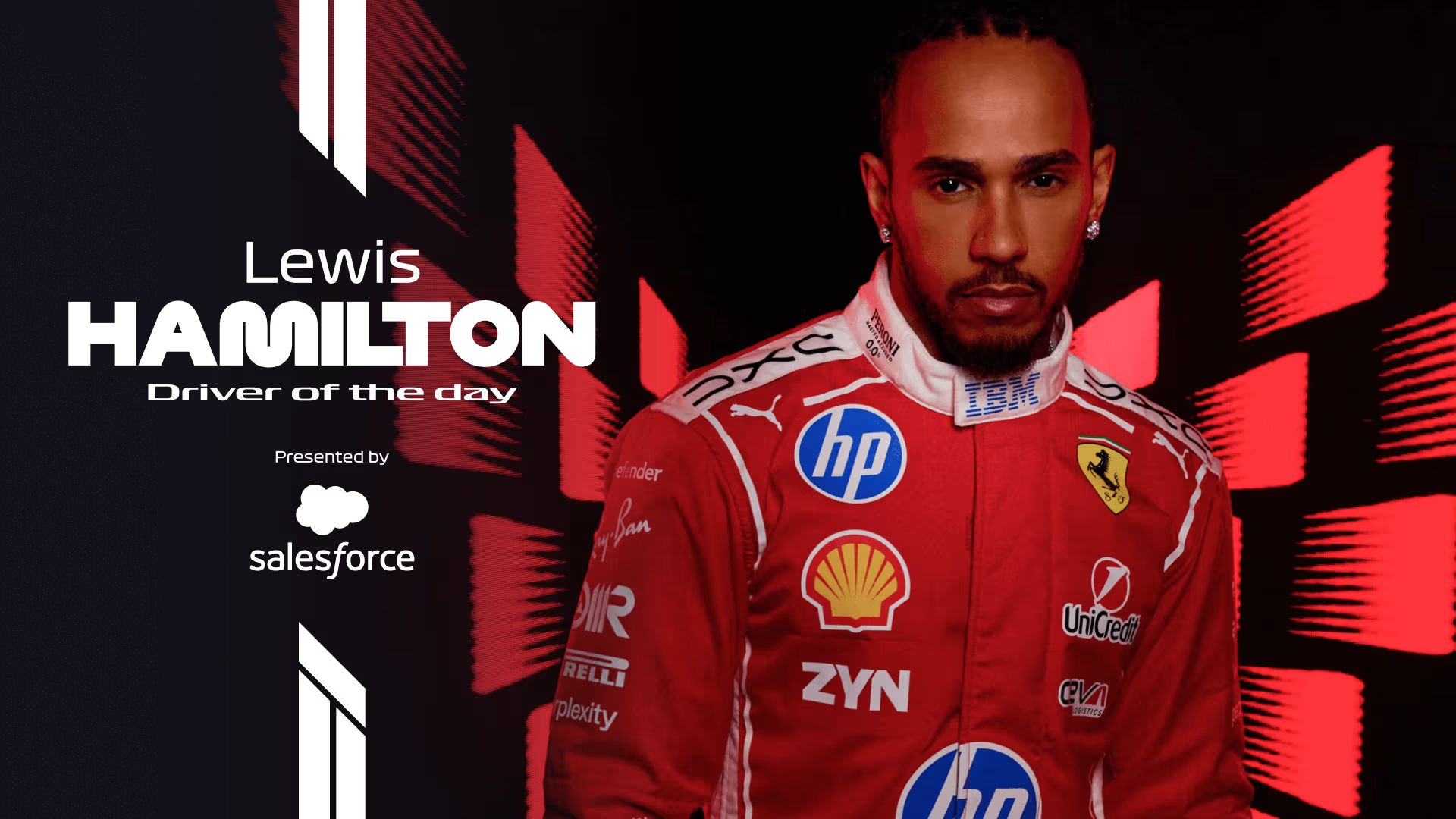
Lewis Hamilton for many has turned around a poor start to his Ferrari career with a good start to the 2026 season. Lewis failed to make a single Grand Prix podium in 2025 and became the Ferrari F1 driver who went the longest without achieving this.
He also failed to score in five of the 24 rounds, although one of those occasions was in China when both Ferrari drivers were disqualified from the final classification. After five rounds of the current season, both drivers have two podiums although Hamilton has bettered his teammate Charles Leclerc with his P2 at the Canadian Grand Prix.
The Monegasque driver has two third-placed finishes in the opening rounds at Melbourne and Suzuka. Leclerc currently lies in third place in the drivers’ championship with 75 points whilst Lewis sits three points further back in fourth.
Mind Games in Montreal
And Ferrari themselves have a comfortable lead over third-placed McLaren whose miserable weekend in Montreal saw the team fail to score points on Sunday. The SF-26 was expected to struggle on the long back straight at the 2026 Canadian Grand Prix yet McLaren’s woes meant this did not prove to be a significant disadvantage, although Max Verstappen in his Red Bull-Ford power car harried Hamilton to the very end.
Leclerc described the weekend as one of the worst in his F1 career, yet ex-Ferrari race engineer Rob Smedley believes the pace of Hamilton in Canada may have had a psychological impact on the Monegasque driver. The seven-time champion was consistently quicker than his teammate throughout the weekend, although in the Sprint Leclerc did manage to finish one place ahead of his teammate.
But come the Grand Prix it was Hamilton who, having qualified P5 (Leclerc P8), shone, and speaking to the High Performance podcast Smedley suggests: “He always brings something special. He’s always brought something special around Montreal. He was quicker than Charles. That got inside Charles’s head because all of a sudden he started to claim that he’d had the worst weekend of his career in Formula 1, stuff like that. So clearly, if Lewis had been three places further back, I wouldn’t have thought that Charles would have referred to his weekend as being the worst weekend of his career.”
Dodging the Simulator
Having bemoaned his problems with setting up the car in Miami, Hamilton vowed not to set foot inside the simulator before the Canadian Grand Prix. Whilst the generation behind Lewis are comfortable in the teams’ simulators, it is something Hamilton has always struggled with from early in his career.
Yet despite this lack of preparation, Hamilton was happy with the feel of the car underneath him all weekend long. And despite not maximizing his potential during the Sprint where he was barged down into sixth by Leclerc and Piastri, Lewis remained bullish for qualifying later that day.
Qualifying Compromises and Strategy Blunders
In Grand Prix qualifying Hamilton was again compromised by his active aero refusing to engage at the start of his final lap. This along with a mistake saw him start the race in Montreal in just fifth place behind the Mercedes and McLaren duo.
Then came what appeared a strange decision from the papaya squad to start the race on wet tyres, when the rest of the leading competitors were all on the slicks. This was the final cherry on the cake for Hamilton, as Norris and Piastri were forced to pit early to correct their mistake.
One Good Race Doesn’t Change the Order
Yet not everyone believes Hamilton has proven he has finally turned a corner with Ferrari, with former Haas F1 team boss Guenther Steiner dismissing the notion that a single top-drawer weekend has changed the driver pecking order at the Scuderia.
“Lewis had a good race. He didn’t go to the simulator. It’s all down to that. He will never go again. He will be winning races soon,” said Steiner in somewhat of a sarcastic fashion. “But I think Charles had a miserable weekend for once. He said it himself. I think he said it was his worst race ever. So he will get out of this and he will be the old Charles back. I think Charles is just one of those drivers who is very good. Lewis had one good race. We cannot jump from one good race now that Charles will be behind him.”
Hamilton’s record ‘relatively’ poor in Monaco
And in support of the view that two podium weekends do not a summer make for Hamilton, it is worth noting they were both at circuits where he has won around 13% of his F1 races. In Shanghai Lewis has claimed victory six times and has gone one better in Montreal.
Up next is Monaco and Hamilton’s history in the Principality is markedly different, with just three wins around the historic narrow streets of Monte Carlo in his career. Further, Lewis last made the podium there in 2019 and has suffered a seven-year drought in terms of the presentation.
In stark contrast, Monaco has become a favored track for Charles Leclerc and after a number of disappointing years where he could have won he claimed victory in 2024. Last season he was second to Lando Norris, although the McLaren car was significantly quicker during qualifying, something outside of the Monegasque driver’s control.
Ferrari and McLaren Expect to be Quick
Both Ferrari and McLaren should be quick in Monaco, and with Ferrari’s famed small turbo the acceleration of the SF-26 will be handy out of the many slow corners around the track. McLaren have a shorter set of gear ratios in their Mercedes engine when compared to the works team, so they too will be quick off the mark and are hoping for a winning weekend.
While Montreal provided a welcome reminder of Lewis Hamilton’s undeniable, “special” race-day pedigree, framing it as a definitive Ferrari career revival is premature. The seven-time champion undoubtedly capitalized on McLaren’s strategic blunder and got inside his teammate’s head for a weekend, but the true test of the Scuderia pecking order lies ahead.
Monaco’s tight, unforgiving streets offer the ultimate litmus test: a circuit where Hamilton historically struggles to find the podium, and where Leclerc holds a distinct psychological and competitive edge. If Hamilton can repeat his Canadian heroics around the Principality, the revival talk may hold weight. Until then, as Guenther Steiner rightly notes, one stellar weekend on a favourite track does not suddenly rewrite the status quo in Maranello.
Would you like to see more TJ13 Formula 1 coverage? Add us to your favourites list on Google to receive trusted F1 news.

The Judge, a nom de plume of an experienced F1 journalist and site founder with long-standing sources across the paddock. With over 30 years of experience in Formula 1 as an insider journalist, I have built trusted connections across the paddock, from race engineers and mechanics to senior team figures. At The Judge 13, I and a handful of trusted colleagues share exclusive Formula 1 news, expert analysis and behind-the-scenes stories you will not find in mainstream motorsport media.

A.J. Hunt is Senior Editor at TJ13, where Andrew oversees editorial standards and contributes to the site’s Formula 1 coverage. A career journalist with experience in both print and digital sports media, Andrew trained in investigative journalism and has written for a range of European sports outlets.
At TJ13, Andrew plays a central role in shaping the site’s output, working across breaking news, analysis, and long-form features. Andrew’s responsibilities include fact-checking, refining editorial structure, and ensuring consistency in reporting across a fast-moving news cycle.
Andrew’s work focuses particularly on the intersection of Formula 1 politics, regulation, and team strategy. Andrew closely follows developments involving the FIA, team leadership, and driver market dynamics, helping to provide context behind the sport’s biggest stories.
With experience covering multiple seasons of Formula 1’s modern hybrid era, Andrew has developed a detailed understanding of how regulatory changes and competitive shifts influence the grid. Andrew’s editorial approach prioritises clarity and context, aiming to help readers navigate complex developments within the sport.
In addition to editorial duties, Andrew is particularly interested in how media narratives shape fan perception of Formula 1, and how reporting can balance speed with accuracy in an increasingly digital news environment.
