

An agreement has been reached! Here’s what’s changing in Formula 1 with immediate effect: After weeks of negotiations, the FIA, the teams and Formula 1 have agreed on a series of immediate rule refinements, effectively bringing an end to the talks. While these changes still require formal approval from the World Motor Sport Council, this is widely considered to be a mere formality ahead of the next race in Miami on 3 May.
However, while the sport has moved quickly to react to early warning signs from the opening rounds, there is already a growing sense that these fixes, that still need team approval, may not go far enough.
Beneath the surface of technical adjustments and safety-driven tweaks, a deeper question is beginning to emerge: has Formula 1 gone too far down a path that cannot be fully corrected by short-term regulation changes?
Would you like to see more TJ13 Formula 1 coverage? Add us to your favourites list on Google to receive trusted F1 news.

Two key areas: safety and performance
The changes fall into two main categories. Firstly, safety concerns, particularly around race starts, speed differentials and wet conditions, have been urgently addressed. Secondly, drivers’ complaints about overly restrictive energy management in qualifying have led to performance-related adjustments aimed at enabling drivers to drive at full speed.
With one exception, all measures are expected to be implemented immediately in Miami. A new start system will be trialled and refined based on feedback instead.
Bearman crash in Japan
Safety overhaul: fixing dangerous race starts
One of the biggest issues in the opening races was inconsistent launch performance. When a car failed to accelerate properly at the start, it created a dangerous speed disparity with cars behind approaching at full throttle.
To counter this, a new system called ‘Low Power Start Detection’ has been introduced. This mechanism identifies when a car is struggling to launch and automatically deploys the MGU-K to provide additional acceleration, helping the driver to avoid becoming a stationary obstacle.
Further tweaks include resetting the energy counter at the start of the formation lap and introducing warning lights to alert following drivers. The entire procedure will be tested in Miami before being finalised.
MORE NEWS – Verstappen’s mysterious trick fuels speculation
Hamilton near miss in Australia
Managing speed differences during races
Another major concern has been the sudden and extreme speed differences caused by energy deployment. A notable example occurred at the Suzuka Circuit, where a dramatic speed surge contributed to a serious crash.
To mitigate these risks, energy deployment is being capped more strictly. The boost will now be limited to +150 kW during races. The MGU-K will still deliver up to 350 kW in designated acceleration zones, but this will drop to 250 kW elsewhere on the track.
This will help to smooth out performance spikes, reducing the likelihood of unpredictable speed jumps, while preserving overtaking opportunities.
MORE NEWS – Red Bull’s Reality Check: Mekies Admits “You Didn’t Believe Us” After Pre-Season Warning
Additional precautions are being taken for wet-weather racing
Wet races have also been identified as a critical danger area. In response, several adjustments have been agreed.
Intermediate tyres will operate at higher temperatures to generate more grip in damp conditions. At the same time, the energy recovery system will be restricted to make cars easier to control when traction is limited.
Visibility, another major concern in wet conditions, is also being addressed. Revised rear light systems will make cars more visible to those behind, particularly in heavy spray.
There will be a qualifying shake-up, with more flat-out driving
Drivers had expressed frustration about having to manage energy levels too much during qualifying laps. Rather than driving at full throttle, they were forced to engage in constant lift-and-coast phases to manage battery deployment.
This issue is now being addressed. The maximum energy recovery limit is being reduced from 8 to 7 megajoules, which will cut the duration of ‘superclipping’ to around two to four seconds per lap. At the same time, the maximum superclipping power will increase to 350 kW, enabling faster energy deployment. You can learn more details about this in another TJ13 article published today.
Additionally, the number of events with reduced energy limits will increase from eight to twelve. These measures are designed to simplify energy management and enable drivers to push harder, bringing qualifying laps closer to the all-out efforts that fans expect.
Stella Breaks Silence on McLaren Rumours as Miami Upgrades Could Shift F1 Balance
Is this too little, too late?
However, there is a growing sense that these changes risk missing the bigger picture. Even before the tweaks were announced, some fans had already become disillusioned with Formula 1’s direction for 2026. Much of that frustration centres on the complex hybrid systems — what Christian Horner once warned could turn into ‘Frankenstein’ power units.
For many viewers, the issue isn’t just safety or qualifying flow; it’s the fundamental nature of the racing itself. Overtaking, which is increasingly dictated by energy deployment phases rather than pure driver skill, can appear artificial. The spectacle risks becoming a series of programmed boosts and restrictions rather than a natural contest of pace, courage, and racing skill.
MORE NEWS – Verstappen Bold Red Bull to McLaren Swap Theory Explained
‘Tweaks’ and more ‘tweaks’ as the F1 ship sinks…
The latest measures, which focus heavily on megajoule limits, deployment caps and energy recovery tweaks, may actually reinforce that perception. Although they aim to simplify the driving experience, they do little to address how complicated and opaque the sport now seems to a wider audience.
There’s also a communication gap. Concepts such as ‘7 megajoules versus 8’ or ‘superclipping windows’ mean little to casual fans, yet they now play a defining role in how a race unfolds. Rather than enhancing the spectacle, the technical layer risks distancing viewers from it.
In that sense, the criticism isn’t necessarily about whether these changes will work — they probably will, in a narrow technical sense. The concern is that they don’t tackle the underlying problem: a formula that feels engineered rather than organic to many.
Would you like to see more TJ13 Formula 1 coverage? Add us to your favourites list on Google to receive trusted F1 news.
The expected immediate impact in Miami
Assuming final approval goes through as expected, which in itself might be a fraught exercise, the majority of these changes will debut at the Miami Grand Prix. The exception is the revised start procedure, which will undergo a live test before being fully implemented.
The rapid response from the FIA and teams highlights how seriously early-season concerns have been taken. Rather than waiting for a long-term overhaul, Formula 1 has opted for immediate intervention to stabilise both safety and the spectacle on the track.
Therefore, Miami won’t just be another race; it will serve as the first real test of whether these swift regulatory tweaks can resolve the issues that were exposed at the start of the 2026 season, or if they will simply mask deeper problems.
NEXT ARTICLE – Date set for Alpine Mercedes deal
The internal turmoil at the Alpine F1 Team has begun to extend far beyond basic questions of ownership. What began as a disagreement over the sale of a 24% stake has evolved into a wider conflict that could transform the team’s sporting strategy.
At the heart of the matter lies a dispute between Renault and the investment firm Otro Capital. This disagreement has created a tense internal environment at a time when stability is crucial, especially as Alpine seeks to gain momentum on the track.
As ownership uncertainty bleeds into decision-making, the consequences may extend well beyond the boardroom.
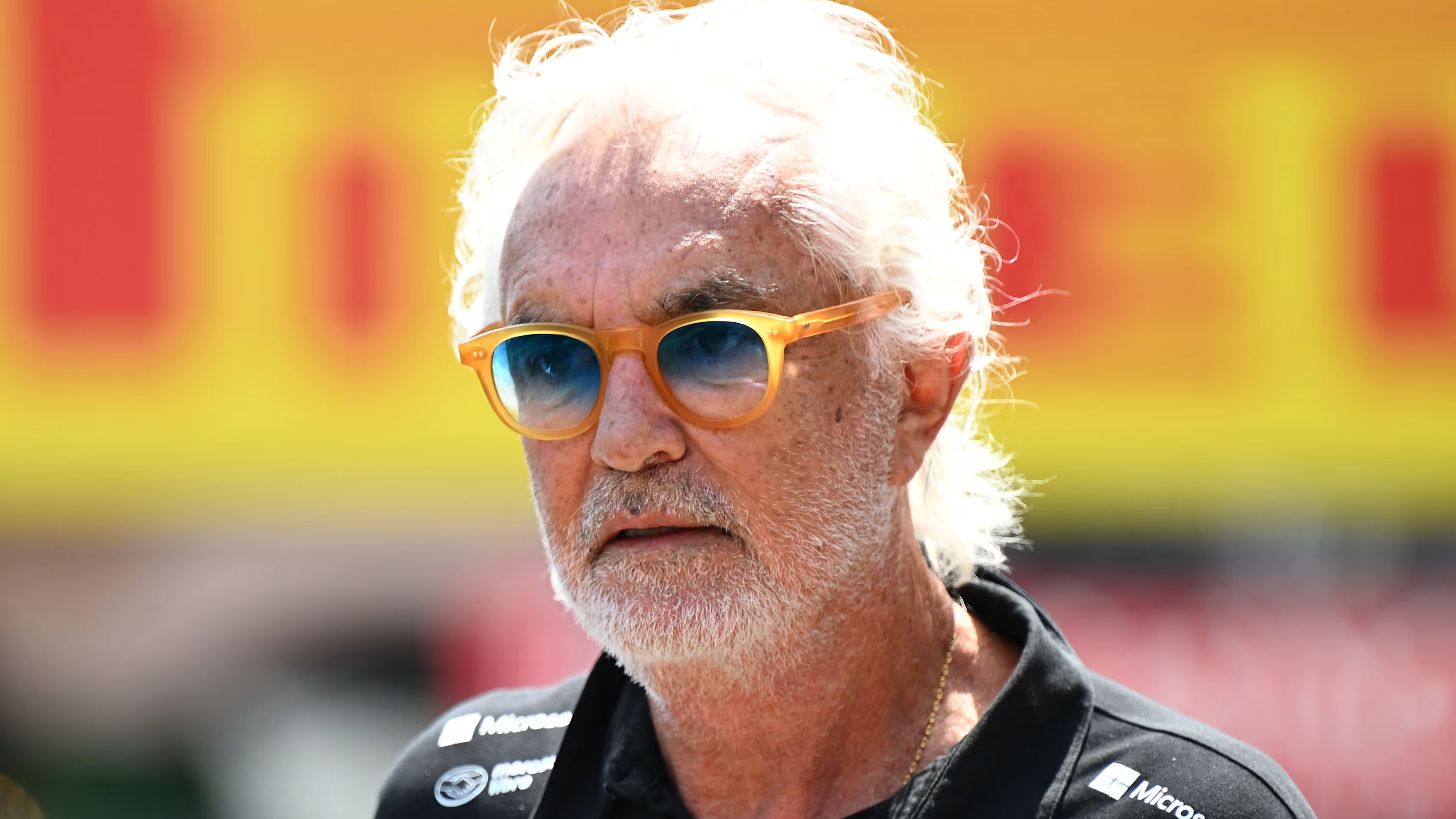
The 24% stake at the heart of the conflict
The origins of the dispute lie in Alpine’s rapid valuation increase. When Otro Capital invested in 2023, the team was valued at around $900 million. Since then, the commercial boom of Formula 1, combined with Alpine’s improving competitiveness, has significantly increased that figure.
Now, the American fund is seeking to sell its 24% stake under more favourable conditions. However, Renault, which still holds a decisive contractual advantage, has resisted this plan.
Under the terms of their agreement, Renault has the right to veto any sale of the minority stake until 13 September 2026. This means that, for now, no transaction can be completed without the majority shareholder’s approval.
This has effectively stalled negotiations and intensified tensions between the…CONTINUE READING THIS STORY

The Judge, a nom de plume of an experienced F1 journalist and site founder with long-standing sources across the paddock. With over 30 years of experience in Formula 1 as an insider journalist, I have built trusted connections across the paddock, from race engineers and mechanics to senior team figures. At The Judge 13, I and a handful of trusted colleagues share exclusive Formula 1 news, expert analysis and behind-the-scenes stories you will not find in mainstream motorsport media.

Craig Alderson is Senior Editor at TJ13, where Craig oversees newsroom operations and coordinates editorial output across the site. With a background in online sports reporting and motorsport magazine editing, he plays a key role in maintaining consistency, speed, and accuracy in TJ13’s coverage.
During race weekends, Craig acts as desk lead, directing contributors, prioritising breaking stories, and ensuring timely publication across a fast-moving news cycle.
Craig’s work focuses heavily on real-time developments in the paddock, including team updates, regulatory decisions, and emerging controversies. This role requires a detailed understanding of Formula 1’s operational flow, from practice sessions through to race-day strategy and post-race fallout.
With experience managing editorial teams, Craig ensures that TJ13 delivers structured, reliable coverage while maintaining the site’s distinctive voice.
Craig has a particular interest in how information moves within the paddock environment, and how rapidly developing stories can be accurately translated into clear, accessible reporting for readers.
