
One line from the post-race analysis at the Japanese Grand Prix cuts straight to the heart of what unfolded. ‘The question is not whether Antonelli was faster. We know he was. The question is, why did McLaren hand Antonelli the easy win?’ This verdict, delivered by former F1 race strategist Ruth Buscombe, encapsulates a race that was decided less by outright speed and more by a series of decisions made in the pit lane.
Explaining on her YouTube channel, Buscombe also identified the pivotal moment in the race, explaining that “everything before the safety car is a chess game; everything after it is the consequence”. McLaren played the opening well at Suzuka, but when the key decisions arrived, they blinked.
These conclusions are based on the analysis of one of the most respected strategic minds in the paddock. Ruth has worked with teams including Haas and Sauber, building a reputation for clear, data-driven race breakdowns.
Would you like to see more TJ13 Formula 1 coverage? Add us to your favourites list on Google to receive trusted F1 news.

A race under control with Piastri
Oscar Piastri did exactly what a leading driver is supposed to do: He got off to a flying start, set a steady pace and, crucially, showed no signs of tyre degradation. In fact, his lap times suggested the opposite. While others were beginning to fade, he was getting quicker, consistently dipping into the mid-1:34 range.
There was no immediate pressure from behind, either. Charles Leclerc and George Russell were managing their own races, while Andrea Kimi Antonelli, despite a strong start, found himself stuck in traffic and unable to demonstrate his true pace.
From the outside, it looked like a race that McLaren could control. The tyres were stable, the gaps were manageable and overtaking is notoriously difficult at Suzuka. There was no obvious trigger to force a strategic gamble.
Report: Newey ‘losing his mind’ as Aston Martin heads for “catastrophe”
The moment McLaren blinked
This is what made the decision on lap 16 so pivotal. McLaren brought in Lando Norris to initiate the first phase of pit stops. The logic was understandable: Pitting Norris early would allow him to clear traffic and potentially undercut the cars ahead.
However, the data did not suggest urgency. His pace drop-off was modest rather than dramatic. More importantly, however, it created a chain reaction. Ferrari immediately responded by bringing in Leclerc, executing the undercut perfectly.
However, Mercedes did nothing.
This lack of reaction was the clearest signal to anyone watching closely. When a team with a car in contention chooses not to cover an undercut, hesitation is rarely the reason. It is confidence.
Antonelli’s hidden advantage
The moment the traffic cleared, Antonelli’s pace revealed the true state of play in the race. Free from the cars ahead, he began setting lap times that were not just competitive, but outright superior. Even on older tyres, he was quicker than both McLarens with fresh rubber.
This was no marginal gain. It signalled a significant performance advantage, particularly through Suzuka’s high-speed sections, where lap time is most heavily influenced. The Mercedes could carry more speed through the flowing corners and deploy its energy more effectively down the straights.
For the first phase of the race, this advantage had been hidden. Once it was revealed, it changed the strategic landscape entirely. Mercedes understood this and remained patient. McLaren did not.
MORE NEWS – F1 cars now making overtake decisions without driver input
A cascade with no reward
Once Norris pitted, the rest of the field followed in what Buscombe described as a cascade. Each team reacted to the one ahead, covering moves rather than making them. The result was a flurry of pit stops that looked decisive but achieved very little.
No driver gained a meaningful position through the undercut. Instead, the order stabilised, with everyone effectively staying where they were.
This is where McLaren’s race began to unravel. They were no longer dictating the strategy. They were merely reacting to it.
The decision that cost them the race
The defining moment came two laps later, when McLaren brought Piastri in. On the surface, it appeared to be a defensive move to cover potential threats from behind. In reality, however, there was no immediate danger.
Leclerc was too far behind to undercut, and Mercedes had already revealed their strategy by staying out. By pitting Piastri, McLaren surrendered their track position at precisely the wrong moment, handing the initiative to Antonelli.
When the safety car was deployed shortly afterwards following an incident involving Oliver Bearman, the consequences became clear. Antonelli was able to pit with minimal time loss and emerge in the lead, while Piastri was left playing catch-up. At Suzuka, that is often a race-ending scenario.
MORE NEWS – Why McLaren could stop Mercedes running away with F1 2026
Why Mercedes had the edge
Even after the restart, the outcome never looked in doubt. Piastri had the pace to keep up in certain sections, particularly in traction zones, but he could not challenge Antonelli where it mattered most.
The Mercedes was stronger through the high-speed corners and had a small but decisive advantage on the straights. Over a full lap, this translated into a gap that was just enough to prevent any realistic overtaking opportunity.
Suzuka rewards rhythm and aerodynamic efficiency, and Mercedes had both. Once they had secured their position on the track, they controlled the race with authority.
NEXT ARTICLE – Max Verstappen Considering Paid 2027 Sabbatical Amid F1 Frustrations
One thing was crystal clear at the recent 2026 Formula One Japanese Grand Prix, and that is Max Verstappen is a very unhappy man. In the FIA press conference he banished a journalist from The Guardian, refusing to answer questions until the offending pork pie hat had left the room.
Verstappen claims Giles Richards had ‘laughed in his face’ following the season finale in Abu Dhabi last season. Having fallen short by just 14 points of becoming only the second F1 driver to claim five consecutive titles, Richards reminded Max of his red mist in Spain where he appeared to ram the Mercedes of George Russell.
The resulting 10 second penalty issued by the race stewards probably cost Verstappen in the region of 9 points that day, so it was not a deciding incident for his season anyway. Red Bull team boss Laurent Mekies is reported to have had words with his star driver following corporate pressure from Austria over the image he was portraying of the Red Bull brand.
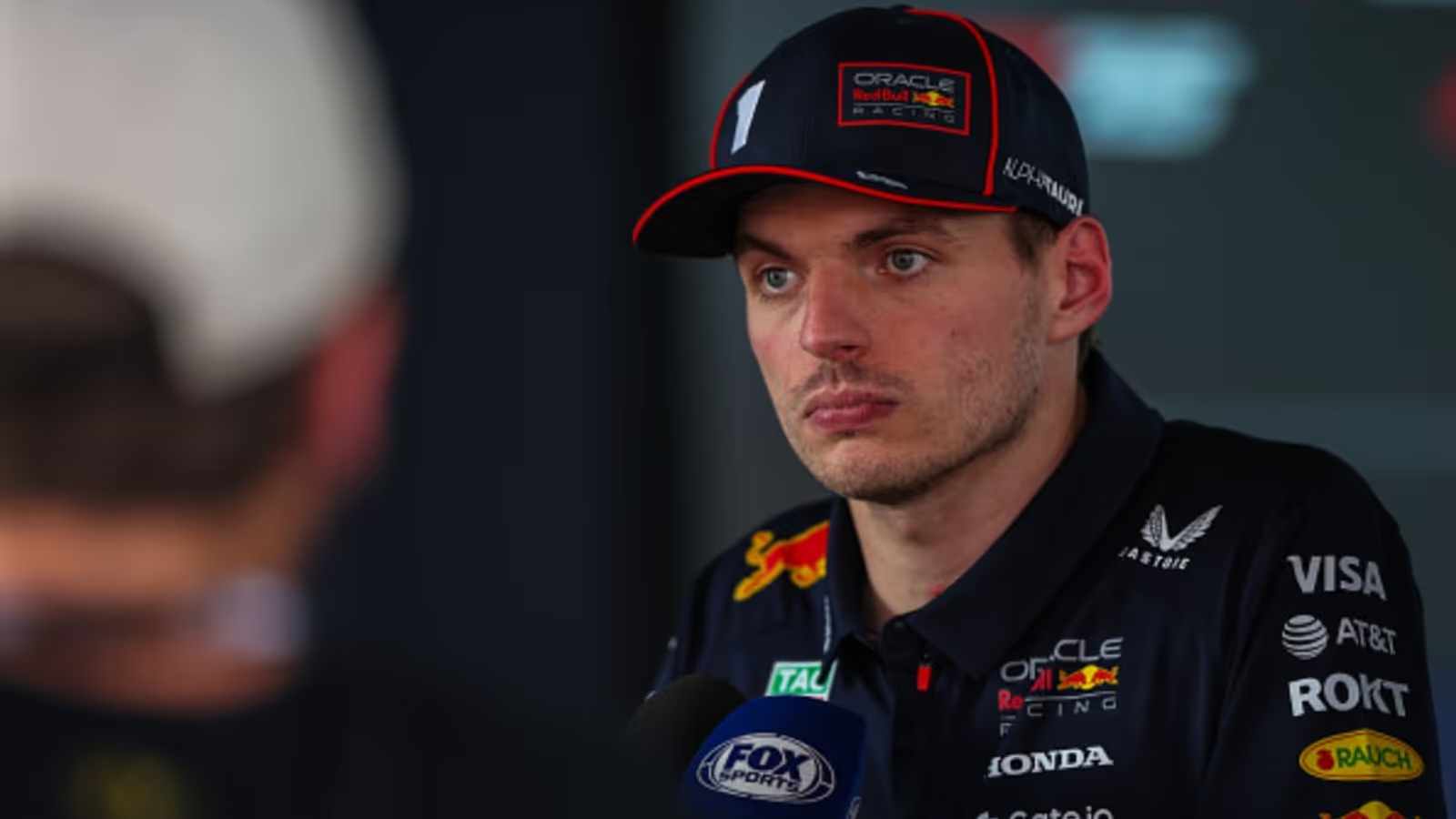
Max reprimanded for dismissing journalists
Thats in itself is a bizarre tale, given that Red Bull energy drinks brand, the extreme sports they have supported and the rebellious attitude of the Red Bull F1 team have always been associated with kicking over the traces. How times have changed since the death of Red Bull founder Didi Mateschitz. But we digress.
As if to make matters worse, Vertsappen had his worst racing weekend of the season. He was out qualified for the second time by new team mate Isack Hadjar and dumped out of the top ten shootout by rookie Arvid Lindblad in the Red Bull sister car. The RB22 car was “undriveable” repeated Max throughout the…CONTINUE READING THIS ARTICLE

The Judge, a nom de plume of an experienced F1 journalist and site founder with long-standing sources across the paddock. With over 30 years of experience in Formula 1 as an insider journalist, I have built trusted connections across the paddock, from race engineers and mechanics to senior team figures. At The Judge 13, I and a handful of trusted colleagues share exclusive Formula 1 news, expert analysis and behind-the-scenes stories you will not find in mainstream motorsport media.

Clara Marlowe is a Formula 1 writer at TJ13 with over 15 years of experience in motorsport journalism, having contributed features to established sports magazines such as Evo, MCN, Wisden Cricket Monthly and other digital outlets.
Clara specialises in human-interest storytelling, focusing on the individuals behind the sport, including drivers, engineers, and team personnel whose roles are often overlooked in mainstream coverage.
At TJ13, Clara contributes long-form features and narrative-driven pieces that explore the personal and professional journeys within Formula 1. This includes coverage of career-defining moments, internal team dynamics, and the human impact of high-pressure competition.
Clara’s work brings depth and perspective to the sport, complementing news and analysis with stories that highlight the people behind the machinery.
Clara has a particular interest in how personal narratives intersect with performance, and how individual experiences shape outcomes across a Formula 1 season.
