
Formula One in 2026 is in a crisis like its never known before. The all new 2026 technical regulations have delivered the most artificial racing the sport has ever seen in its three quarters of a century of racing.
A big sit down is planned for April 9th between the FIA, F1, the drivers and the teams where the entire concept of the 2026 rules will be laid bare. At the heart of the crisis is the pumped up hybrid power units the manufacturers pressed for with their 50/50 split between internal combustion engine (ICE) and the electrical component.
The new power units were conceived almost 8 years ago when the FIA was panicking over the number of manufacturers in the sport. In the previous decade Toyota, BMW and Ford had all come and gone and Red Bull Racing were facing the prospect of no engine supplier after their relationship with Renault hit an all time low.
Auto manufacturers decides F1’s future
In line with the expectations for the automative trade, hybrid engines were expected to be the future of road cars and so the trend towards electrification in partnership with traditional engine technology was believed to represent the future of the industry.
In the meantime, particularly in Europe, governments demanding a shift to net zero implemented regulations which meant fully electric cars and not hybrids, were promoted as the future of road cars. The UK initially outlawed the sale of hybrid cars from 2030., whilst the rest of Europe had a more relaxed timeline of 2035.
Yet the boffins from Porsche, Audi, Mercedes and even Honda blinded by their own obsessions with how the future would shape up forced the FIA in a direction which is proving to be a catastrophe for the sport. Since the acquisition of F1 by US media giant Liberty media, much of the focus on how the sport progresses has been based on making the product more exciting and accessible to a wider fan base and this means more overtaking at whatever the cost.
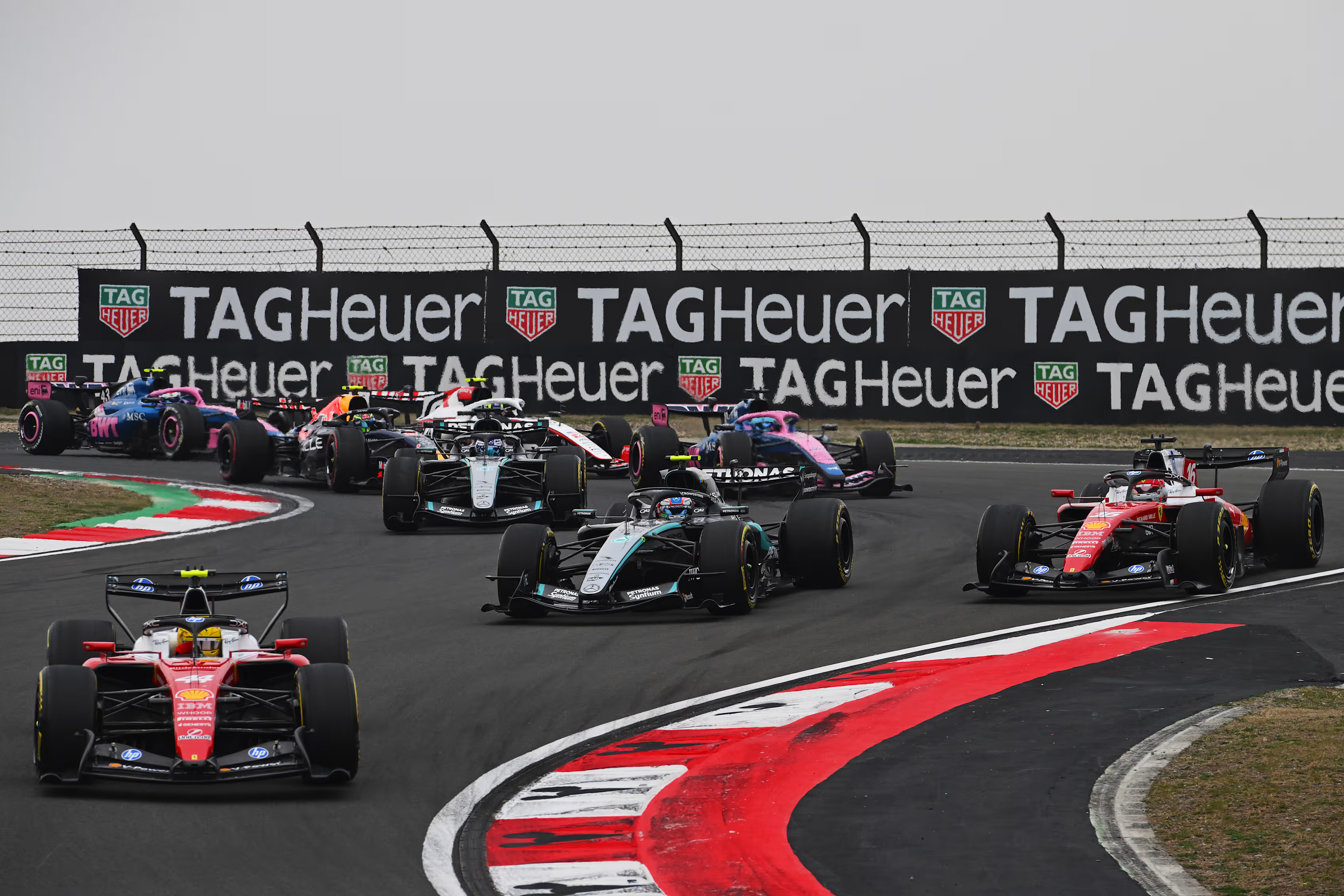
At the season opener in Melbourne this year, the number of overtakes rose from 45 in 2025 to a 120 at the 2026 Australian Grand Prix. A great success, surely? Yet in bizarre fashion, the overtaking was so plentiful the TV director cuold not keep up with all the on track action which led to a fragmented production which at times was confusing for even the most die hard fan.
Algorithm driven F1 overtakes
Further, the plethora of overtakes was multiplied by the fact that a driver deploying their battery to make a pass was then disadvantage by the lack of electrical power he had remaining compared to the driver behind – who would then re-pass within the next few corners.
Hilariously, some of the overtaking was not even intended as Lando Norris explained in Japan. “Honestly, some of the racing…I didn’t even want to overtake Lewis,” laughed the McLaren driver when asked about his on track battles with the seven times champion. “It’s just my battery deploys, I don’t want it to deploy, but I can’t control it. So I overtake him and then I have no battery, so he just flies past [on the next straight].
“This is not racing, this is yo-yoing. And when you’re just at the mercy of whatever the power unit delivers…the driver should be in control of it at least, and we’re not. Yes, the racing can look great on TV, but the racing inside the car is certainly not as authentic as it needs to be,” concluded the current world champion.
Given the complexity of the electrical energy deployment and the FIA rules governing it, drivers are mistakenly deploying an electrical energy boost when they back off the throttle as Norris explains. “The problem is it [the battery] deploys into 130R – I have to lift, otherwise I’ll drive into him, and I’m not allowed to go back on throttle.”
“Not enough control for the driver”
When the driver reduces his throttle input more than 98%, the computer instantly deploys 200kw of battery power, which Norris is clearly stating he didn’t want. “If I go on throttle, my battery deploys, and I don’t want it to deploy because it should have come. But because you lift, you have to go back on [throttle], it re-deploys. There’s nothing I can do about it.”
“So, there’s just not enough control for a driver, and that’s why you’re just too much at the mercy of what’s behind you. It’s just not how it should be.” Talk about robot racing. Algorithms are deciding when the F1 cars overtake and not the driver. Farcical.
There have been a number of suggestions as to how Formula One can fix the biggest mess its ever created for itself including increasing fuel flow rates, increasing the maximum harvesting in one go from 250kw to 350kw and most sensibility – in this writers humble opinion – turning down the ratio of electrical power.
The 50/50 ICE/hybrid split of power was predicted by Red Bull Racing back in 2023 to be a significant problem. Then team boss Christian Horner described the future F1 racing machines as “Frankenstein monsters” which would ate times merely use the internal combustion engine as a power generator for the battery.
F1 debacle entirely predictable
Max Verstappen also gave an in depth interview in the autumn of that season explaining how cars would suddenly lose power along a straight making them sitting ducks and the racing spectacle stupid. When asked what the FIA officials position was to Red Bull’s findings, he replied: “Not sure how many of them are aware…”
Increasing the fuel flow to allow the ICE to produce more power whilst driving the rear wheels is a non-starter for this season. Teams have fixed architectures in terms of fuel tank sizes and technology that accelerates the fuel ignition. Some would benefit others would be hugely disadvantaged.
Allowing more harvesting is also a silly way of progressing because it fails to deal with the huge closing speeds when a car is on the electrical boost compared to another recovering energy. This leaves a simple proposition – reduce the ratio of electrical power from 50% to around 30%. Most of this energy at the majority of there tracks could be generated from braking alone.
Gone would be the lift and coast to generate the battery and the algorithm driven overtakes and a qualifying lap would once again be a “full send” mission for each of the drivers.
The real F1 fix will be a farce
In reality this would see the electrical power rated at 210kw although the farcical nature of this might be as equally embarrassing as the situation F1 finds itself in presently. The 2025 F1 PU’s had a maximum of 120kw, so after almost a decade of debate F1’s bold new future and billions spent in research and development, the sport has merely upped the old hybrid power units by less than a 100kw.
No wonder F1 CEO, Stefano Domenicali commented the current set of PU regulations were “political” in their nature – and of course before his time. Formula One has given too much power to the manufacturers and the lunatics are running the asylum.
An alternative approach would be to make the next generation of F1 engines, simple. V8’s with a KERS style battery charge deployment. Slashing the cost of the massively complex hybrids could see a return to an era when smaller independent manufacturers could design and supply power units as in the days of Ilmoor, Cosworth and Judd. And an era when the drivers were in charge of their racing cars.
NEXT ARTICLE: Max Verstappen Considering Paid 2027 Sabbatical Amid F1 Frustrations
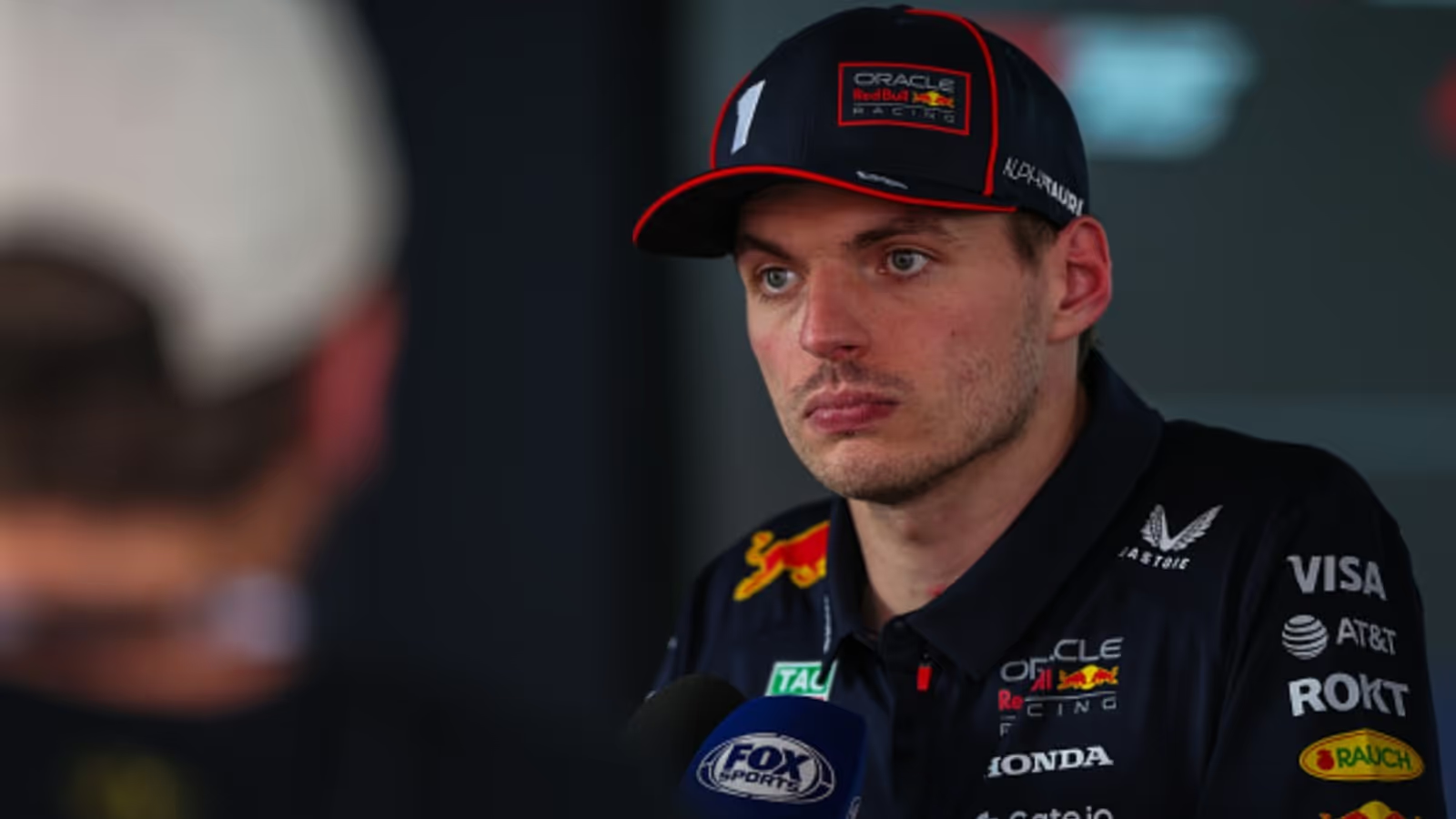
One thing was crystal clear at the recent 2026 Formula One Japanese Grand Prix, and that is Max Verstappen is a very unhappy man. In the FIA press conference he banished a journalist from The Guardian, refusing to answer questions until the offending pork pie hat had left the room.
Verstappen claims Giles Richards had ‘laughed in his face’ following the season finale in Abu Dhabi last season. Having fallen short by just 14 points of becoming only the second F1 driver to claim five consecutive titles, Richards reminded Max of his red mist in Spain where he appeared to ram the Mercedes of George Russell.
The resulting 10 second penalty issued by the race stewards probably cost Verstappen in the region of 9 points that day, so it was not a deciding incident for his season anyway. Red Bull team boss Laurent Mekies is reported to have had words with his star driver following corporate pressure from Austria over the image he was portraying of the Red Bull brand…. CONTINUE READING

A.J. Hunt is Senior Editor at TJ13, where Andrew oversees editorial standards and contributes to the site’s Formula 1 coverage. A career journalist with experience in both print and digital sports media, Andrew trained in investigative journalism and has written for a range of European sports outlets.
At TJ13, Andrew plays a central role in shaping the site’s output, working across breaking news, analysis, and long-form features. Andrew’s responsibilities include fact-checking, refining editorial structure, and ensuring consistency in reporting across a fast-moving news cycle.
Andrew’s work focuses particularly on the intersection of Formula 1 politics, regulation, and team strategy. Andrew closely follows developments involving the FIA, team leadership, and driver market dynamics, helping to provide context behind the sport’s biggest stories.
With experience covering multiple seasons of Formula 1’s modern hybrid era, Andrew has developed a detailed understanding of how regulatory changes and competitive shifts influence the grid. Andrew’s editorial approach prioritises clarity and context, aiming to help readers navigate complex developments within the sport.
In addition to editorial duties, Andrew is particularly interested in how media narratives shape fan perception of Formula 1, and how reporting can balance speed with accuracy in an increasingly digital news environment.
