

How Ricciardo escaped Red Bull’s second seat trap — others weren’t so fortunate. Daniel Ricciardo has made a strikingly honest admission about his Formula 1 exit, one that says as much about Red Bull as it does about himself.
Speaking candidly on the Ford’s podcast ‘Drive, with Jim Farley’, Ricciardo revealed that he was “grateful” for the decision that ultimately ended his time on the grid, admitting that he may never have walked away of his own accord.
“I don’t know if I would have made that decision myself,” he admitted. “So in a way, I’m grateful.”
This is a rare moment of vulnerability from a driver known for his confidence and charisma. However, viewed in the context of Red Bull’s relentless driver environment, the comment takes on a deeper meaning, one that still resonates across the team today.

A decision he couldn’t make himself
Ricciardo’s words point to a truth that many elite athletes struggle to confront: knowing when it’s time to retire.
By the end of his Formula 1 career, the Australian had endured a difficult period characterised by inconsistency, physical and mental fatigue, and an increasing feeling that his former level of performance was becoming more difficult to achieve.
Rather than a dramatic collapse, it was a gradual erosion, the kind that is often hardest to accept from the inside.
This is what makes his admission so powerful. He was not a driver who was forced out unexpectedly. He was one who, deep down, recognised the trajectory but couldn’t quite bring himself to step away.
Crucially, this happened within one of the most unforgiving environments in Formula 1.
MORE NEWS – McLaren are a genuine threat to Mercedes F1 dominance
Ricciardo: “I had poured my heart and soul into F1”
“I was let go twice in the last two years, and that really took its toll on me. I had poured my heart and soul into it and felt pretty exhausted. In hindsight, though, I was grateful that they made the decision for me,” admits the Australian.
During his final stint in Formula 1, Ricciardo broke his hand in a racing accident. The time he spent out of action and the races he missed threw the Australian off his stride. Was the accident a sign?
“It would have been hard for me to say: ‘I’m done with that chapter’, I probably knew I was done, though, because it was getting harder for me to drive at the same level as guys like Fernando Alonso, who is in his forties. I’d lost that certain something. And it’s okay to admit that.”
NEWS – Verstappen to Mercedes? Palmer Predicts ‘It Will Happen’ Amid Red Bull Struggles
The reality of the Red Bull second seat
Although it is true that Ricciardo had periods with Renault and McLaren, two teams that were not performing at Red Bull Racing’s level when the Australian first left the team, the main reason for leaving a competitive outfit at the height of his career was a certain Dutchman.
Since his departure, Red Bull Racing has cycled through multiple drivers alongside Max Verstappen, with remarkably similar outcomes:
Pierre Gasly was promoted, struggled and was quickly demoted. Alex Albon followed a nearly identical path.
Sergio Pérez enjoyed moments of success, but ultimately succumbed to mounting pressure and inconsistency. Liam Lawson, Yuki Tsunoda and a new wave of young drivers, including Isaak Hadjar, Verstappen’s current team mate, continue to orbit the same high-pressure system.
The pattern is clear: drivers arrive with promise, but few leave with enhanced reputations. Ricciardo left the team at the peak of his powers only to be fighting for points in cars incapable of scoring consistent points.
The slow decline culminated into a return to the Red Bull fold, albeit with the junior team using inferior machinery, compounding the issue of inconsistent performances and a carrot dangling of a potential return to Red Bull Racing, partnering once again with Verstappen.
MORE F1 NEWS – Liam Lawson could race this month, but there’s a major problem
Verstappen: the constant in the equation
At the centre of it all is Verstappen, the benchmark against which every teammate is measured.
The Dutchman’s exceptional talent, coupled with a car philosophy often tailored to his driving style, has established one of the most challenging benchmarks in modern Formula 1.
Matching Verstappen is not just about speed; it’s also about confidence, adaptability and resilience when constantly compared to him.
Even Ricciardo, one of the few drivers to have genuinely competed with Verstappen during their early years together, ultimately chose to step away from that internal battle.
Others have not had that luxury.
MORE NEWS – A serious accident awaits Lewis Hamilton? “It will happen sooner or later”
A system under pressure
What makes Ricciardo’s comments especially relevant now is the broader uncertainty surrounding Red Bull’s current situation.
Questions over performance, direction and internal changes, as well as Verstappen’s own long-term future, have introduced a level of instability not seen in years.
In that context, the second seat becomes even more volatile, it’s not just a performance challenge, but a psychological one too.
Young drivers stepping into the role are not just competing. They are entering a system with a proven track record of quickly and ruthlessly exposing limitations.
As many in the paddock now acknowledge, it is one of the toughest jobs in the sport.
Understanding it before the rest
Ricciardo’s legacy at Red Bull is often viewed through the lens of what came after: the move to Renault, the struggles at McLaren and his eventual exit from Formula 1.
However, his recent admission reframes that narrative.
He did not just leave Red Bull. He was made to leave a situation that has since tested, and in many cases broken, those who followed him.
Would you like to see more TJ13 Formula 1 coverage? Add us to your favourites list on Google to receive trusted F1 news.
NEXT ARTICLE – Max Verstappen Considering Paid 2027 Sabbatical Amid F1 Frustrations
One thing was crystal clear at the recent 2026 Formula One Japanese Grand Prix, and that is Max Verstappen is a very unhappy man. In the FIA press conference he banished a journalist from The Guardian, refusing to answer questions until the offending pork pie hat had left the room.
Verstappen claims Giles Richards had ‘laughed in his face’ following the season finale in Abu Dhabi last season. Having fallen short by just 14 points of becoming only the second F1 driver to claim five consecutive titles, Richards reminded Max of his red mist in Spain where he appeared to ram the Mercedes of George Russell.
The resulting 10 second penalty issued by the race stewards probably cost Verstappen in the region of 9 points that day, so it was not a deciding incident for his season anyway. Red Bull team boss Laurent Mekies is reported to have had words with his star driver following corporate pressure from Austria over the image he was portraying of the Red Bull brand.
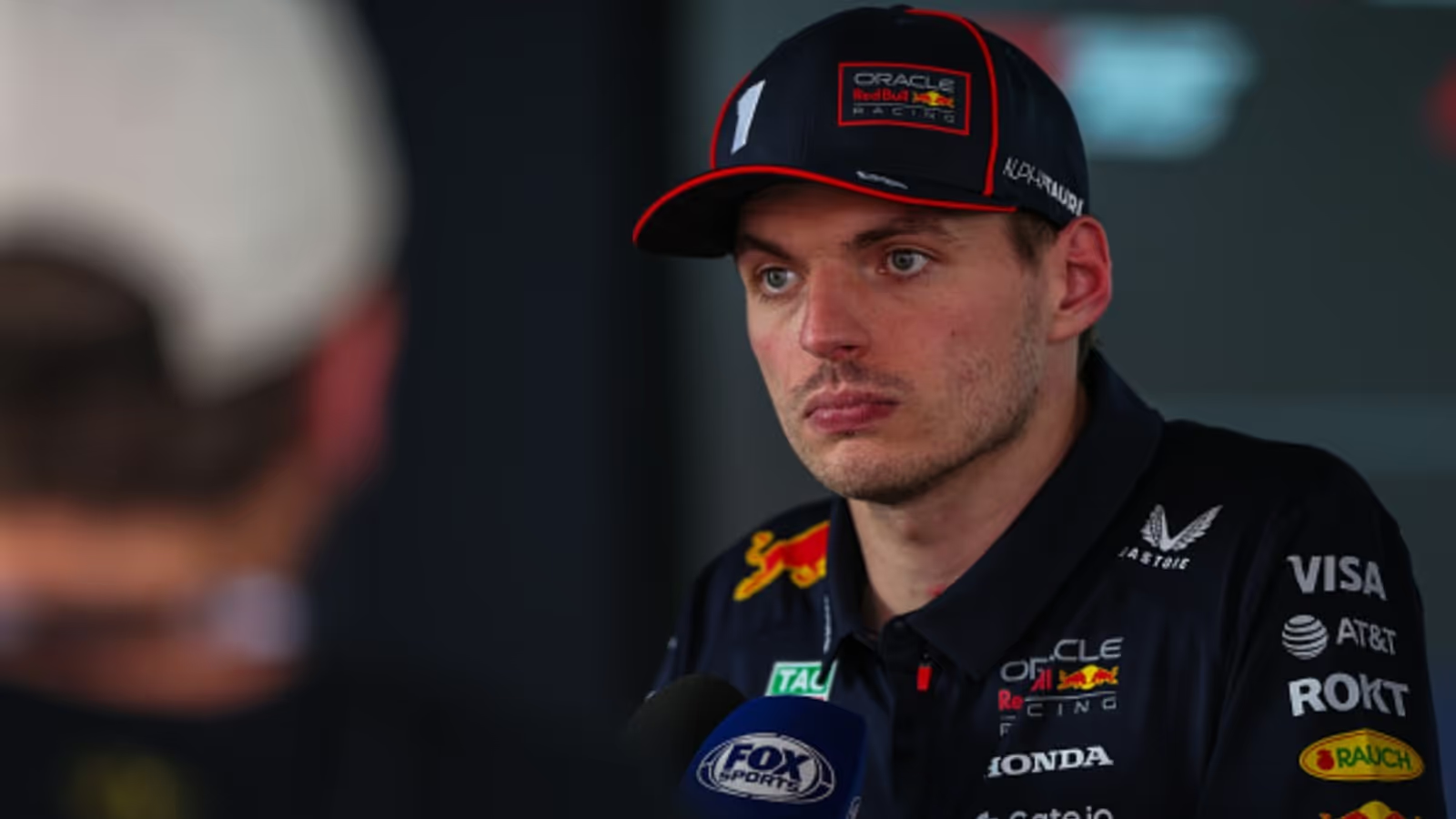
Max reprimanded for dismissing journalists
Thats in itself is a bizarre tale, given that Red Bull energy drinks brand, the extreme sports they have supported and the rebellious attitude of the Red Bull F1 team have always been associated with kicking over the traces. How times have changed since the death of Red Bull founder Didi Mateschitz. But we digress.
As if to make matters worse, Vertsappen had his worst racing weekend of the season. He was out qualified for the second time by new team mate Isack Hadjar and dumped out of the top ten shootout by rookie Arvid Lindblad in the Red Bull sister car. The RB22 car was “undriveable” repeated Max throughout the…CONTINUE READING THIS ARTICLE

Sofia Trevena is a Formula 1 writer at TJ13 with an academic background in cultural studies and published research on global sport. Sofia Trevena examines Formula 1 as both a competitive discipline and a cultural phenomenon, combining scholarly perspective with journalistic analysis.
At TJ13, Sofia covers topics including the global growth of Formula 1, the sport’s cultural influence, and the historical context behind modern developments. Sofia frequently writes on Formula 1 history, drawing connections between past eras and the current competitive landscape.
Her work also explores the broader social dimensions of the sport, including media narratives, fan engagement, and the globalisation of Formula 1 as an entertainment product.
With a deep interest in the sport’s heritage, Sofia provides readers with context that extends beyond race results and headlines.
Sofia aims to highlight how Formula 1 reflects wider cultural and societal trends, offering a perspective that complements technical and news-driven reporting.
