
Ferrari have indeed excelled themselves this season bit in terms of their power unit, which is second only to Mercedes’ but also in their aerodynamic concepts visible on the chassis. There is the ‘Macarena’ rear wing which when ‘open’ flips through 180 degrees to reduce the drag when it is deployed along the straight.
The nickname for the rear wing was coined by Scuderia boss Fred Vasseur during pre-season testing because its distinct rotating motion reminded him of the 1990’a dance moves. It is an extreme interpretation of Formula One ’s new 2026 active aerodynamic regulations and whilst most teams used a flag which opens in similar fashion to the old DRS, the Macarena wing flips upside down when in ‘straight line mode (SLM).
Ferrari did not utilise their new rear wing design in Australia, but it appeared once again on the car the following weekend in Shanghai. However, it was removed from both Lewis Hamilton and Charles Leclerc’s cars after the Friday practice session due to concerns over its potential durability.
The Scuderia have said the Macarena wing will return when they are confident it is capable of performing as expected across an entire Grand Prix distance. Another of Ferrari’s innovations appeared in pre-season testing, a kind of exhaust style beam wing which improved the airflow around the entrance to the diffuser.
Beam wings have been banned this season, but Ferrari found a way to produce a similar effect from their exhaust wing. It is not treated as a beam wing due to the fact it is part of the rear imapact structure of the car and the diffuser and within the volumes allowed in the regulations. Beam wings were elements bolted on below the main rear wing and so a re classified as different, although Ferrari will benefit from a similar aerodynamic effect with their ‘exhaust wing.’
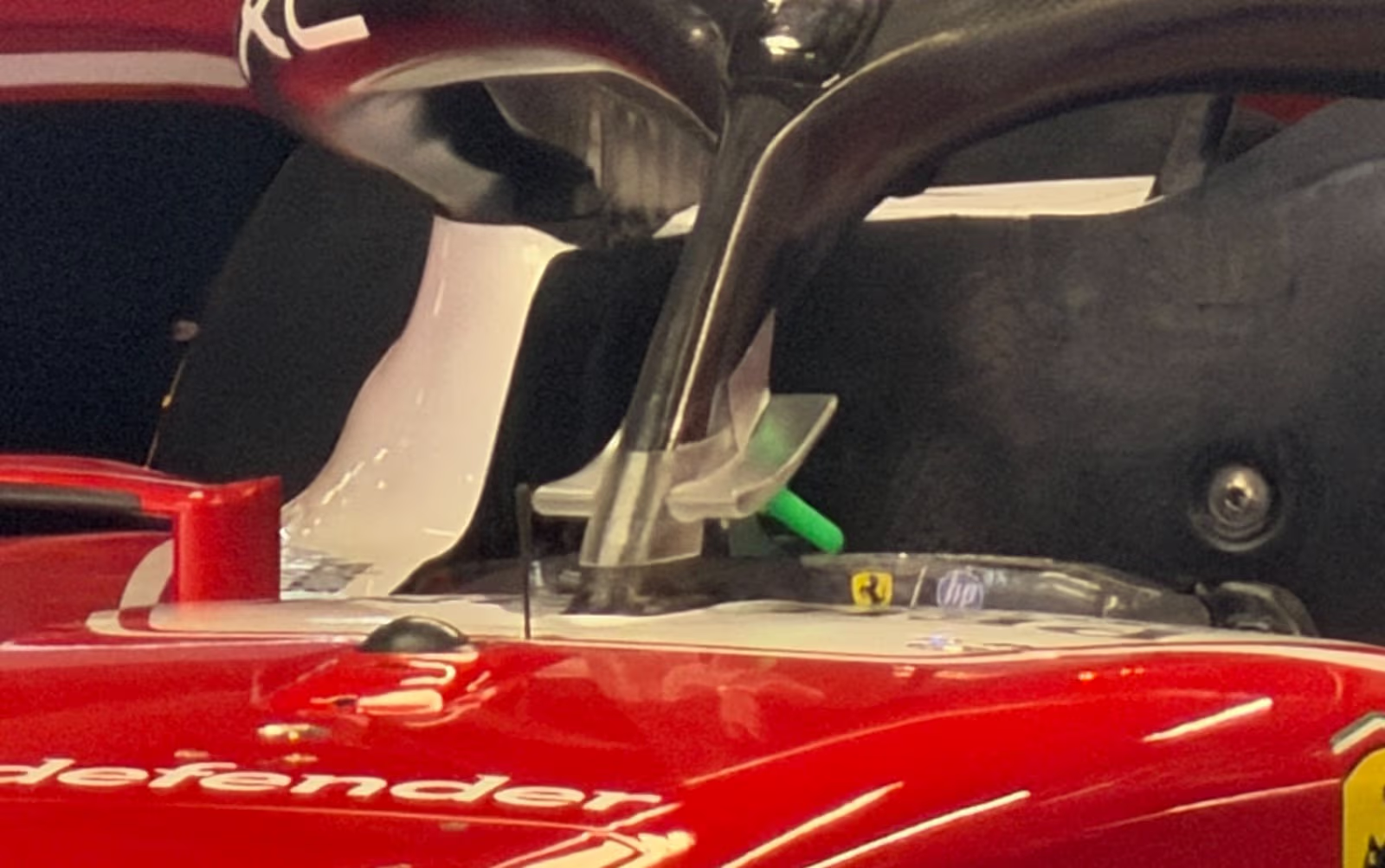
Both of these innovations have been accepted by the FIA and the competitor teams as legal interpretations of the all new 2026 regulations. However, in China another of Ferrari’s gizmo’s from their ACME department appeared on the SF-26 for practice and in the Sprint, but was notably removed before the Grand Prix on Sunday. The items in question are being called ‘halo winglets’ due to the position where they are fitted.
Would you like to see more TJ13 Formula 1 coverage? Add us to your favourites list on Google to receive trusted F1 news.
Winglets fitted during the Sprinty events but removed for the GP
In the pictures above, they are clearly identifiable, mounted on the front centre pillar of the halo and their intent is to manage the airflow around the drivers helmet in a more efficient fashion. Instead of the air hitting the drivers helmet square on at over 200mph, the winglets divert the air up and over the top of the halo.
So why were the winglets present for practice and the Sprint session but removed by Ferrari for the Grand Prix? Both components passed the FIA post Sprint scrutineering session, although the official documents posted do not mention the winglets at all. It was subsequent questions from the FIA posed at Ferrari which were the reasons the winglets disappeared on Sunday.
The front of the Formula One cars are heavily restricted in terms of bodywork components and pretty much nothing is allowed above the front nose cone. The halo area too is heavily constrained on how the teams may interpret its fitting and design. There is an allowance for a fairing to be fitted to the halo, although this is specified as a ‘secondary roll hoop’ and would sit at the top of the halo itself.
Adrian Newey faces the sack as Aston Martin team boss with Horner waiting in the wings
A heavily restricted area for bodywork
Ferrari’s winglets are above the nose and attached to the halo’s central pillar. The fact the winglets were not made of carbon fibre and are transparent is the key to understanding what Ferrari were doing with their winglets. The choice of material for the winglets and it being transparent was not a co-incidence and nether was it because they would obstruct the drivers Kline of sight.
In the entire tome of FIA regulations pertaining to the location, dimensions and composite materials used in an F1 car’s design, just one component is mandated as being transparent. The windscreen.
Ferrari have argued that their winglets were in fact a windscreen which makes the location of the winglets understandable. Teams are allowed to fit ‘transparent windscreens’ altho9ugh there are some dimensional constraints in terms of X-Y axis and the thickness of the screen but it may be fitted in the zone where no other components are allowed.
Verstappen’s Red Bull RB22 weight issue exposed after Chinese GP weighbridge photo leaked online
Is it a windscreen?
The Scuderia’s design team will have complied with all the dimensional restraints, so what made the winglets potentially controversial and why did they disappear? Ferrari did argue that their wingless were compliant with there windscreen regulations, but the FIA were unconvinced with the petition.
It appears the issue was not the dimensions of the winglets, but potential the composite material from which they were constructed that the Italians were unable to prove to be compliant. Any ‘windscreen’ must be derived from a specific laminate and as yet Ferrari were unable to prove this beyond all doubt.
This is not to say the winglet compounds were not properly sourced and following a deeper dive from the FIA into the procurement of there material together with its construction methodology the winglets may well return at a later date.
In turn, Ferrari took the decision it was not worth the maybe tenth of a second – probably less – of time it would gain to risk a post Grand Prix ‘protest’ from a rival team or them ultimately being deemed illegal by the FIA. For now the winglets are no more.
Would you like to see more TJ13 Formula 1 coverage? Add us to your favourites list on Google to receive trusted F1 news.
NEXT ARTICLE – Penalty for Max Verstappen: “This should not be tolerated”
Is a penalty for Max Verstappen likely? After narrowly missing out on a fifth world title last season, Max Verstappen began the 2026 campaign determined to fight back. However, just two races into the new season, the Dutchman finds himself under pressure and is becoming increasingly vocal about his frustrations.
The opening rounds have been far from ideal for the Red Bull driver. At the season-opening Australian Grand Prix on 8 March, Verstappen could only manage sixth place, a result that fell well short of expectations for a driver of his calibre…. CONTINUE READING


A.J. Hunt is Senior Editor at TJ13, where Andrew oversees editorial standards and contributes to the site’s Formula 1 coverage. A career journalist with experience in both print and digital sports media, Andrew trained in investigative journalism and has written for a range of European sports outlets.
At TJ13, Andrew plays a central role in shaping the site’s output, working across breaking news, analysis, and long-form features. Andrew’s responsibilities include fact-checking, refining editorial structure, and ensuring consistency in reporting across a fast-moving news cycle.
Andrew’s work focuses particularly on the intersection of Formula 1 politics, regulation, and team strategy. Andrew closely follows developments involving the FIA, team leadership, and driver market dynamics, helping to provide context behind the sport’s biggest stories.
With experience covering multiple seasons of Formula 1’s modern hybrid era, Andrew has developed a detailed understanding of how regulatory changes and competitive shifts influence the grid. Andrew’s editorial approach prioritises clarity and context, aiming to help readers navigate complex developments within the sport.
In addition to editorial duties, Andrew is particularly interested in how media narratives shape fan perception of Formula 1, and how reporting can balance speed with accuracy in an increasingly digital news environment.
