
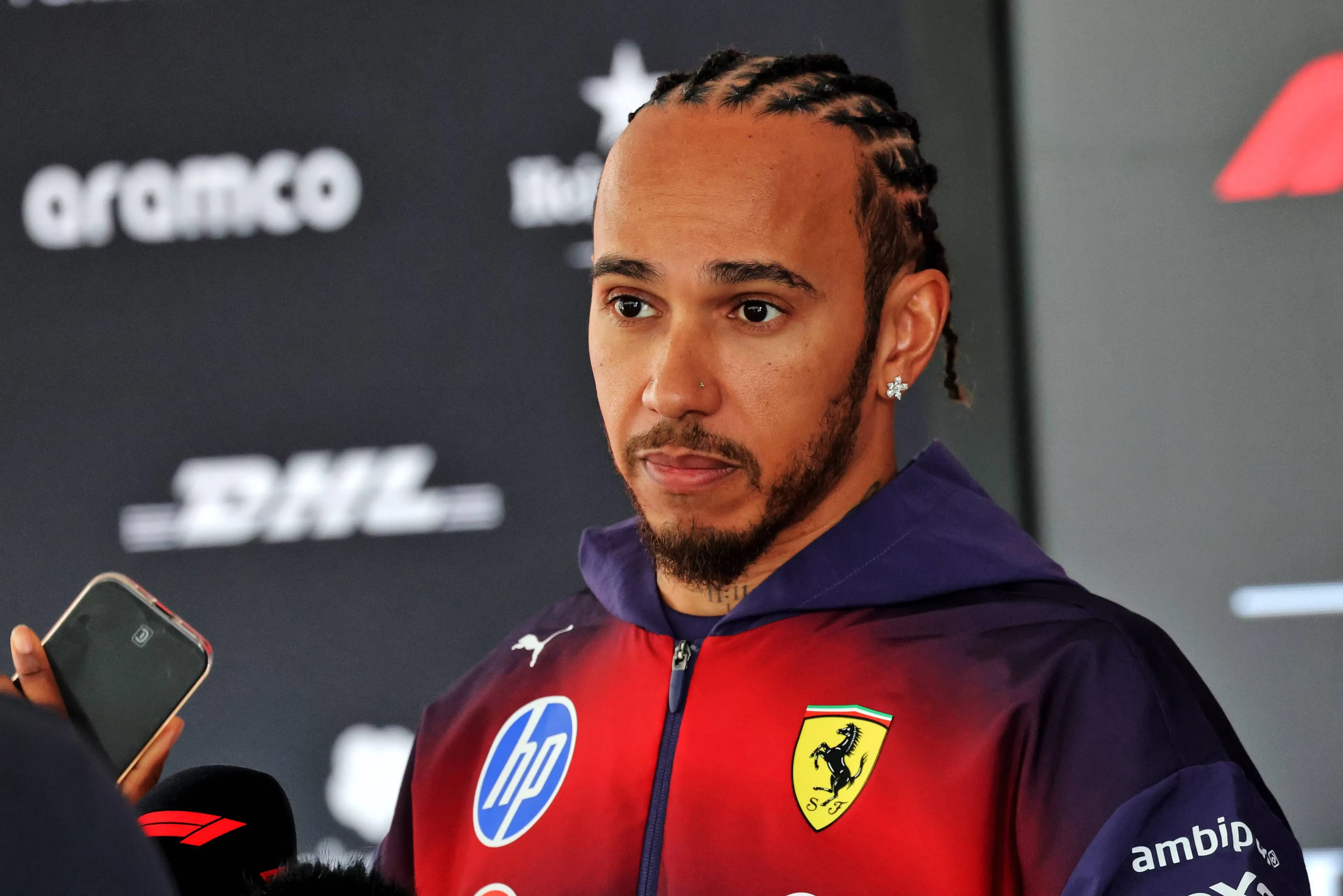
Ferrari emerged as the standout team during Friday practice at the Monaco Grand Prix, with the SF-26 showing the characteristics needed to thrive around the narrow streets of Monte Carlo.
While it remains only the opening day of the weekend, Ferrari’s performance provided genuine encouragement. The team topped both practice sessions, with Charles Leclerc leading the way in FP1 before Lewis Hamilton responded in FP2. The result was a Ferrari one-two across both sessions, albeit with the drivers reversing positions.
The SF-26 appeared well suited to Monaco’s unique demands. Strong mechanical grip, stable handling and excellent traction allowed both drivers to push with confidence through the low-speed sections that dominate the circuit.
There are still areas requiring attention. Leclerc reported that he would like greater confidence under braking, while Ferrari‘s engineers are also working to optimise performance from the soft tyre compound. Early indications suggest the car may currently be extracting more consistent performance from the medium tyres, meaning there is still potential to unlock additional pace when it matters most in qualifying.
That focus is particularly important because Monaco remains a circuit where grid position is often decisive. Fuel-load comparisons are less relevant than at other venues, making qualifying pace the primary concern heading into Saturday.
Would you like to see more TJ13 Formula 1 coverage? Add us to your favourites list on Google to receive trusted F1 news.
Verstappen could be the surprise contender
Before the weekend began, even Red Bull appeared cautious about its prospects.
On paper, Monaco should not suit the RB22’s characteristics, and expectations inside the team were relatively modest. However, Friday’s running told a different story.
Max Verstappen finished just 0.168 seconds behind Hamilton’s benchmark time in FP2, a deficit that appears entirely recoverable given the rapid evolution of the circuit throughout the weekend.
Perhaps more significantly, Verstappen sounded more comfortable with the car than expected. The Dutchman reported a better feeling in FP2, and Red Bull’s pace looked considerably more competitive than many anticipated before arriving in Monaco.
With both McLaren and Mercedes encountering difficulties on Friday, Verstappen may have positioned himself as Ferrari’s most serious challenger for pole position.
McLaren’s Monaco concerns grow
Friday proved considerably more complicated for McLaren. The team arrived in Monaco celebrating its 1,000th Grand Prix weekend and expecting the characteristics of the MCL40 to suit the Principality. Instead, the opening sessions exposed several weaknesses.
Although the McLaren has demonstrated strong traction throughout the season and possesses a shorter wheelbase than some rivals, those advantages did not translate into immediate competitiveness around Monaco’s slow-speed corners.
Team concerns regarding long-duration low-speed turns appeared to be validated. Sections such as the Fairmont Hairpin and Rascasse require drivers to carry steering lock for extended periods, an area where the MCL40 appeared less comfortable than Ferrari’s package.
The situation worsened during FP2 when Lando Norris suffered what appeared to be an electrical issue, potentially involving the battery system. The problem significantly reduced his running on a circuit where building confidence lap after lap is critical.
As a result, McLaren enters Saturday with substantial work ahead if it hopes to challenge at the front.
Traffic could become a defining factor in qualifying
One of the most significant talking points heading into qualifying is traffic management.
For 2026, the Formula 1 grid has expanded from 20 to 22 cars. While that increase may seem small, Monaco’s 3.337-kilometre layout magnifies every additional car on track.
In theory, the average spacing between cars falls from approximately 167 metres with 20 cars to around 152 metres with 22 cars. In reality, traffic is rarely distributed evenly, making clean laps increasingly difficult to achieve.
The challenge will be particularly acute in Q1, where drivers must balance finding clear track space with avoiding impeding rivals. Team strategists and race engineers will play a crucial role in managing track position during the opening stages of qualifying.
A poorly timed release or an encounter with slower traffic could easily determine whether a driver progresses to Q2.
Why Monaco may suit Formula 1’s 2026 cars
Friday also provided the first meaningful glimpse of Formula 1’s new-generation cars around Monaco.
Visually, the smaller dimensions of the 2026 machines were immediately apparent. The reduced size appears better suited to the narrow confines of Monte Carlo, even if it remains too early to judge whether overtaking opportunities will increase significantly.
Much may depend on the effectiveness of the new Overtake Mode system during Sunday’s race.
At the same time, the reduced downforce levels compared to previous generations have increased the challenge for drivers. Several competitors were seen wrestling their cars through Monaco’s tight corners, highlighting the greater emphasis on driver skill.
Teams have also taken advantage of Monaco’s unique characteristics by introducing additional wing elements in areas where the absence of Straight Mode hardware allows opportunities to generate extra local downforce.
Battery management, meanwhile, is far less problematic in Monaco due to the circuit’s heavy braking zones and lack of extended straights. The track therefore represents one of the most natural fits for Formula 1’s 2026 regulations, helping explain why Friday’s running produced such an encouraging spectacle for drivers and teams alike.
Why Friday matters
Ferrari may be trying to keep expectations under control, but Friday’s evidence suggests the Italian team has a genuine opportunity to secure pole position. Hamilton and Leclerc looked comfortable throughout the day, while Red Bull’s unexpectedly strong pace ensures Verstappen remains firmly in the conversation.
With McLaren searching for answers and traffic likely to play a decisive role in qualifying, Saturday’s battle for pole could become one of the most unpredictable and important sessions of the 2026 season so far.
Would you like to see more TJ13 Formula 1 coverage? Add us to your favourites list on Google to receive trusted F1 news.

Craig Alderson is Senior Editor at TJ13, where Craig oversees newsroom operations and coordinates editorial output across the site. With a background in online sports reporting and motorsport magazine editing, he plays a key role in maintaining consistency, speed, and accuracy in TJ13’s coverage.
During race weekends, Craig acts as desk lead, directing contributors, prioritising breaking stories, and ensuring timely publication across a fast-moving news cycle.
Craig’s work focuses heavily on real-time developments in the paddock, including team updates, regulatory decisions, and emerging controversies. This role requires a detailed understanding of Formula 1’s operational flow, from practice sessions through to race-day strategy and post-race fallout.
With experience managing editorial teams, Craig ensures that TJ13 delivers structured, reliable coverage while maintaining the site’s distinctive voice.
Craig has a particular interest in how information moves within the paddock environment, and how rapidly developing stories can be accurately translated into clear, accessible reporting for readers.
