
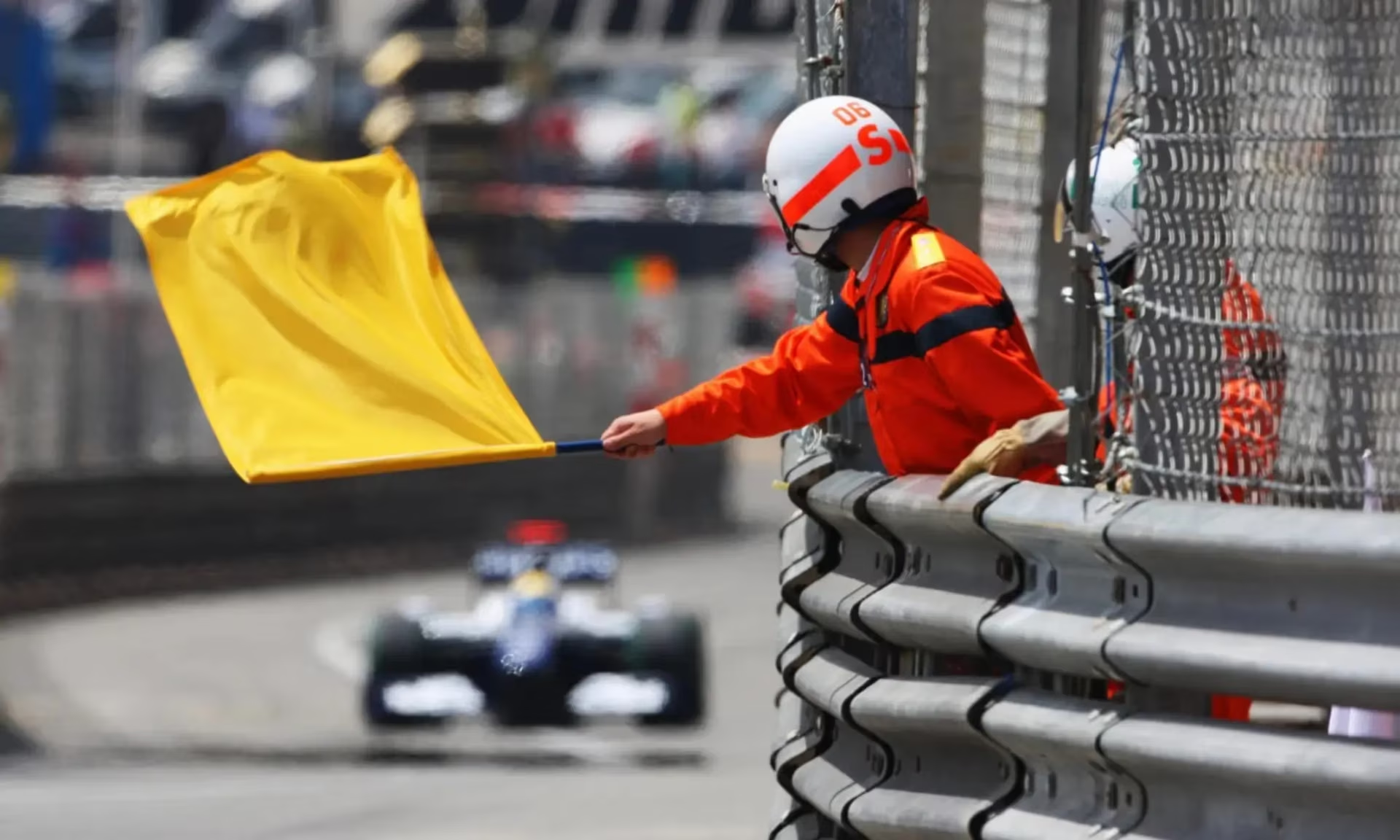
The debate over George Russell’s pole position in Austria continues to rage in the paddock. Max Verstappen lost control of his Red Bull at the penultimate corner of the Red Bull Ring and smashed into the barrier on the first of the final flying laps in Q3.
His approach to the corner was at more than 300 km/h, yet race control and the marshals only deployed a single yellow flag to cover the incident. Right behind him on track, George Russell saw the flag, obeyed the regulations, lifted from the throttle, and lost about a quarter of a second before nailing it flat out to claim pole position.
The 22-Second Delay
Some 22 seconds later, race control deemed the situation dangerous enough to upgrade the single yellow to a double yellow, meaning the remaining drivers were forced to “slow down and be prepared to stop.” All of their times for that run were deleted under the double-waved yellow regulations.
Kimi Antonelli also passed the scene before the flag was upgraded, but a misunderstanding between him and his race engineer meant the young Italian treated the situation as though it was in fact a double-waved yellow. Consequently, he did not improve on what had been a competitive time on his previous run.
A Flawed Rule Book Exposed
TJ13 slammed the FIA’s handling of the situation, as clearly any incident on the approach to Turn 9 at such high speeds should have triggered an automatic double-waved yellow flag or even an immediate red flag halting the session.
The fault, of course, was not George Russell’s, who merely made the best of a flawed rule book that must be addressed. Max Verstappen has now confirmed no blame should be attached to the Mercedes driver, indicating that given the same circumstances, he probably would have done the exact same thing.
“Now you can read the rules really well, and you complete your lap and you’re allowed to keep it. But I think, first of all, it should not have been a single yellow. That is at least a double yellow or a red,” said the Red Bull driver.
“That the driver then, of course, optimizes around it, I think that’s fair play. I probably would have tried to do the same—that’s just how it goes. But it should not even be allowed or impossible to finish your lap like that. I think that’s, for me, the main concern in all of it.”
No one is suggesting that every single incident be flagged a double-waved yellow and then immediately downgraded should race control and the local marshals deem it safe. Yet, there are certain high-speed sectors on the F1 calendar where any incident requires an immediate and maximum caution for safety reasons.
The Threat of a Free Pole Position
As it happened, Russell walked away with pole position. But had Verstappen already been sitting on the fastest provisional time before his crash, that accident would have effectively denied anyone else the opportunity to beat him. This is no tin-hat conspiracy theory, given F1’s history.
Historical Precedents of “Treachery”
Back in 2006, Michael Schumacher was on provisional pole in Monaco and was the first of the front-runners to attempt a final lap. As he approached the penultimate turn at Rascasse—with rival drivers behind him on faster sectors—Schumacher feigned a brush with the wall and stalled his Ferrari.
Out came the yellow flags, and the rest of the field were denied their final qualifying laps. The stewards were unimpressed, issuing Schumacher a heavy penalty that relegated him to a back-of-the-grid start for the Grand Prix.
The Infamous 2014 Monaco Stoppage
Then in 2014, when Mercedes had produced a car and engine package that was the class of the field, the intense rivalry between teammates Lewis Hamilton and Nico Rosberg exploded after a controversial end to qualifying.
With just over a minute of the top-ten shootout remaining, Rosberg—who was on provisional pole—locked up on the run down from Casino to Mirabeau and took to the escape road. The marshals properly flagged the sector as yellow. Hamilton, running behind on a faster lap, was forced to abort his effort.
Three hours later, Rosberg was cleared by the stewards, prompting an outspoken Hamilton to suggest he might adopt a “Senna/Prost resolution” to the situation—intimating he might drive his teammate off the track at some point later that season.
Carlos Sainz Backs the IndyCar Solution
Yet, there is a simple solution to prevent drivers from ever considering such treachery, and it is actively employed in North America’s premier single-seater racing series: IndyCar. Speaking during the media day at Silverstone, Carlos Sainz raised this exact example as a path F1 should consider moving forward.
“The way George handled it, I think, was perfect for what the rulebook allows you to do, and he deserved that pole position because he played the rules to perfection,” said Sainz. “But it should never have been allowed to finish that lap or to close a lap in that kind of dangerous situation.
“You could say, well, if Max had been on pole in the first run and then he produced that crash, and then there’s a red flag and no one improves their lap, it would be unfair for George, Kimi, and everyone—because the guy on pole is not letting us improve the lap time.”
Disincentivising the Mistake
Sainz admitted that back in his Ferrari days, when he found himself on provisional pole, the thought of “doing a Schumacher” did cross his mind. The solution?
“And for that, I think that anyone who generates a yellow flag or a red flag in qualifying should get a three-place grid drop. So at least you get penalised and you get disincentivised to cause a flag.”
When the Williams driver’s comments were put to Verstappen, the Dutchman believed an even tougher line should be taken.
“I think when someone does it deliberately, it should even be a bigger penalty than that. But from my side, of course, it was out of my control what happened there.”
The Zero-Tolerance American Playbook
In IndyCar, where qualifying for non-oval circuits is run in a similar multi-segment fashion to Formula 1, the rules are uncompromising. If a driver causes a yellow flag that affects another competitor’s push lap, they immediately lose their fastest time for that session. If the flag is red, their best two laps are deleted, and the driver is instantly barred from continuing in the session.
Furthermore, if the yellow flag prevents a rival from completing a fast lap, the guilty party is automatically blocked from advancing to the next qualifying segment.
Simple, clear rules like these mean that F1 race control would no longer have to debate how to be fair to field competitors while simultaneously exposing marshals and stranded drivers to extreme danger.
Would you like to see more TJ13 Formula 1 coverage? Add us to your favourites list on Google to receive trusted F1 news

A.J. Hunt is Senior Editor at TJ13, where Andrew oversees editorial standards and contributes to the site’s Formula 1 coverage. A career journalist with experience in both print and digital sports media, Andrew trained in investigative journalism and has written for a range of European sports outlets.
At TJ13, Andrew plays a central role in shaping the site’s output, working across breaking news, analysis, and long-form features. Andrew’s responsibilities include fact-checking, refining editorial structure, and ensuring consistency in reporting across a fast-moving news cycle.
Andrew’s work focuses particularly on the intersection of Formula 1 politics, regulation, and team strategy. Andrew closely follows developments involving the FIA, team leadership, and driver market dynamics, helping to provide context behind the sport’s biggest stories.
With experience covering multiple seasons of Formula 1’s modern hybrid era, Andrew has developed a detailed understanding of how regulatory changes and competitive shifts influence the grid. Andrew’s editorial approach prioritises clarity and context, aiming to help readers navigate complex developments within the sport.
In addition to editorial duties, Andrew is particularly interested in how media narratives shape fan perception of Formula 1, and how reporting can balance speed with accuracy in an increasingly digital news environment.

Such harsh rules have zero place in the highest level of circuit racing, as only actual deliberate acts should ever face a sporting penalty rather than genuine errors, & only Schumi’s 2006 Monaco GP act was actually deliberate; hence, he was penalized for it.
Therefore, Sainz was also unreasonable with his view.
Besides, no lap times were deleted because no one was on a flying lap anymore once single changed to double, meaning that doubles only affected everyone’s in-laps.
All things considered, keeping things unchanged is the best & fairest approach.