
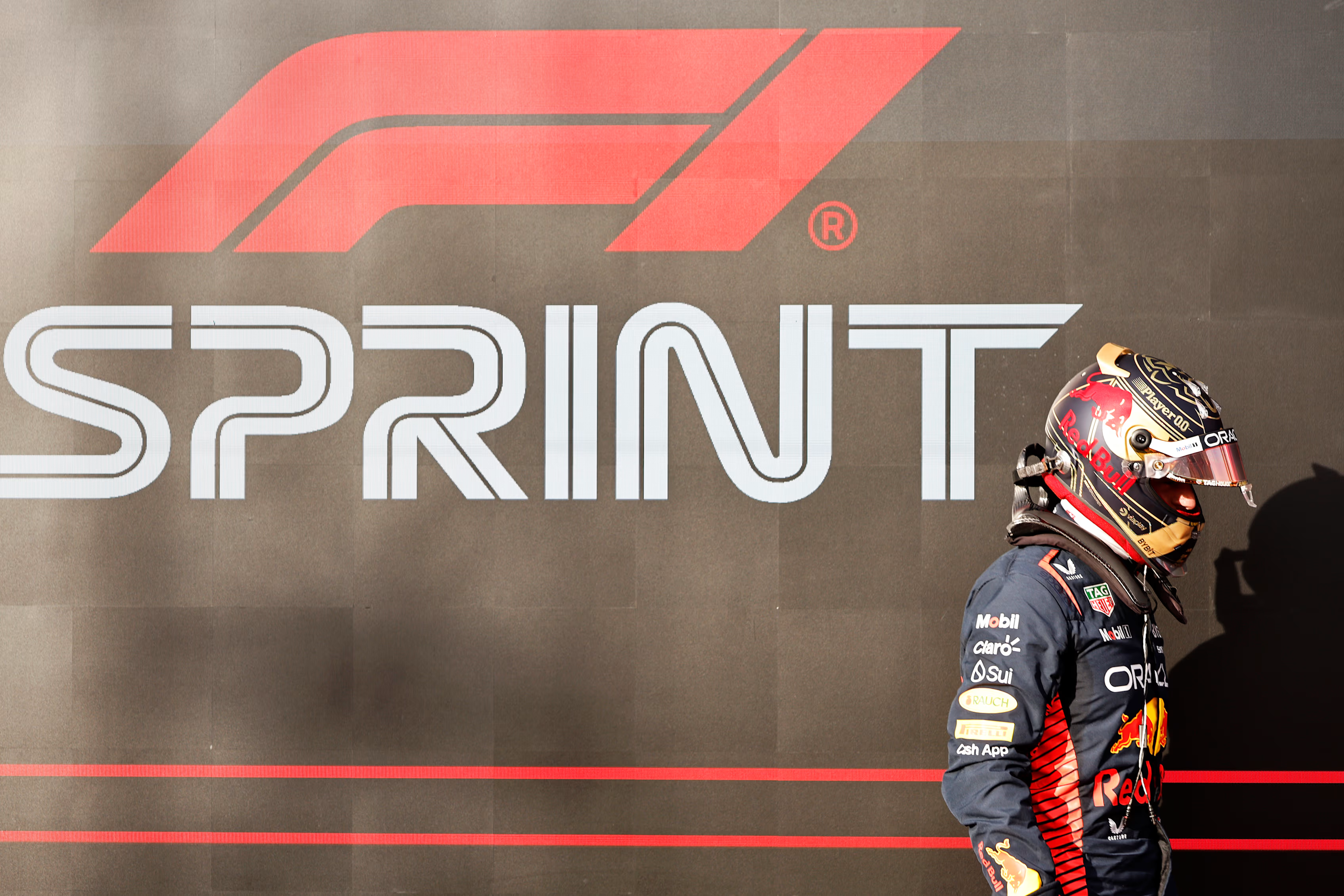
When Formula 1 introduced the Sprint format at the 2021 British Grand Prix, it triggered immediate backlash from purists, drivers, and team bosses alike. Liberty Media’s goal was simple: replace meaningless Friday practice sessions with meaningful, competitive on-track sessions for each of the three days of the event.
This would, of course, boost ticket sales and improve TV ratings for Fridays, which were previously often a damp squib. However, the execution created several massive points of friction. Here are the main reasons the F1 Sprint was so controversial upon its arrival.
Low Payouts and High-Stakes Risks
In year one, only the top three drivers in the Sprint scored points, and they were minimal: three for first place, two for second, and one for third. Clearly, drivers were not going to push to the absolute limit and risk smashing their Grand Prix race cars into pieces for such minimal rewards.
Further, many felt pole position for the Grand Prix had been diminished given this was set by the finishing order of the Sprint race itself. Again, the risk of destroying their Grand Prix machinery meant drivers took on the Sprint in a conservative fashion, leading to processional rather than exciting racing.
The Sprint schedule radically altered the engineering workflow. Teams were granted just one 60-minute practice session on Friday morning before being thrown straight into qualifying. As soon as Friday qualifying began, the cars entered Parc Fermé conditions—meaning teams were legally locked into their mechanical setups for the rest of the weekend. If a team miscalculated their ride height or wing angles in FP1, their entire weekend was effectively ruined before Saturday’s sunrise.
The 2021 season also marked the introduction of F1’s strict financial cost cap. Team principals (particularly Christian Horner and Toto Wolff) pointed out that adding an extra racing start increased the likelihood of expensive crash damage. Smaller teams worried that a single multi-car accident during a Saturday Sprint could completely wipe out their development budget for the final quarter of the season.
Points tweaked
Tweaks came in 2022 to resolve some of the bugbears. The driver quickest in Friday qualifying was now the official pole sitter for the Grand Prix, which restored the value attached to being awarded such a prize for the history books.
Further, points were awarded from first to eighth place in an effort to make the Sprint a more meaningful event and press the teams and drivers to try harder. Yet there remained a redundant practice session on Saturday morning which, for most, felt like a waste of time.
Shifting Formats and the Verstappen Critique
Come 2023, the Sprint became a standalone event with its own qualifying session and race, with Grand Prix qualifying being restored to Saturday afternoon. Further, after the Saturday morning short-form race, the cars were deemed no longer to be in Parc Fermé, allowing the engineers to reconfigure their balance to correct for any mistakes made during FP1.
Given the commercial success for the race promoters, the number of Sprint events was increased to six for the 2023 year, although not all the drivers were happy about this move. For Max Verstappen, a Grand Prix weekend should build anticipation toward a single crescendo on Sunday afternoon. He argued that running a mini-race on Saturday completely gives the game away.
“For me, the Sunday is then a bit taken away,” Verstappen explained. “When you do all these kinds of things, you already know what’s going to happen tomorrow between all the cars in terms of race pace, so it takes away that magic of waking up on Sunday morning and wondering: ‘How is our race pace going to be? Who is going to be quicker?'”
Ironically, prior to the start of the 2026 season, of the 24 Sprint races held since its inception, Max Verstappen claimed victory in 13. This year’s winners are George Russell in China, Lando Norris in Miami, and Russell again at the recent Canadian Grand Prix.
Sprints to double to 12 in 2027
With Silverstone receiving its first Sprint weekend format since the inception of the racing series back in 2021, the promoters have sold out a record 565,000 tickets across the weekend—the highest ever for an F1 three-day event.
After practice one, where Lewis Hamilton was quickest by far, TJ13 sources in the paddock reveal that for 2027, the Sprint format will be expanded to include double the number of venues of the current season. Twelve Sprints will take place next season, yet which venues will host these weekends remains unknown.
The last time FOM presented this idea to the F1 Commission, it was ruled out by the FIA, which claimed their resources were already stretched thin. More racing each weekend, they argue, requires more scrutinizing of the cars and places greater stress on race control and the stewards. Clearly, FOM has stumped up a few million more to overcome the FIA’s objections.
More Sprint tweaks considered
Further, the teams are likely to have received some concessions. They are strictly restricted on the number of paddock personnel they are allowed each weekend. This will be a lever to get that number increased, along with a relaxation of further technical rules.
The incremental mechanical wear and tear on the F1 cars as they push flat out for six more Sprint races means their power units are likely to be pushed beyond the tolerance limits for which they were designed. Further, there is a higher likelihood of a car crashing during a race than when collecting data during a practice session, so presumably budgets and cost caps will also be increased.
Ideas under discussion to improve the Sprint include extending the race beyond its current 100 km and forcing the teams to use both soft and medium tires, creating more interest in strategy. Currently, the teams run the medium tire and, given the race is so short, make no strategic tire changes.
Indycar style stop ten shootout
One further suggestion is to switch up the top ten qualifying session in the Sprint to something similar used by IndyCar when they race on an oval circuit.
There, the drivers who have qualified for the top ten go out one by one, from the slowest qualifier to the fastest. They are allocated one out-lap, one fast-lap attempt for pole, and an in-lap.
Would you like to see more TJ13 Formula 1 coverage? Add us to your favourites list on Google to receive trusted F1 news

The Judge, a nom de plume of an experienced F1 journalist and site founder with long-standing sources across the paddock. With over 30 years of experience in Formula 1 as an insider journalist, I have built trusted connections across the paddock, from race engineers and mechanics to senior team figures. At The Judge 13, I and a handful of trusted colleagues share exclusive Formula 1 news, expert analysis and behind-the-scenes stories you will not find in mainstream motorsport media.

Can we just get rid of the sprints. If we keep them, they need to be limited to as few races as possible.
Let’s do away with sprints qualifying by having the drivers draw their starting position out of a hat.
I feel like sprint races are best when they’re an occasional treat, not a regular thing. Otherwise the weekend schedule gets too often cluttered and frankly, getting anything else done is too hard.
Keep it as a special occasion to be savoured, not ”the norm”
Nothing shocking, as doubling the amount for next season has been all but confirmed for some time, although I quite like the tweak ideas mentioned here.