
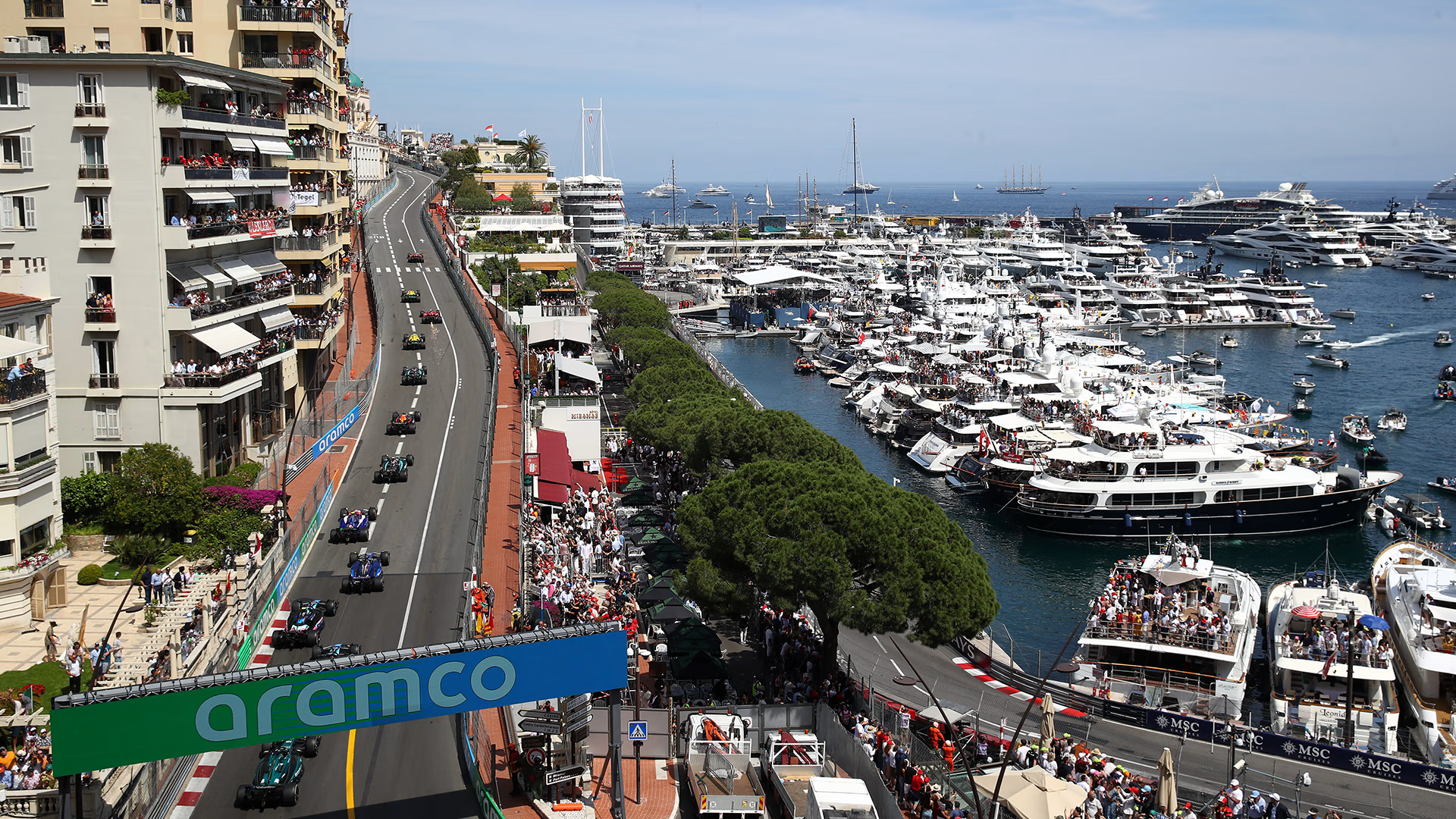
The much-maligned 2026 Formula One cars are set to tackle the streets of Monaco this weekend, and for the first time this season there may be little debate about “super-clipping” and “lift-and-coast,” together with cars running out of battery halfway along the straights.
While being one of the most iconic circuits on the calendar, in the last half a century the racing in the Principality has often been sterile. As the cars continued to grow bigger and wider, with ever more powerful acceleration and braking capabilities, the narrow, winding streets of Monaco did not offer much in the way of overtaking opportunities.
The Struggle for Sunday Spectacle
Such was the processional nature of the 2024 Grand Prix de Monaco that, for the first time in history, the drivers who finished in the top ten did so in the exact same order they started the race. The weekend in the Côte d’Azur was becoming such a turn-off for fans that discussions have been held over changing the layout of the historic circuit.
The importance of qualifying on Saturday has become critical for the drivers, given that since the last modification to the circuit in 2003, only three times has a race not been won from the front row. In fact, out of the 23 races held in Monaco since 2003, 16 were won directly from pole position. Failing to start on the front row makes winning Monaco almost statistically impossible without heavy rain, safety cars, or critical pit-wall errors.
2026 Regulations: An Unintentional Blueprint for Monaco
Yet there is hope that things will change at the upcoming weekend for the 2026 Monaco Grand Prix. In what most considered to be the biggest regulation change in the sport’s history, both new power units and chassis were introduced ahead of this season. Given Monaco is a major outlier on the calendar in terms of circuit style, the regulations were not made with this event in mind, but it may turn out to be a track where the changes have a major impact.
The chassis regulations have created smaller cars which are also easier to follow closely, with both elements potentially creating opportunities at the extremely tight circuit.
The power-unit changes, focused on improving sustainability, saw an increase to 50 percent electronic power—a move that has proved highly contentious due to the challenges drivers have faced in ensuring they have sufficient power to drive flat out for an entire lap. Monaco’s combination of having many slow corners and relatively few straights means recharging the battery is not expected to be an issue, allowing drivers to push without concern.
Optimism in the Paddock
Few know the circuit better than Charles Leclerc, who grew up on the streets he now gets to race his Ferrari around, and finally claimed a maiden home race victory in 2024 after securing a third pole position in Monaco. In fact it is Leclerc’s bad luck in his own back yard that has meant the ratio of pole to wins is not even higher.
“I think Monaco is actually going to be one of those races where these cars might be very good,” Leclerc said. “We now have lighter cars, which I think is a good thing, we can definitely feel that and, for a track like Monaco, this has its benefits.
“I think the electric side is going to be a lot less big in Monaco just because we’ll be recharging quite a bit with all the corners that there are. So, I’m quite excited for Monaco, it should be a good track for these cars.”
World championship leader Kimi Antonelli was even more bold in his prediction for the race, suggesting he thinks overtaking will be possible.
The 19-year-old Italian will arrive in Monaco with a 43-point lead over his Mercedes teammate George Russell at the top of the standings, but the unique nature of the circuit means the Silver Arrows could face a major challenge in attempting to extend the five-race winning streak they have begun the season with.
“We may see some overtaking because cars are smaller,” Antonelli said. “Of course, you will still have to commit massively to make the move stick, but I think it’s not going to be impossible. I also think it’s going to be more fun to drive the car around the track.
“It’s going to be interesting with the smaller cars, with the battery. Obviously there were talks with the FIA with closing speeds. I think Monaco is not going to be an issue [for that] because it’s super easy for the battery because you don’t have long straights, so we won’t face that issue at all on track.”
Redefining the Chasing Pack
Mercedes are not expected to have it all their own way this weekend for two reasons. Firstly, Ferrari, while lacking the outright power of the Mercedes power unit, have an engine which accelerates quickly from a standing start and out of the slower, low-traction corners.
McLaren too are in with a chance; despite running the same Mercedes engine, they have elected to run shorter gear ratios than the Brackley-based squad, so they again have good acceleration when compared to the beast that is the W17.
Pushing to the Absolute Limit
Perhaps the most consistent complaint from drivers about the new regulations has been regarding the power units preventing them from pushing flat out on qualifying laps. The drivers need to alter their approach to corners to ensure they have sufficient charge to push for the entirety of straights. Just about every driver on the grid appears to agree this is not right, and that qualifying, and to a lesser degree the race, should be about pushing to the limit.
Reigning world champion and last year’s Monaco winner Lando Norris says that while the drivers will still be occupied by the intricacies of the new power units, pushing flat out should not be a problem.
“Monaco might be one where you can just push flat out confidently knowing that there are no issues,” the McLaren driver said in Canada. “But you’re still going to be thinking of gears, revs, boost pressure, all of these things in every corner.
“I have not done it on the simulator yet so I don’t know how many complications come from some of those issues at times, but there’ll certainly be fewer issues by having to be at the top of the pack before long straights and things like that. But Monaco is always special no matter what car you’re in, no matter how much electricity you’ve got in it or not. Certainly, Monaco is one of the ones, especially qualifying, you look forward to more than anything.”
A Litmus Test for F1’s Future
Ultimately, the 2026 Monaco Grand Prix stands as a critical litmus test for Formula 1’s controversial new regulations. By shrinking the physical footprint of the chassis and minimizing the power unit’s dependency on long straights for battery deployment, the sport has inadvertently tailored its rules to thrive in the tightest confines on the calendar.
While the ghost of 2024’s processional race still haunts the paddock, the genuine optimism shared by frontrunners like Leclerc, Antonelli, and Norris suggests Sunday could offer a drastically different story.
Would you like to see more TJ13 Formula 1 coverage? Add us to your favourites list on Google to receive trusted F1 news.

The Judge, a nom de plume of an experienced F1 journalist and site founder with long-standing sources across the paddock. With over 30 years of experience in Formula 1 as an insider journalist, I have built trusted connections across the paddock, from race engineers and mechanics to senior team figures. At The Judge 13, I and a handful of trusted colleagues share exclusive Formula 1 news, expert analysis and behind-the-scenes stories you will not find in mainstream motorsport media.

A.J. Hunt is Senior Editor at TJ13, where Andrew oversees editorial standards and contributes to the site’s Formula 1 coverage. A career journalist with experience in both print and digital sports media, Andrew trained in investigative journalism and has written for a range of European sports outlets.
At TJ13, Andrew plays a central role in shaping the site’s output, working across breaking news, analysis, and long-form features. Andrew’s responsibilities include fact-checking, refining editorial structure, and ensuring consistency in reporting across a fast-moving news cycle.
Andrew’s work focuses particularly on the intersection of Formula 1 politics, regulation, and team strategy. Andrew closely follows developments involving the FIA, team leadership, and driver market dynamics, helping to provide context behind the sport’s biggest stories.
With experience covering multiple seasons of Formula 1’s modern hybrid era, Andrew has developed a detailed understanding of how regulatory changes and competitive shifts influence the grid. Andrew’s editorial approach prioritises clarity and context, aiming to help readers navigate complex developments within the sport.
In addition to editorial duties, Andrew is particularly interested in how media narratives shape fan perception of Formula 1, and how reporting can balance speed with accuracy in an increasingly digital news environment.
