
As much as the teams, drivers and F1 broadcasters tell the fans the racing is great in 2026, there is a massive problem with the all new F1 racing this year. Yes the race starts have been filled with drama, as the Ferrari’s with their small designed turbo’s launch off the line ahead of the Mercedes cars, but once the sugar rush fades the spectacle becomes mundane.
The problem is with the all new hybrid powertrains which manufacturers like Honda and Audi insisted must have a 50/50 power split between the battery and the internal combustion engines (ICE). Basically, the amount of power demanded from the battery has been set too high and so the cars a running out of charge and slowing down in strange locations.
Back in the summer of 2023, the then Red Bull Racing team boss, Christian Horner, claimed that simulations performed in Milton Keynes had revealed this state of affairs. He described the incoming cars as “Frankenstein monsters” which would need to merely use the ICE as a power generator at times.
Christian Horner predicted the F1 energy management crisis
At the time he was mocked by Toto Wolff who claimed Horner’s “complaints” stemmed from the fact the Red Bull Powertrain programme in its infancy was not fairing well. Yet hey presto, Horner was right and Charles Leclerc’s qualifying lap in China is all the proof anyone needs that radical changes are needed from the FIA.
The Ferrari driver is one of the finest qualifiers amongst the current crop of F1 competitors. The 28 year old Monegasque has 27 pole positions to his name although his win rate of just 8 Grand Prix is an indictment on how Ferrari have built their previous cars.
During Sprint qualifying in China, Leclerc suffered a slide at the rear of his SF-26. This is nothing unusual given the drivers leave it all out there on track in an effort to claim pole position. Yet Charles’ response to the slide set in motion a host of automatic algorithm defined electrical procedures which to cut a long story short left him well down on electrical power for the long back straight.
In effect, the computer decided it was time to deploy full power after Leclerc’s response of lifting for the slide. But through turn 10/11 in Shanghai, this is not the most efficient place for that deployment to take place. So it was nothing to do with Leclerc that his SF-26 had less electrical power on the back straight than his previous run. Its all in the algorithm.
Red Bull factory concerns as Verstappen reportedly wants to join Mercedes: “He will look for a way”
Leclerc’s Ferrari takes over in qualifying
Post the session, Charles Leclerc bemoaned the the all new cars and powertrains. “They are very strange in qualifying.
I felt in the past one of my strengths was that, come Q3, I was just taking massive risks to get something out more, and now when you do that you start confusing the engine side of things. You start losing a lot more than what you gained. So, consistency pays off more…which is a little bit less exciting inside the car for Q3, because you cannot push as much as you would want.”
And Leclerc was not alone in suffering a similar incident, Haas Esteban Ocon also decelerated too much for the liking of the computer. This resulted in his car deploying too much power in the wrong place rather than saving it for the long back straight.
“I did a very good lap, the corners were all very well-optimised, but for some reason because I was not at 100% throttle at the right place, I was at 97%, I lost three tenths on the back straight,” revealed Ocon. “That’s where that shouldn’t happen.”
Why Pirelli’s 2026 tyre choices are failing to deliver exciting F1 races
McLaren boss critical of the FIA
There were a number of car debacles which took place at the season opener in Melbourne. One included home boy Oscar Piastri who was hijacked by his computer which decided to light up the rear tyres mid-corner, spinning him into the barrier on the way to the grid.
The FIA decided an urgent meeting was required with potential regulation changes coming before round three at the Japanese Grand Prix. Yet given to the causal onlooker, the weekend in Shanghai passed off without too much drama, the discussion was kicked into the long grass and no changes will be enforced this coming weekend.
Now under pressure from a number of senior paddock individuals, the FIA will engage with all the F1 participants in a pow wow to sort out the current on track malaise both the drivers and fans are suffering.
McLaren team boss, Andrea Stella was critical in China of the artificial nature of the new F1 racing and the fashion in which the drivers must change their inputs to one’s which are unfamiliar in any form of racing. “Do we accept that this counterintuitive situation belongs to the business or not?” he said. “I think this is more of a high-level philosophical question. I think fans are a part of this in finding the answer, but above all, drivers are a part of this in finding the answer. So I think it’s for F1 and the FIA now to collect the feedback, and create a picture,” Stella concluded.
Leaked Rant at Aston Martin: Stroll furious with Adrian Newey
The 50/50 power split MUST change
Whilst fans are divided over the quality of the new racing, they are unanimous in their opinions that qualifying should see drivers travelling flat out. There are a number of solutions the FIA can take to return qualifying to its pride of place. The amount of electrical energy allowed over a single lap can be reduced, although this inevitably means the cars will travel more slowly, although the drivers will be properly pushing.
A little more complex but eminently possible with minimal changes to the powertrain architectures would be to up the fuel flow and make the ICE more powerful. However, given the FIA’s drive towards F1 net zero in 2030, burning more fuel may be an anathema to those pushing the green agenda.
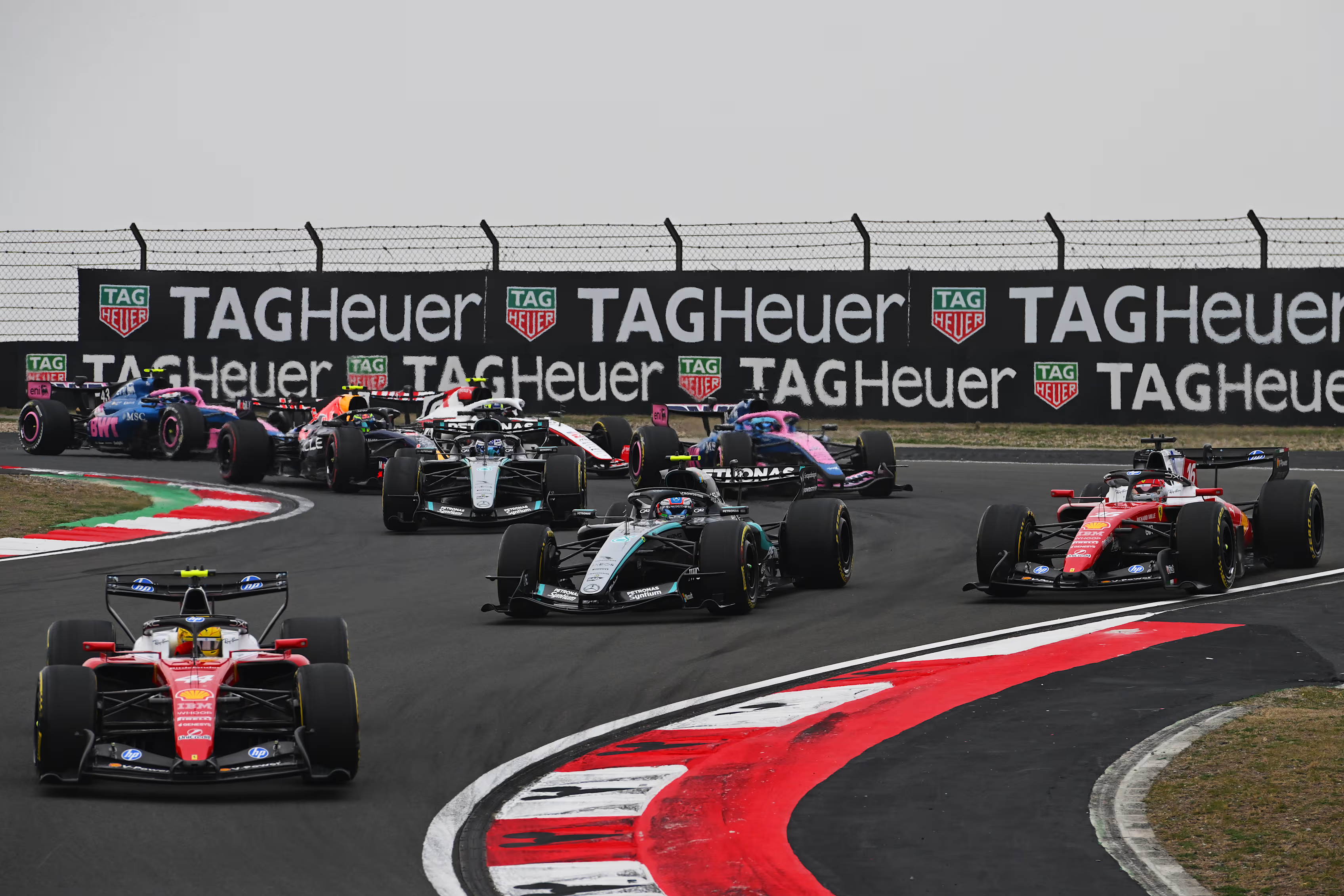
Whilst these actions would improve qualifying no end, the matter of the Grand Prix is a completely different matter. Currently we see lots of battles early in the race, before it settles down into the order of 1-2 Mercedes, 3-4 Ferrari, 5… the rest of the field.
Ferrari protest Mercedes front wing legality
Sugar rush F1 racing will fade away
One of the reasons Kimi Antonelli was able to claim his maiden victory in China, was because his team mate qualified out of position. In the early stages of the race, Russell was embroiled with battling the two Ferrari cars whilst Kimi Antonelli optimised his energy for the best lap times and pulled away at around a second a lap.
Battling for lap after lap – as did Hamilton, Leclerc and Russell in Shanghai – is very inefficient on the electrical energy deployment. As Leclerc already stated, “consistency” is the best way to achieve the optimum lap time.
It won’t take long for the engineers in the teams to realise they need to take the long view of the race and instruct their drivers to desist from the early race battles we are seeing presently. Then the FIA will have to address the regulations again to prevent Grand Prix becoming mere glorified time trials.
NEXT ARTICLE: A deeper dive into Mercedes’ treatment of George Russell as “temporary”
Last Updated on March 25 2026, 12:58 pm
George Russell is the bookmakers odds on favourite to win the 2026 drivers’ Formula One championship. Mercedes have hit the ground running, and faster than everyone else, under the all new FIA technical and sporting regulations.
Mercedes have won all three races across the first two weekends of the year, with Russell claiming victory in Australia and the Sprint event in China. Kimi Antonelli scored his maiden victory in the Chinese Grand Prix, although he benefitted from a mechanical gremlin suffered by Russell in qualifying which handed the young Italian pole position and the ultimate win on Sunday afternoon.
The fact Mercedes have completed 1-2 finishes on both Grand Prix this year is a statement of how far ahead of the field they are. In the history of Formula One, 1-2 finishes at the opening two rounds of a championship has happened just six times. In 1950 and 1952 there was no contractors’ championship, but one of the drivers finishing in the 1-2 for Alfa Romeo and subsequently Scuderia Ferrari went on to win the drivers title….. CONTINUE READING


The Judge, a nom de plume of an experienced F1 journalist and site founder with long-standing sources across the paddock. With over 30 years of experience in Formula 1 as an insider journalist, I have built trusted connections across the paddock, from race engineers and mechanics to senior team figures. At The Judge 13, I and a handful of trusted colleagues share exclusive Formula 1 news, expert analysis and behind-the-scenes stories you will not find in mainstream motorsport media.

A.J. Hunt is Senior Editor at TJ13, where Andrew oversees editorial standards and contributes to the site’s Formula 1 coverage. A career journalist with experience in both print and digital sports media, Andrew trained in investigative journalism and has written for a range of European sports outlets.
At TJ13, Andrew plays a central role in shaping the site’s output, working across breaking news, analysis, and long-form features. Andrew’s responsibilities include fact-checking, refining editorial structure, and ensuring consistency in reporting across a fast-moving news cycle.
Andrew’s work focuses particularly on the intersection of Formula 1 politics, regulation, and team strategy. Andrew closely follows developments involving the FIA, team leadership, and driver market dynamics, helping to provide context behind the sport’s biggest stories.
With experience covering multiple seasons of Formula 1’s modern hybrid era, Andrew has developed a detailed understanding of how regulatory changes and competitive shifts influence the grid. Andrew’s editorial approach prioritises clarity and context, aiming to help readers navigate complex developments within the sport.
In addition to editorial duties, Andrew is particularly interested in how media narratives shape fan perception of Formula 1, and how reporting can balance speed with accuracy in an increasingly digital news environment.
