
Max Verstappen hurtled into the barrier at the final corner, pushing his Red Bull car to the absolute limit in a vain attempt to claim pole position. This section of the Red Bull Ring has the highest cornering speeds of the complete lap, with the cars approaching Turn 9 traveling at 300–310 km/h (186–192 mph).
As the drivers rotate their cars through the unforgiving turn, the speed at the apex remains an eye-watering 250 km/h (155–161 mph) as they lift briefly before taking the final corner flat out. Clearly, a loss of grip even for an instant is fatal for an F1 car, as Verstappen’s Red Bull demonstrated.
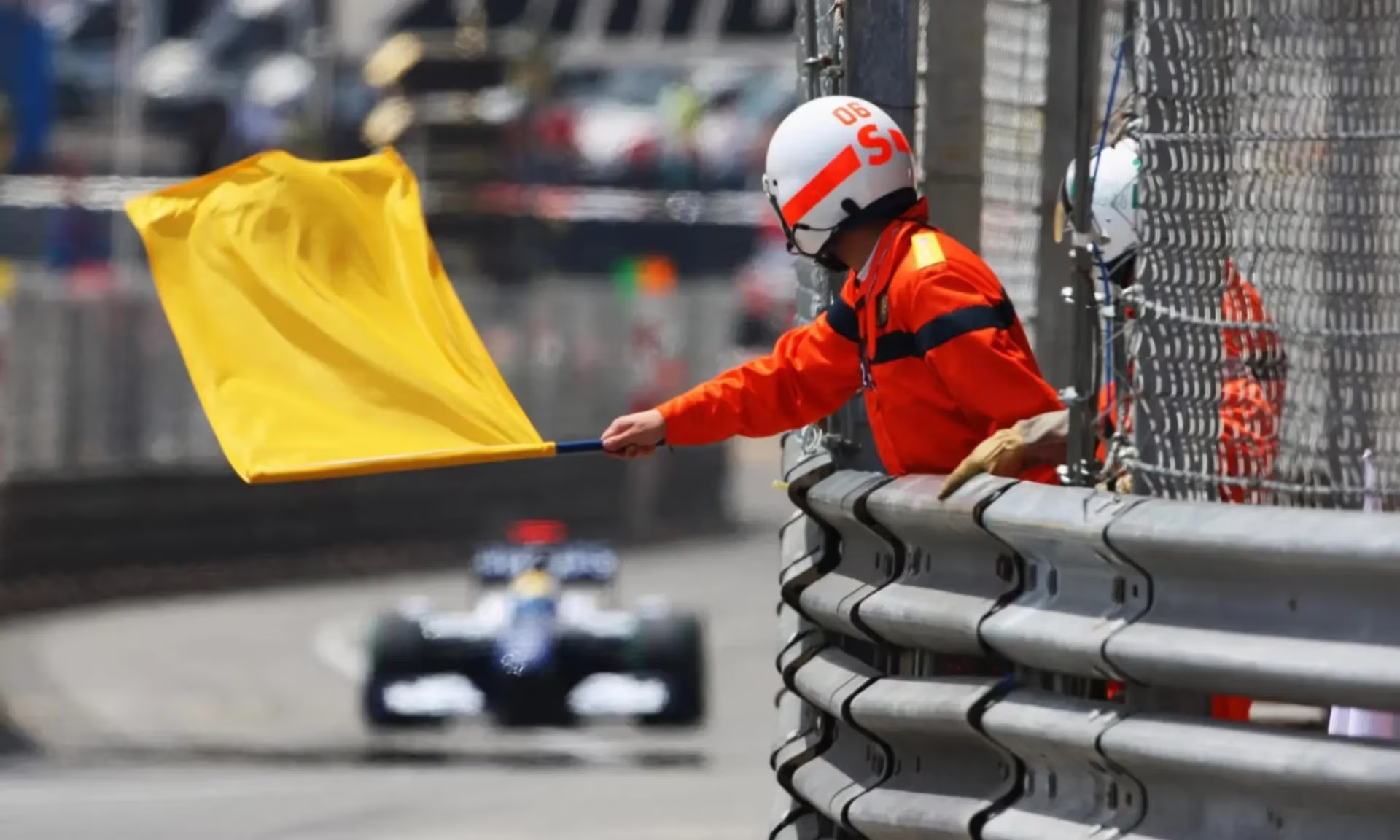
The danger of another car losing control in a similar fashion was immediately obvious to anyone who has a modicum of an understanding of motor racing. Race control deployed a single yellow danger flag instantly.
Article 26.1
In the FIA regulations under GENERAL SAFETY, Article 26.1 states:
“A. Single Waved Yellow Flag: Any driver passing through a waved yellow flag marshalling sector must reduce their speed and be prepared to change direction. In order for the stewards to be satisfied that any such driver has complied with these requirements they are expected to have braked earlier and/or discernibly reduced speed in the relevant marshalling sector.”
Yet George Russell, who was languishing in the middle of the top-ten shootout and next on track behind Verstappen, managed to complete his lap, passing the stricken Red Bull and claiming pole from Charles Leclerc by what in F1 terms was a massive quarter of a second. His improvement from his previous run was nigh on half a second.
Behind him, a number of drivers were on their final push lap, and the expectation of most fans and analysts would be that the broken Red Bull would instantly mean—for safety reasons—they would all, including Russell, be forced to slow and lose their final Q3 run.
The 22-Second Delay to a Double Yellow
And indeed, no other driver improved their times. Back at race control, some 22 seconds after the incident, the race director upgraded the yellow flag to a double-waved yellow flag. Again, Article 26.1 b) is very clear about what this means:
“Double Waved Yellow Flag: Any driver passing through a double waved yellow flag marshalling sector must reduce speed significantly and be prepared to change direction or stop. In order for the stewards to be satisfied that any such driver has complied with these requirements it must be clear that the driver has not attempted to set a meaningful lap time on the relevant lap. Furthermore, during a sprint qualifying or qualifying session, any driver passing through a double waved yellow flag marshalling sector will have that lap time deleted.”
Russell’s teammate, Kimi Antonelli, also passed the Red Bull while only the yellow flag was showing, but he misinterpreted it as a double-waved yellow and obeyed the appropriate regulation. The rest of the field were forced to abandon their final pole shootout laps.
Despite expectations, Russell retained his lap time and claimed pole position for the 2026 Austrian Grand Prix, and it appears his instant reactions and clear mind managed to interpret what now appear to be utterly ridiculous and dangerous safety rules from the FIA as he passed the yellow flag.
Russell Explains the “100-Metre Lift”
Speaking after the session, with the stewards having confirmed Russell had not broken the yellow flag regulations, the Mercedes driver explained the events as they evolved in front of him.
“The lap was unbelievable and then obviously I got the single yellow in the last sector but I did a 100-meter lift, lost a huge amount of time… I don’t have the answer for sure, where it came from, but it felt very sweet,” Russell said.
“It’s a corner where you can see quite a lot, a huge lift and I was going to assess the situation as soon as I got to the corner, if the car was there. As it was a single yellow, I was pretty confident there was no danger. As soon as I turned into the corner, I already saw the green up ahead. I actually thought the car had continued, because I didn’t see the car; it was so far off the track, I didn’t see the car whatsoever. It was only when I saw the replay after I saw it was well off into the wall.”
Doing the Math on a “Discernible” Slowdown
We do not have the exact details of the loss of speed Russell experienced from his “100-meter lift,” although he did admit prior to the corner his dashboard showed he was half a second up on the pole time and only a quarter of a second after his lift. Some medium-difficulty math would suggest that this is a speed reduction of 25 km/h from a car traveling at 250 km/h.
This does not pass the yellow flag regulation test of “discernibly reduced speed in the relevant marshalling sector.” Yet this is not Russell’s fault but that of the FIA, who fail to interpret and police their regulations properly. Furthermore, it is nigh on impossible to “change direction” through Turn 9 at such speeds—another stipulation of the yellow flag rules.
The nature of this incident should have received an immediate double-waved yellow flag rather than a single yellow, given the speeds involved and the likelihood that all the drivers would be pushing hard on their final qualifying lap.
Lessons Unlearned: Safety vs. Entertainment
Since the death of Ayrton Senna and, more recently, Jules Bianchi, the FIA have preached safety until they are blue in the face. Yet it appears they have an operational issue in their ability to signal danger to drivers on track.
It may be necessary to ensure in the future certain corners, such as Turn 9 at the Red Bull Ring, are instantly flagged as double-waved yellows when an incident occurs in that sector. Whatever the hazard, a car approaching the turn at over 300 km/h is immediately in peril or at risk of creating it.
In North America’s premier single-seater racing series, IndyCar, race control pre-empts the corners where any kind of incident will immediately be flagged as a “full-course yellow,” resulting in the deployment at once of a safety car.
In F1, race control do make an effort not to intervene as much during qualifying sessions as they would do in a race, in an attempt to ensure fairness to all drivers. Yet their number-one job is safety, and yesterday their decisions were both dangerous and ridiculous to even the newest F1 fan. They were also unfair to all the drivers other than George Russell.
Would you like to see more TJ13 Formula 1 coverage? Add us to your favourites list on Google to receive trusted F1 news.

A.J. Hunt is Senior Editor at TJ13, where Andrew oversees editorial standards and contributes to the site’s Formula 1 coverage. A career journalist with experience in both print and digital sports media, Andrew trained in investigative journalism and has written for a range of European sports outlets.
At TJ13, Andrew plays a central role in shaping the site’s output, working across breaking news, analysis, and long-form features. Andrew’s responsibilities include fact-checking, refining editorial structure, and ensuring consistency in reporting across a fast-moving news cycle.
Andrew’s work focuses particularly on the intersection of Formula 1 politics, regulation, and team strategy. Andrew closely follows developments involving the FIA, team leadership, and driver market dynamics, helping to provide context behind the sport’s biggest stories.
With experience covering multiple seasons of Formula 1’s modern hybrid era, Andrew has developed a detailed understanding of how regulatory changes and competitive shifts influence the grid. Andrew’s editorial approach prioritises clarity and context, aiming to help readers navigate complex developments within the sport.
In addition to editorial duties, Andrew is particularly interested in how media narratives shape fan perception of Formula 1, and how reporting can balance speed with accuracy in an increasingly digital news environment.

I’m sorry – but does GR slip the Marshall’s brown envelopes before EVERY GP (but forgot to in Monaco, apparently!) or something???
How DOES he seemingly ALWAYS get away with a “no further investigation” outcome?? AND – if he really DID feel he was obeying the Rules – WHY the need to be saying over the radio that it was a single yellow, he HAD lifted off, etc etc … ? IT STINKS!
He’s an embarrassment to sportsmanship. Send him to the back of the grid (but preferably OUT of F1 altogether). Sickening
No it’s not sickening George is a bright boy and knows the rules much better than most
and will probably win F1 title this year