
The Ghost of Albert Park to return? A lot of water has passed under the bridge since the opening round of the 2026 Formula One season at Albert Park. The Grand Prix start itself nearly resulted in a catastrophic accident; due to the new turbo-lag dynamics and tricky energy harvesting of the 2026 engines, several drivers suffered terrible launches or completely ran out of battery deployment immediately off the line.
The extreme speed differences on the straights, caused by cars running out of electric deployment while others were at full power, sparked a severe backlash from drivers like Lando Norris, who warned someone was going to “go over the fence.”
Prior to the fourth round in Miami, the FIA tweaked the harvesting and deployment rules to reduce some of the drastic on-track speed differentials, and the subsequent races appear to have been more about the racing and less about the extreme nature of the sport’s new hybrid rules.
Running on Empty: The Silverstone Problem
However, Silverstone will be the first time the all-new F1 cars will again be exposed to a high-speed circuit which is relatively energy-poor in terms of recovering kinetic power. There is no heavy braking zone like Turns 1 and 9 in Barcelona, so recovering electrical energy will be tough for the drivers.
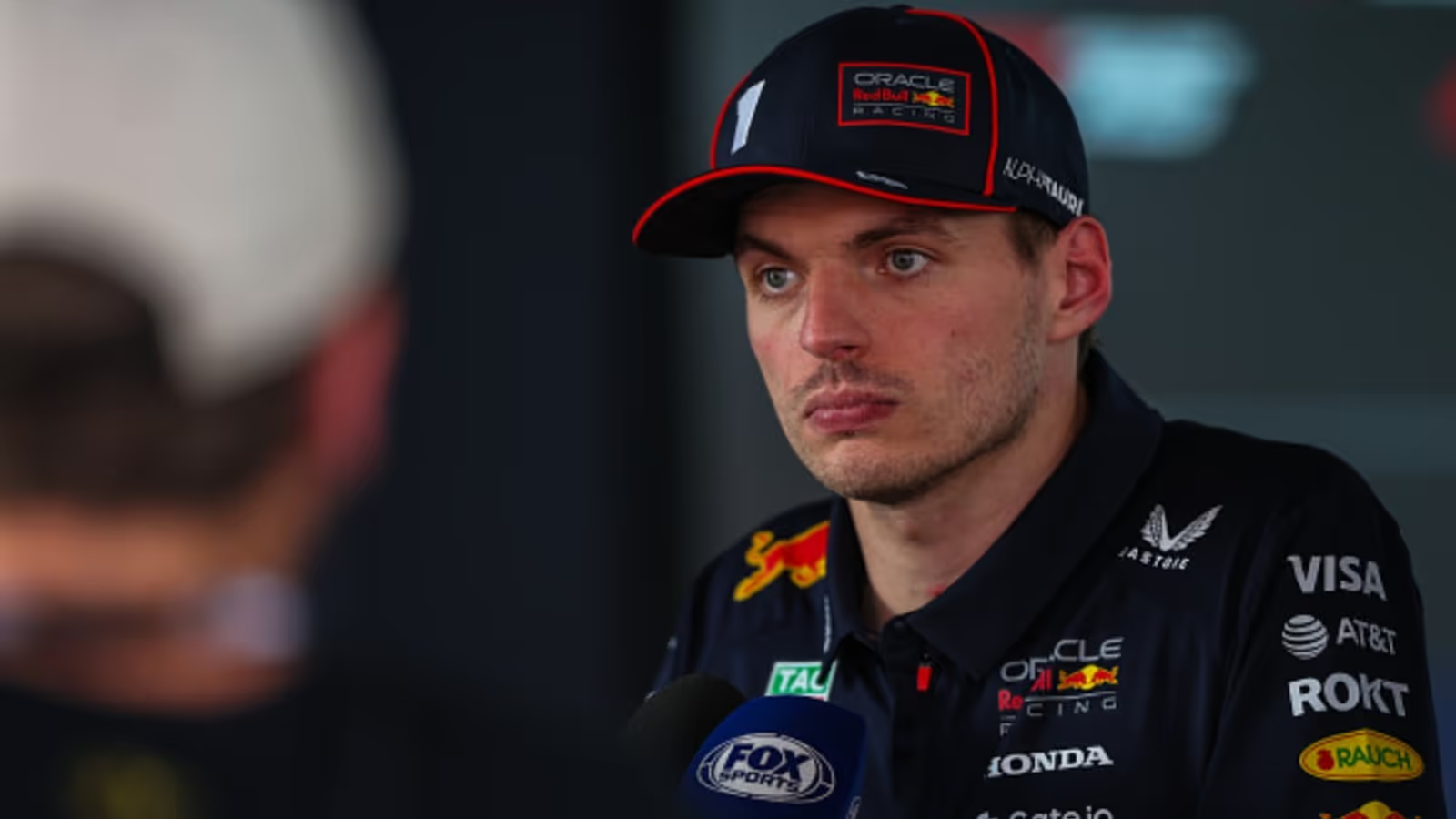
Quadruple F1 champion Max Verstappen expects this weekend’s British Grand Prix to be the toughest test for the new generation of machinery, with the fast-flowing nature of the circuit magnifying the energy management issues the drivers will face.
Verstappen had his best result of the season last time out in Austria, as Red Bull brought their biggest upgrades to the RB22 seen this season. Yet when asked about the team’s hopes for Silverstone, Max’s response was telling.
“Silverstone, I love the track, but I did a few laps on the simulator and I just started laughing,” said the Dutch racer. “It felt like a different track, to be honest. You barely have battery around the lap.”
“It’s just constantly flat [on the throttle]. So yes, it’s going to feel very different compared to what we are used to around Silverstone because of the layout of the track. Here [in Austria] you have long straights and big braking zones, so you can charge the battery. There you have long straights but in a fast corner, for example, so you can’t really charge the batteries, and then the next straight you don’t have a lot [of electrical energy] to spend. It’s going to be a tough one,” Verstappen concluded.
The Tricky 50/50 Power Dilemma
The all-new 2026 power unit regulations have upgraded the electrical contribution threefold to deliver 50% of the total output alongside the internal combustion engine (ICE). In Monaco and at the Red Bull Ring, the drivers were blessed with a huge amount of electrical deployment at their disposal, so energy management was less of a concern.
Silverstone is a very different prospect, and drivers will run short of electrical power and will have to decide when to use it and when to rely merely on the ICE. Verstappen has been one of the most outspoken critics of the all-new F1 rules, and after a consensus presented by the drivers, the FIA and manufacturers have agreed to shift the ratio of power to 60/40 (in favour of the ICE) going forward.
Yet this will be phased in over the next two seasons, and the paddock is collectively holding its breath for the potential racing disaster awaiting at the British Grand Prix. With Red Bull being deemed to have the most powerful ICE by the FIA, Silverstone may provide an opportunity for Max and their team to take their first victory of the season.
Ferrari’s Looming Power Crisis
Ferrari were found to have more than a 4% power deficit to the Ford/Red Bull Powertrain and brought an upgraded unit to the Austrian Grand Prix. Yet despite this power upgrade, the red cars looked well off the pace, something disguised by their relatively close proximity in qualifying.
Whilst Ferrari claim they believe the engine upgrade worked as expected, certain paddock insiders believe the deficit to Red Bull is in excess of 8%. The Maranello-based team were never going to recover that deficit with one upgrade, but they do have another opportunity this year under the FIA’s ADUO programme to bring another.
Given much of the energy recovery comes from the internal combustion engine at a circuit like Silverstone where braking is minimal, the British Grand Prix may see the Scuderia finish fourth-best of the top teams in both qualifying and the race.
Analysis shows that on the back straight in Austria, the Ferrari was 20 km/h slower than the Mercedes on the run down to Turn 4. This will be repeated at Silverstone along the Hamilton Straight, the International Straight, through the Maggots and Becketts complex, and down the final Hangar Straight.
Third-place finisher in Austria, Kimi Antonelli, highlighted Ferrari’s problem: ”They were deploying so weirdly, I almost crashed with Leclerc in Turn 1.” Furthermore, the young Italian demonstrated the lack of Ferrari electrical power early in the race when he made an unusual pass on Charles Leclerc through Turn 9—as the SF-26 ran out of battery and was harvesting well before the corner.
Milton Keynes Performs a Miracle
Mercedes too, were surprisingly declared to be more than 2% down on the Red Bull Powertrain, meaning that the Milton Keynes-based team has performed some kind of miracle having never before built an F1 power unit.
Toto Wolff has indicated that, unlike Ferrari, his team have no immediate plans to upgrade their power unit under the ADUO allowance offered by the FIA.
Race Control Under the Microscope
All eyes will be on race control and the stewards come the British Grand Prix, following a shocking decision not to deploy double-waved yellow flags after Max Verstappen lost control of his RB22 at the Red Bull Ring at over 300 km/h. Max was pushing hard in qualifying when his Red Bull car failed him, sending him hurtling into the barriers at the high-speed final corner complex.
George Russell exploited the failings of the FIA regulations, obeyed the single yellow flag rule by lifting and losing a few tenths of a second, yet still claimed pole position come the chequered flag. At Silverstone, there are a number of high-speed corners where, should a car lose grip and hit the barrier, a double-waved yellow must be immediately deployed.
Would you like to see more TJ13 Formula 1 coverage? Add us to your favourites list on Google to receive trusted F1 news.

A.J. Hunt is Senior Editor at TJ13, where Andrew oversees editorial standards and contributes to the site’s Formula 1 coverage. A career journalist with experience in both print and digital sports media, Andrew trained in investigative journalism and has written for a range of European sports outlets.
At TJ13, Andrew plays a central role in shaping the site’s output, working across breaking news, analysis, and long-form features. Andrew’s responsibilities include fact-checking, refining editorial structure, and ensuring consistency in reporting across a fast-moving news cycle.
Andrew’s work focuses particularly on the intersection of Formula 1 politics, regulation, and team strategy. Andrew closely follows developments involving the FIA, team leadership, and driver market dynamics, helping to provide context behind the sport’s biggest stories.
With experience covering multiple seasons of Formula 1’s modern hybrid era, Andrew has developed a detailed understanding of how regulatory changes and competitive shifts influence the grid. Andrew’s editorial approach prioritises clarity and context, aiming to help readers navigate complex developments within the sport.
In addition to editorial duties, Andrew is particularly interested in how media narratives shape fan perception of Formula 1, and how reporting can balance speed with accuracy in an increasingly digital news environment.
