
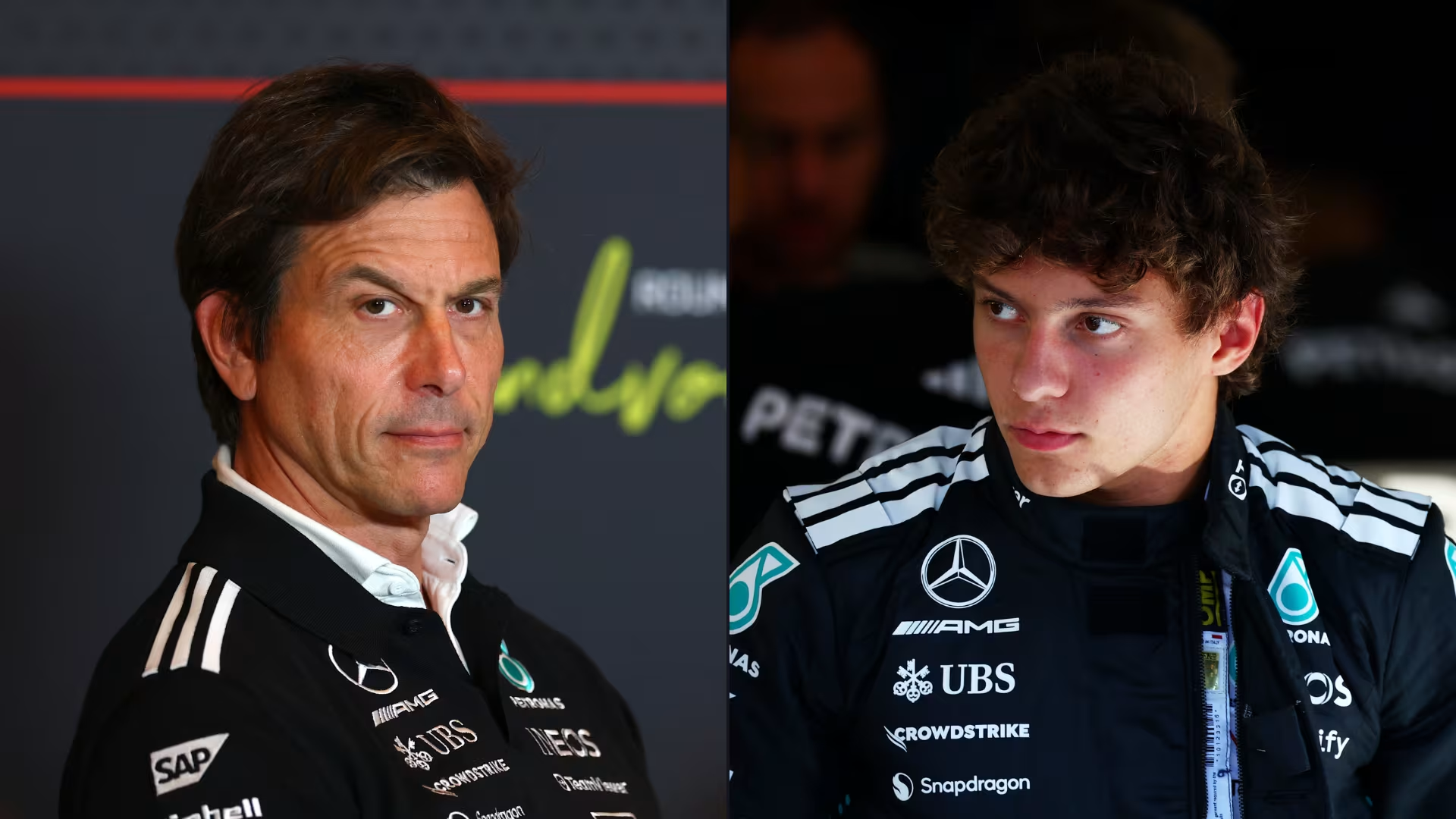
The first-ever Sprint race at the Circuit Gilles Villeneuve in Montreal evoked memories of a bygone Mercedes-AMG F1 era, where Nico Rosberg and Lewis Hamilton battled for every inch of the track, often to the despair of their team boss.
Such was the case with Kimi Antonelli and George Russell yesterday that Toto Wolff was called upon to mediate between the pair, and reading between the lines, he appears to have sided with his senior driver.
Detailed slow-motion replays indicate that, indeed, Kimi Antonelli, making a move around the outside of Turn 1, was marginally ahead of his teammate. The rules then require the driver on the inside to give him space, which Russell clearly did not. Yet, mysteriously, race control did not even note the incident, never mind suggest the stewards have a look at the matter—given Russell could have slowed to allow Antonelli space, but in doing so would have surrendered the lead of the Sprint.
Of course, with the incident involving two drivers from the same team, Mercedes were not on the blower to the race director pestering for a ruling, and it appears the FIA officials prefer to let sleeping dogs lie when they are not called upon to act.
“Hot-Headed” or Just Braver on the Brakes?
Antonelli was heavily criticised by a number of the broadcasters for his second attempt just three corners later to regain the lead. “Hot-headed” was a phrase bandied around, and the intervention of Toto Wolff attempting to shut down his driver over team radio merely served to enforce the notion.
Yet again, the replays show that the young Italian did have the over-speed on Russell to make the move down the inside of the Turn 3 chicane. But having outbraved his teammate in the braking zone, he hit a small bump in the track’s surface, which caused him to lock up and have to take to the grass. This move cost him second place, as Lando Norris was lurking and slipped by as Antonelli regained control of his car.
Kimi was incensed over team radio that his teammate had, in effect, ‘run him off the road’ in Turn 1. After protesting the move to his engineer twice, Toto Wolff unusually intervened over team radio—usually a sign that ‘enough is enough.’ Again, on the warm-down lap after the chequered flag, Kimi remained upset, suggesting Russell had shown how they were to race in the future—and he would react accordingly.
Again, Wolff came over team radio telling his driver to be quiet and that they would discuss the matter in private. Speaking live after the Sprint, Wolff attempted to play down the matter, suggesting it was merely a low-scoring Sprint event and they would use it as a “framework” to lay down the rules of engagement between the Mercedes drivers.
Wolff Condones the Gridiron Approach
Yet his responses gave hints of justification for Russell’s actions. Conversely, there is the suggestion that Antonelli was in the wrong.
“We sat them down and said, ‘How do we want to race? Are we racing the other car, like any third car’—which I’m fine with—’and you don’t leave the space?’” Wolff explained.
This, in fact, condones Russell’s actions, which by the FIA ‘driving standards rules’ were improper—even though race control badly managed the issue.
“Or do you want to leave the space,” Wolff continued, “which I would not expect, because fundamentally you are racing to win and winning a championship? Or are we playing this super-smooth sailing, and you only overtake each other on the straight or under braking? We agreed that we trust them. They know how to push, but in any case, neither is expecting the other to leave space because it’s too important.”
Despite his years of trying to defuse racing issues between Nico Rosberg and Lewis Hamilton, Wolff’s response appears to tee up further similar incidents between both his current drivers. He then went on to ask what Max Verstappen would do.
“It’s good to know the rules,” said Wolff. “Would Max have left space there? No. Would Max have opened the door or left enough space in Turn 1? He wouldn’t.”
A Flawed Verstappen Analogy
Yet citing Verstappen’s approach to racing is a fundamentally flawed argument in this discussion. Firstly, the Red Bull driver has rarely been battling his teammates on track in over ten years of F1 racing; his duels are with a third-party car. Of course, Verstappen would have done exactly what George did, but he has suffered criticism and even penalties at times for such actions. Why would the Mercedes boss encourage his drivers into such future mortal combat?
In a season where Mercedes are expected to dominate, it is great for the fans that both Mercedes drivers are permitted to race each other hard—even over the limit at times. Yet for Mercedes harmony, this is a disaster, something Wolff should anticipate.
Antonelli now has a licence to use every marginal trick in the book to best his teammate and presently looks quicker than Russell on most occasions. For now, Toto Wolff appears philosophical over the matter and implies it will be his drivers who set their own racing code of conduct.
“So, how do we want to do this between teammates? And I think it’s important for them to decide how they want to race each other, and then live with the outcome. Is that today? You said they’ve got to decide, so it’s got to happen in the next few hours, yes?”
“No, that’s the rules now, and it’s a framework that they have established amongst themselves, and we are happy,” concluded the Mercedes team boss.
Would you like to see more TJ13 Formula 1 coverage? Add us to your favourites list on Google to receive trusted F1 news.

A.J. Hunt is Senior Editor at TJ13, where Andrew oversees editorial standards and contributes to the site’s Formula 1 coverage. A career journalist with experience in both print and digital sports media, Andrew trained in investigative journalism and has written for a range of European sports outlets.
At TJ13, Andrew plays a central role in shaping the site’s output, working across breaking news, analysis, and long-form features. Andrew’s responsibilities include fact-checking, refining editorial structure, and ensuring consistency in reporting across a fast-moving news cycle.
Andrew’s work focuses particularly on the intersection of Formula 1 politics, regulation, and team strategy. Andrew closely follows developments involving the FIA, team leadership, and driver market dynamics, helping to provide context behind the sport’s biggest stories.
With experience covering multiple seasons of Formula 1’s modern hybrid era, Andrew has developed a detailed understanding of how regulatory changes and competitive shifts influence the grid. Andrew’s editorial approach prioritises clarity and context, aiming to help readers navigate complex developments within the sport.
In addition to editorial duties, Andrew is particularly interested in how media narratives shape fan perception of Formula 1, and how reporting can balance speed with accuracy in an increasingly digital news environment.

TW is full of it, isn’t he!!
KA was quite right – HE was forced off the road by GR (who, we k ow, is the biggest whinger out there is someone dares to BREATHE on his car!) … but TW was concerned the stewards would look at it as a result of KA’s complaints over the radio and give GR a penalty – WHICH THEY SHOULD HAVE DONE, irrespective of whether a complaint is lodged.
For TW to think those watching could be hoodwinked by his intervention and later comments is simply crass on his part