
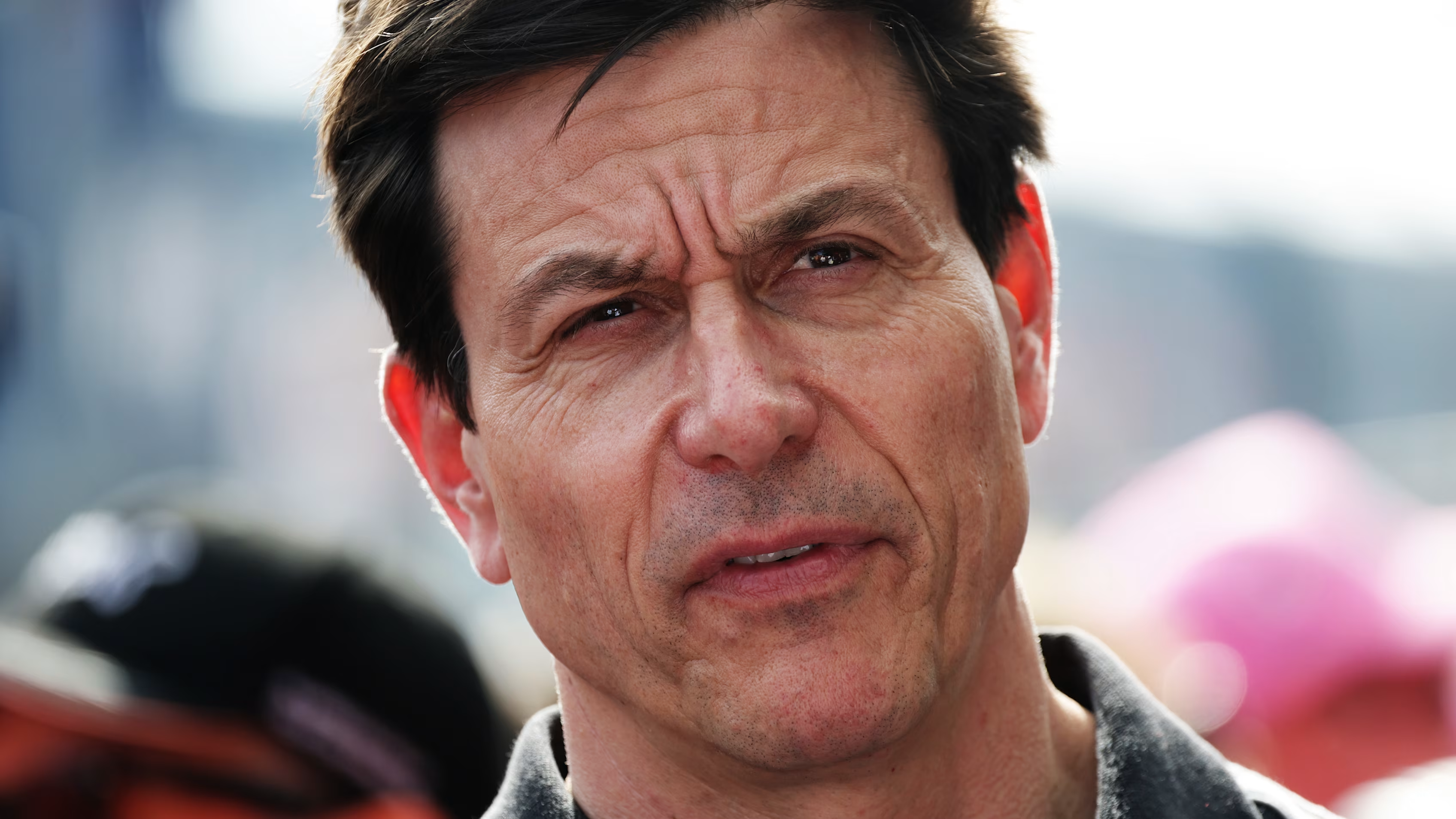
Everything and everyone has a price—so they say, but it appears the $3bn valuation placed on the Alpine Formula One team by majority shareholders Renault was a bridge too far. Mercedes have withdrawn from their discussions to buy the Otro Capital 24% stake in the French-owned outfit in what always appeared to be a long-shot arrangement.
How things have changed in just 25 years in Formula One, when we remember late in 2008 Ross Brawn bought the Honda F1 works team for just £1. Back then an F1 team was a liability and as the sport’s former supremo—Bernie Ecclestone—used to say: “The quickest way to become a millionaire in F1… is to start a billionaire.”
The Liberty Media Revolution
Since the acquisition of the commercial rights to F1 by Liberty Media in January 2017 for $4.4bn plus the existing debt (a total cost of $8bn), values in the sport have skyrocketed for a number of reasons. Primarily because this deal effectively ended the 40-year dictatorial, Euro-centric reign of billionaire ringmaster Bernie Ecclestone and ushered in the modern, Americanized era of the sport.
The Netflix series, Drive to Survive, was commissioned and instantly attracted a vast audience, including many who had never experienced F1. Then came the long-awaited Digital Revolution as Liberty instantly loosened draconian paddock video restrictions, allowing teams and drivers to create content for YouTube, TikTok, and Instagram. They also launched F1 TV, a direct-to-consumer over-the-top streaming platform.
Cost Caps and Exploding Team Valuations
However, the biggest influence on F1 in 2021, possibly since its inception, was the fact that Liberty achieved what was previously thought impossible: a mandatory financial spending cap for teams. This leveled the playing field, prevented top teams like Ferrari and Mercedes from spending $400+ million a year, and made every single slot on the grid a highly stable, profitable franchise.
To illustrate how quickly values have inflated in F1, consider the entry point for minority stakes over the last few years. In 2022, the chemical giant Ineos bought a 33% stake in the Mercedes F1 team at a valuation that pegged the total team worth at roughly $800 million.
Fast forward to recent transactions, and Mercedes CEO Toto Wolff sold a 15% minority stake to American billionaire George Kurtz at a staggering $6 billion valuation. Yet the Alpine minority stake was only valued at around 300% ($3bn) of the investors’ initial buy-in, and worryingly, it appears to indicate that F1 has hit the top of its market.
Alpine’s Stalled Upward Trajectory
What goes up must come down at some point, though it is true Alpine are not the powerhouse that Mercedes-AMG F1 are. Yet when they sold the 24% stake to Otro in 2023, they were firmly the sixth-best team, scoring 120 points and collecting two podiums that year. In 2026, they are again the sixth-best team and after just five weekends have collected 65 points, surely signs of progress?
The Otro investors joined at a time the team management was perpetuating what we now know was a myth of the 100-race mountain to climb. Launched in late 2021 by former Alpine CEO Laurent Rossi, the plan was a structural blueprint designed to exploit F1’s newly introduced budget cap regulations. Rather than spending endlessly, Renault/Alpine mapped out exactly 100 Grands Prix (roughly four seasons) to methodically transition from a mid-field team into a World Championship contender.
That came to a miserable end at the 2025 Canadian Grand Prix. So, is the collapse of the Mercedes buy-in to Alpine a cause for concern for the owners of F1?
The Realistic Disconnect in Analyst Predictions
Despite the meteoric rise of the racing series, sports business analysts note that F1 teams are still technically trading at a discount compared to American leagues. While the average NFL team sits at $7.1 billion and the NBA at $5.4 billion, F1 has a vastly larger, more continuous global audience. As a result, venture capital firms view F1 teams as highly underpriced assets with substantial room left to grow.
In late 2025, financial and sports business publication Sportico released its F1 franchise valuations, revealing every team on the grid was then worth over $1.6bn. It meant the average value of an F1 team was worth $3bn, which is what Alpine expected Mercedes to pay.
Yet the Mercedes team and Toto Wolff had drawn a line on the price at $2.2bn, according to BBC Sport and The Athletic, based on standard corporate valuation models using multiples of the team’s income. Which means the Sportico valuations now seem high compared to what investors were prepared to pay for the 24% stake in the French-owned team.
Paddock Backlash Against the A-B Team Model
It could be, in part, the reason Mercedes were loath to pay the Alpine asking price was due to the fact McLaren’s CEO has been beating the drum over the ownership model of F1 teams. Zak brown once again raised the matter in an open letter to the FIA this year, claiming A-B F1 team ownership models would hurt the integrity of the sport.
He detailed the potential for on-track collusion, citing the example of Daniel Ricciardo securing the fastest lap at the 2024 Singapore GP to strip McLaren of a vital championship point. This, of course, favored Ricciardo’s sister team, Red Bull Racing.
Further, there are advantages A-B owned teams have in terms of personnel. When the Red Bull parent company sacked Christian Horner, they instantly promoted Laurent Mekies from their B-team, the Racing Bulls. For independent teams, they would have had a mighty period of gardening leave to wait.
McLaren, who have recruited Max Verstappen’s race engineer, may have an 18-month period to wait before Lambiase is free to join them in Woking.
Synergies, Block Voting, and Regional Monetization Limits
There are other synergies enjoyed by teams being jointly owned, such as resource sharing, wind tunnels, and component manufacturing synergies, which independent teams do not have. This gives the A-B teams a financial advantage under the cost cap.
Finally, in terms of block voting, teams with the same owners could manipulate decisions made at the F1 Commission by, for example, voting for the propositions of a particular manufacturer. So, it could be Mercedes were concerned about the upcoming 2030 Concorde Agreement, where they may have been forced to sell their Alpine stake in a hurry—hence the discounted offer.
The business analysts who compare the F1 valuation to that of the NFL may also be missing a trick. F1’s audience is truly global, but in many geographic regions where the sport is avidly followed, the spending power of the viewers is far less than in the developed Western countries.
This is reflected in how advertising spend is allocated by the likes of Google, where the highest rates per click are paid in Europe, the USA, and Canada. A click from South Africa, by comparison, pays around half.
A Shifting Market Landscape
So, the collapse of the Alpine deal with Mercedes does not necessarily represent a shock moment for Formula One and the teams in terms of it failing to increase its value year on year. It is likely to be a combination of issues, including the risk of A-B team ownership being banned in the near future.
Further, it could be the expectations from certain financial analysts are unrealistic in terms of the value in the reach of the sport. Yet there has been a seismic change since comments made by the head of Alpine, Flavio Briatore, back in 2024 when he claimed: “There are many people who want to buy the team. Every month, we have one or two offers to buy Alpine.”
Two years on, and no deal has come to fruition.
Would you like to see more TJ13 Formula 1 coverage? Add us to your favourites list on Google to receive trusted F1 news.

A.J. Hunt is Senior Editor at TJ13, where Andrew oversees editorial standards and contributes to the site’s Formula 1 coverage. A career journalist with experience in both print and digital sports media, Andrew trained in investigative journalism and has written for a range of European sports outlets.
At TJ13, Andrew plays a central role in shaping the site’s output, working across breaking news, analysis, and long-form features. Andrew’s responsibilities include fact-checking, refining editorial structure, and ensuring consistency in reporting across a fast-moving news cycle.
Andrew’s work focuses particularly on the intersection of Formula 1 politics, regulation, and team strategy. Andrew closely follows developments involving the FIA, team leadership, and driver market dynamics, helping to provide context behind the sport’s biggest stories.
With experience covering multiple seasons of Formula 1’s modern hybrid era, Andrew has developed a detailed understanding of how regulatory changes and competitive shifts influence the grid. Andrew’s editorial approach prioritises clarity and context, aiming to help readers navigate complex developments within the sport.
In addition to editorial duties, Andrew is particularly interested in how media narratives shape fan perception of Formula 1, and how reporting can balance speed with accuracy in an increasingly digital news environment.
