
Amid growing uncertainty surrounding Max Verstappen’s future, Ralf Schumacher offered a candid evaluation of the situation: “Being in Formula 1 is something very special. Of course, he now has the opportunity to say, ‘I don’t like this.’ But try finding an alternative,” insisted Ralf Schumacher on the Backstage Pit Lane podcast.
The brother of Michael Schumacher continued, saying: “A GT car is beautiful, but at 1.4 tons, no matter how much battery power a Formula 1 car has, it’s something else entirely. Then there’s the fact that you’re driving around the world and competing against the best drivers in the world. I can’t imagine Max giving that up so quickly.”
These comments come at a pivotal time for Verstappen, whose mounting frustration with Formula 1’s new regulations has fuelled speculation about his future in the sport.
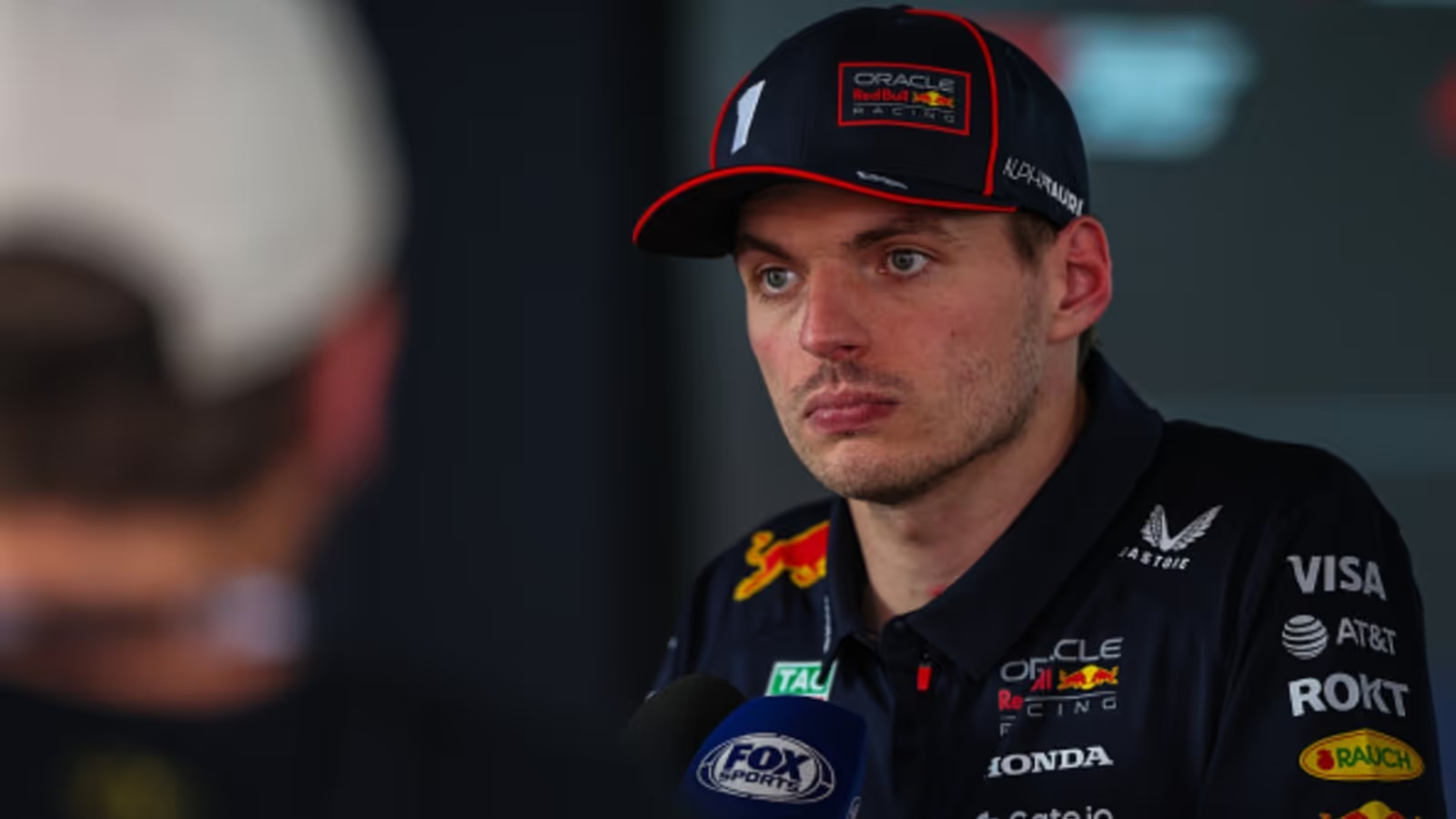
Schumacher: Verstappen must adapt
Schumacher did not hold back in his assessment of the reigning world champion’s mindset. While acknowledging Verstappen’s dissatisfaction, he made it clear that the Dutchman now faces a personal challenge.
“Max is frustrated with the new regulations and the new Formula 1. Even if he were to win, he wouldn’t particularly like it, but it would make things easier for him and there would be less criticism. Now he simply has to put his ego to one side, after all, he’s well paid for it, and act as a team player; that’s what’s important now.”
It is a pointed message. Verstappen has built his career on relentless competitiveness and dominance, but the shifting landscape of Formula 1 in 2026 has disrupted his comfort zone. The new technical era has altered the characteristics of the cars, the dynamics of the races, and the competitive balance, factors that appear to have unsettled even the sport’s most formidable driver.
MORE F1 NEWS – Liam Lawson could race this month, but there’s a major problem
Retirement talk after Japan raises eyebrows
After finishing eighth in the Japanese Grand Prix, Verstappen refused to rule out retiring at the end of the season. This was an unusual display of openness from a driver who has usually projected a total focus on winning.
Such comments inevitably sparked debate across the paddock. Is this genuine disillusionment, or simply frustration following a difficult start to the campaign?
Ralf Schumacher, a former Formula 1 driver who competed from 1997 to 2007 and won six Grands Prix with teams including Williams and Toyota, is now a prominent TV pundit in Germany, renowned for his candid analysis and insider perspective. The former German racing driver firmly believes that Max Verstappen’s competitive instincts and the unique appeal of Formula 1 will ultimately keep him on the grid.
A champion feeling isolated
Beyond performance, Schumacher highlighted a deeper issue: Verstappen’s current isolation within Red Bull Racing.
“Max could really use a fatherly friend like Dr Helmut Marko right now, someone who could take him in his arms and say, ‘We have to get through this together’. Marko is sorely missed at Red Bull. At the moment, Max Verstappen is the only voice; otherwise, you don’t hear a thing. And that’s the case, even though it’s not Max’s job.”
“Verstappen is currently being ‘left alone’ at Red Bull. He needs to be taken out of the spotlight a bit.”
These remarks point to a significant cultural shift within the team. Verstappen, who was once supported by a strong and experienced leadership structure, now appears to be carrying a heavier burden both on and off the track.
The changing power structure at Red Bull
To understand Verstappen’s situation, it’s essential to consider the wider transformation behind the scenes.
For years, Red Bull’s success was underpinned by a stable core of senior figures. Helmut Marko played a pivotal mentorship role, acting as both a talent scout and a confidant to Verstappen. His influence extended beyond strategy into driver management and psychological support.
Meanwhile, Christian Horner provided leadership as team principal, overseeing one of the team’s most successful periods. Further, Jonathan Wheatley, the sporting director, ensured operational excellence at race weekends.
However, the past year has seen a steady erosion of this structure.
High-profile departures and internal tensions have reshaped the leadership dynamic. Those who once presented a united front are no longer as visible, or, in some cases, are no longer present at all. Even long-serving, respected team members such as mechanic Ole Shank have reportedly left, further weakening the sense of continuity.
The cumulative effect is significant: Verstappen is no longer surrounded by the same experienced individuals who helped guide him through earlier phases of his career.
MORE NEWS – Red Bull boss under pressure from Austria as chassis to blame, not the engine
Why Marko’s absence matters most
Of all these changes, Marko’s reduced influence, or even absence, may be the most impactful.
Marko has long been seen as Verstappen’s closest ally within the Red Bull system. He played a key role in bringing the Dutch driver into Formula 1 and remained a pivotal figure during his rise to multiple world championships.
Without that ‘fatherly’ presence, as Schumacher described it, Verstappen may be feeling the loss of a trusted adviser, someone capable of providing perspective during difficult periods.
In a sport where marginal gains and mental resilience often define success, that kind of support can be invaluable.
The road ahead for Verstappen
Despite the turbulence, Schumacher remains convinced that Verstappen will not walk away from Formula 1.
The allure of the sport, its speed, global stage and elite competition, remains unmatched. As Schumacher pointed out, alternatives such as GT racing simply cannot replicate the same intensity or prestige.
The focus, therefore, shifts back to Verstappen himself. Can he adapt to the new regulations? Can he embrace a more team-oriented role during Red Bull’s transitional phase? Most importantly, can the team rebuild the support structure that once enabled his dominance?
For now, the answers remain uncertain. But one thing is clear: Verstappen’s future is not just about his performance on the track; it is also closely linked to the evolving identity of Red Bull Racing. As Schumacher’s comments underline, the next move belongs to the champion.
Would you like to see more TJ13 Formula 1 coverage? Add us to your favourites list on Google to receive trusted F1 news.
NEXT ARTICLE – How the FIA got into this F1 mess and what not to do to get out of it
Having watched Formula One for over 40 years, I don’t remember the sport getting itself into such a mess as it has with the all new 2026 regulations. Of course there were the tragedies which saw the death of Ayrton Senna and Jules Bianchi together with other one off farcical situations like the 2005 US Grand Prix where just six cars started the race.
Other silly ideas included aggregate qualifying back in 2005 where drivers ran one lap on Saturday afternoon and another on Sunday and the grid was set by their total of the two runs. In 2016, elimination qualifying was tried, where the cars went out all together and every 90 seconds the slowest was eliminated.
Both formats lasted a handful of race weekends before being dropped. There are a number of other ‘unusual’ efforts made by the FIA which led to driver boycott in Imola in 1982 together with the two lap race in Belgium in 2021 which saw George Russell claim his first podium in a Williams F1 car.

FIA desperate to engage manufacturers
Yet never has the FIA conspired to create a set of technical and sporting regulations which are so widely hated by drivers and fans alike. As much as various broadcasters have made light of the matter, comparing the 2026 F1 racing to Mario Kart, the current F1 spectacle is currently a debacle with drivers having to go slower to ultimately set a faster lap time and with terrifying closing speeds as the mega boost from the electrical power source runs dry.
Lessons must be learned and as early as 2024, F1 supremo Stefano Domenicali was talking down the all new 2026 era of F1 racing. In an interview with motorsport.com he hinted the reason the new regulations had been framed as they were was due to F1’s desperation to engage with more engine manufacturers.
Having fallen out with Renault at the last big regulation cycle in 2014, Red Bull faced the possibility of having no power unit supplier. Mercedes and…CONTINUE TO READ THIS ARTICLE

Craig Alderson is Senior Editor at TJ13, where Craig oversees newsroom operations and coordinates editorial output across the site. With a background in online sports reporting and motorsport magazine editing, he plays a key role in maintaining consistency, speed, and accuracy in TJ13’s coverage.
During race weekends, Craig acts as desk lead, directing contributors, prioritising breaking stories, and ensuring timely publication across a fast-moving news cycle.
Craig’s work focuses heavily on real-time developments in the paddock, including team updates, regulatory decisions, and emerging controversies. This role requires a detailed understanding of Formula 1’s operational flow, from practice sessions through to race-day strategy and post-race fallout.
With experience managing editorial teams, Craig ensures that TJ13 delivers structured, reliable coverage while maintaining the site’s distinctive voice.
Craig has a particular interest in how information moves within the paddock environment, and how rapidly developing stories can be accurately translated into clear, accessible reporting for readers.
