
Two race weekends down and the all new Formula One 2026 regulations have indeed had the biggest impact on the sport since its inception. As happened last time the engine rules were radically changed in 2014, it is Mercedes who have turned out on top. That said, Ferrari too have done a decent job as they sit second behind the silver arrows in the constructors’ championship.
For the rest of the field, the picture is not so rosy. If we tot up the points scored by the other nine constructors they total just four more than the Scuderia have accumulated across two races weekends.
Of course, it was expected there would be big winners and losers but presently the championships look to be a race between Ferrari and Mercedes, with the latter looking the stronger of the two.

FIA pause rule changes before Japan
The Sprint weekend in China happens to have settled some of the nerves up and down the paddock, as the expected emergency rule changes before Japan in less than two weeks time have been put on hold. Concerns remain that the disparity of performance between a car out of electrical power and one using its electrical boost systems are creating huge speed differentials which could result in a massive accident.
Then there’s the unwanted spectacle of drivers ‘going slow, to go fast’ in qualifying and the much criticised need to ‘lift and coast’ when in previous generations the cars would be flat out approaching a corner.
Unsurprisingly, Mercedes boss Toto Wolff believes on the whole the new regulations are working well, but given his drivers have won all three races to date, why would he say otherwise? “Qualifying flat-out would be nice. But when you look at the fans and the excitement that is there live, the cheering when there are overtakes, and also on social media, the younger fans, the vast majority through all the demographics likes the sport at the moment,” said the Mercedes team principal in China.
“So, yes, we can always look at how we’re improving it. But at the moment, all the indicators say, and all the data say, that people love it. And that’s why I spoke with Stefano [FOM CEO], he says that too. So it is driving the car that, for some, is not most pleasant.”
Drivers in unison critical of new F1 regulations
Following the opening weekend in Australia, the majority of the divers appeared disconsolate at the 2026 regulations, with many openly critical of the dominance of the energy management they now have to perform. Red Bull’s Max Verstappen labelled the new formula as “anti-racing” comparing it to “Formula E on steroids” together with “Mario Kart”. He described the driving experience as “not fun at all” and claimed the rules are “fundamentally flawed”.
Max has been known to be outspoken own his views such as the introduction of the Sprint format, yet his incandescence was on another level in Melbourne. Lando Norris too was scathing stating F1 had gone from “best cars ever made” to “probably the worst“. He criticised the racing as “artificial” and expressed safety concerns, warning of a “big accident” due to massive speed differences caused by energy management.
Ferrari’s Lewis Hamilton too described the new rules as “ridiculously complex” and “completely against F1’s principles” during the Australian GP weekend. Esteban Ocon called the racing “artificial” and the returning Sergio Perez the new formula as “a lot less fun” than when he last raced inn 2024.
In fact almost all the drivers with the exception of the Mercedes pair were outspoken in their dislike of what Formula One has become. Yet what a difference a week makes. Yes Max Verstappen increased the volume of his attack on F1’ new rules, but some of the other drivers softened their rhetoric with Lewis Hamilton taking on the mantle of the British Prime Minister and adopting a complete U-Turn.
Ferrari criticised for lack of team orders handing Mercedes another 1-2
Lewis Hamilton shocking U-Turn
Following his podium finish in Chines Grand Prix, Hamilton was exuberant and made a particular dramatic claim. “I think it’s the best racing that I’ve ever experienced in Formula 1,” he said after finally securing his first Ferrari podium after 23 other attempts. “It felt like go-karting, back and forth, back and forth, and you could really position your car in a nice way where there was a thin piece of paper between us sometimes.”
Of course much of this is presumably due to the pressure heaped on the seven times F1 champion who was dominated last year by team mate Charles Leclerc. In the Shanghai race on Sunday, he and Leclerc went wheel to wheel for lap after lap producing a mesmerising display of close action racing. It was indeed most entertaining.
Yet should F1 be entertainment or Sport and can it be both successfully? Since Liberty Media bought the commercial rights to F1 in 2017, much has been spoken about how the “product” is being improved. Sprint races which cater for those with a smaller attention span than traditional F1 fans have been hailed a success and for 2027 FOM is proposing increasing the number of Sprint weekends from 6-12.
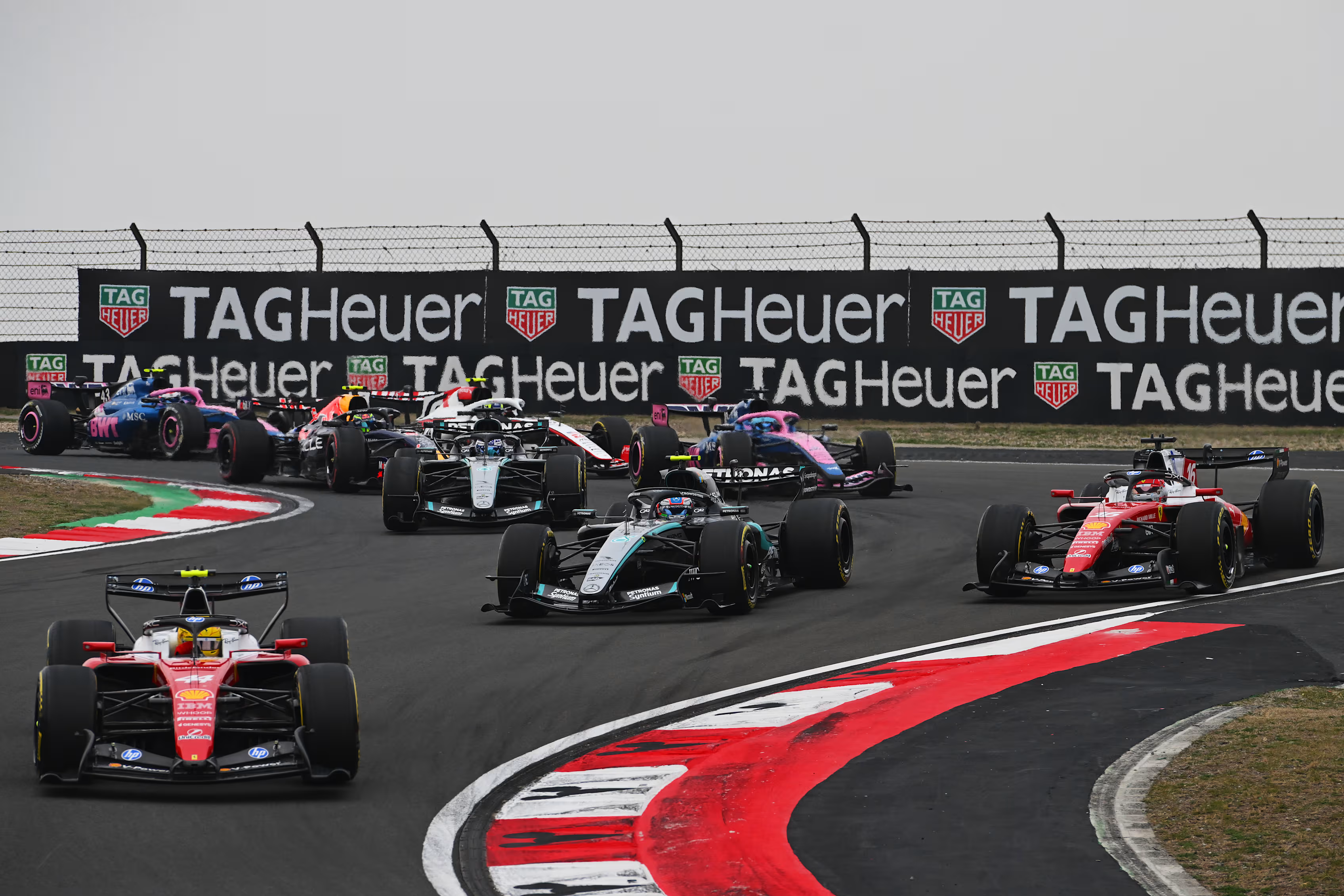
From the two weekends in 2026 so far, a patter to the racing is emerging. The starts are frenetic with drivers gaining and losing a huge number of places and the battles raging up and down the field are relentless as each burns through their electrical power boosts overtaking and being overtaken. Yet this sugar rush does not last for the full race and for good reason.
FIA consider allowing F1 testing to replace Bahrain and Saudi GP’s
Artificial overtaking creates a spectacle
This kind of overtaking is extremely artificial and moreover is not in fact the optimum fashion in which to complete the race in the minimum time possible. This was evident in Shanghai, when Kimi Antonelli made an early break from his team mate and the pair of Ferrari drivers. Whilst they squabbled overtaking each other for lap after lap, the young Italian settled down and used his deployable energy in an efficient manner.
For lap after lap he was a second quicker than his battling rivals behind and once they’d sorted out their order his lead was a race winning eight seconds. In the previous era of Formula One there were resources to be managed, just like now with the electrical energy. Tyre wear was crucial to a race strategy, with some drivers choosing to run several seconds off the full race pace, to ensure they did not have to make an additional pit stop and lose over half a minute in race time.
The same is true of the electrical energy currently at the finger tips of the F1 drivers and in time all the high energy battles at the start of the races will stop and we’ll settle into another form of resource managed ‘racing.’ Only this time it will in fact be worse than ever. Tyre wear was always some kind of ‘dark art.’ The most efficient way to use your electrical power is an algorithm which any home PC can work out.
The current Haribo fuelled excitement of racing at the start of a Grand Prix will inevitably disappear and so will some of the interest inn F1 racing. The focus on entertainment first will become self defeating and we will be left with a desire to once again see real sporting competition.
Chinese GP Retirement! Paddock Whispers: Uncertain Max Verstappen F1 Future
Magic F1 moments not being made
Gary Anderson, ex-chief F1 car designer writes in today’s Telegraph. “F1 and the FIA will probably look at the increase in overtaking and think it is a job well done. Their objective was to have more entertainment for the younger audiences. I am not young anymore, so I still have a memory of when I thought a race was good because a driver did something exceptional; something that made you sit up and go “wow”. That was usually an exceptional talent like Michael Schumacher, Lewis Hamilton in his heyday, Ayrton Senna or Alain Prost to name but a few.”
The problem with the new F1 formula is there are so many overtakes taking place, it becomes hard for the TV director to capture them all and the audience to take them in. More is not always better and in the long term this will dilute the great moments fans remember from watching F1of yesteryear.
Given we’re stuck with the current power unit regulations for some years, its right the FIA are trying to dial down the effect of the super electrical boosts and false overtaking. Yet in the long term F1 needs to take a long look at itself.
Let Formula E be electric car racing, let the world endurance series run their sophisticated hybrid motors and let us see F1 return to the time when visceral V8 engines roared in unison at lights out. Let’s bring back the original and uniques soundtrack of F1 which has stood the test of time over more than half a century.
Would you like to see more TJ13 Formula 1 coverage? Add us to your favourites list on Google to receive trusted F1 news.
NEXT ARTICLE: F1 fans robbed as FOM/FIA has no intention of rescheduling Bahrain and Saudi Grand Prix
Last Updated on March 16 2026, 1:33 pm
As was much expected, the FIA finally confirmed the cancelation of the F1 races schedules for April to be held in Bahrain and Saudi Arabia. The unexpected war in Iran has thrown the Fomrula One 2026 calendar into disarray.
There were hopes that the races could be replaced in Istanbul and Portimao but it appears the political will was not there to upset F1’s two Middle East partners who between them pay in the region of 10% of the entire hosting annual fees received by Formula One Management (FOM).
It was inevitable that the Bahrain Grand Prix would be cancelled given it is just over three weeks away and with president Trump and his Israeli ally suggesting the war would be at least 4-6 weeks in length. The close proximity of the Gulf Kingdom just over 400km from the closest point to Iran was just too big a risk to take…. CONTINUE READING


The Judge, a nom de plume of an experienced F1 journalist and site founder with long-standing sources across the paddock. With over 30 years of experience in Formula 1 as an insider journalist, I have built trusted connections across the paddock, from race engineers and mechanics to senior team figures. At The Judge 13, I and a handful of trusted colleagues share exclusive Formula 1 news, expert analysis and behind-the-scenes stories you will not find in mainstream motorsport media.

A.J. Hunt is Senior Editor at TJ13, where Andrew oversees editorial standards and contributes to the site’s Formula 1 coverage. A career journalist with experience in both print and digital sports media, Andrew trained in investigative journalism and has written for a range of European sports outlets.
At TJ13, Andrew plays a central role in shaping the site’s output, working across breaking news, analysis, and long-form features. Andrew’s responsibilities include fact-checking, refining editorial structure, and ensuring consistency in reporting across a fast-moving news cycle.
Andrew’s work focuses particularly on the intersection of Formula 1 politics, regulation, and team strategy. Andrew closely follows developments involving the FIA, team leadership, and driver market dynamics, helping to provide context behind the sport’s biggest stories.
With experience covering multiple seasons of Formula 1’s modern hybrid era, Andrew has developed a detailed understanding of how regulatory changes and competitive shifts influence the grid. Andrew’s editorial approach prioritises clarity and context, aiming to help readers navigate complex developments within the sport.
In addition to editorial duties, Andrew is particularly interested in how media narratives shape fan perception of Formula 1, and how reporting can balance speed with accuracy in an increasingly digital news environment.

It’s neither sport nor entertainment this season, in my view.
As was once said – and I paraphrase now – if it is neither use nor ornament, so don’t give it houseroom. I’m done with F1 – and the rest of my family feel the same (even the younger demographic, Toto)
“I’m done with F1″… and yet here you are
F1 in it’s current form is not racing. Bring back the V8s.