
A new row is brewing in Formula One which again revolves around Mercedes HPP who build the F1 powertrains. The Brackley based outfit has been embarrassed for the last two seasons as their engine customer McLaren has wiped the floor with them, winning three championships.
Now the new era of F1 has been, unsurprisingly it is the top three powertrain manufacturers who look to have the fastest cars. Is this because their engines are better than those supplied to their customers? No because this is against the FIA regulations.
Back in 2014 this was indeed the case, where Mercedes would bring upgrades to their powertrains and their customers would have to wait for the production capabilities to produce enough for them maybe weeks later. The rules have been changed to prevent this.
Mercedes customers had different engines in testing?
The next possibility is that the customer teams have to develop their own software to run the powertrains efficiently and Mercedes HPP in developing the power units is miles ahead of them in this aspect. Again this is not the case. The rules state the customer teams must have identical power units (PU) in terms of architecture along with the software which controls the functionality of the PU.
Given McLaren have had the best car for the past two and half seasons, then have they done such a bad job of it that they were almost 0.9 seconds slower than Mercedes in qualifying and 51 seconds adrift of winner George Russell come the chequered flag on Sunday?
Again the answer is no. Mercedes are way ahead of the field because of their power unit is the simple explanation and its due to the incremental time they have had to simulate its varying performance modes. Whilst the customer teams must have identical power units to the works team for the entire season long, in testing this is not the case.
McLaren now suspect they were given powertrains which did not perform to the standard they do now and that Mercedes with an upgraded PU was sandbagging in Bahrain to make their customers believe they were all running similar engines
Shock: Verstappen to race for MERCEDES in 2026 24 hour classic
Williams boss caught off guard by the level of power deployment in Australia
The evidence presented for this is two fold. Firstly, on arriving in Australia Williams found their simulations were way off in terms of the engine power they had available. Remember team principals can’t be aggressively open about their criticism of Mercedes in fear of reprisals and so much of what they say is in a kind of coded form.
“What Mercedes are doing on the power unit is something that caught us off guard,” said James Vowles the Williams team boss post Melbourne qualifying. “It took a qualifying for us to really see just how off the pace we are. In that regard, that’s probably three tenths [missing from the engine] – something in that ballpark.”
This means Williams believe had they been able to optimise the running of their Mercedes engine, they would have been there tenths quicker in qualifying. In truth this would have made little difference to Alex Albon’s qualifying efforts, yet three tenths is a huge chunk of time.
James Vowels, a Mercedes lifer left the team in 2022 to become Williams team principal, but he offered veiled criticism that he felt the Mercedes HPP division could have been more open over the information they shared about how the power should have been deployed by the engine.
F1 project botched: Newey and Aston Martin mocked in Italian press
Mercedes refuse to answer McLaren’s questions for “weeks”
“I had expected it to a certain extent, yes. That’s why I said I was caught out yesterday,” stated Vowels. “It is not an open door, as you would imagine, because that’s where the performance is found. So it is down to us to try and work around it.”
This comment gives the impression that it’s the customer’s job to work out how the power should deployed and given Vowels relationship with Mercedes his position is understandable. However, McLaren team boss Andreas Stella also waded into the debate over the information delivered by Mercedes HPP to their customers. He was less careful than usual in his wording and his comments again raise the suspicion the Mercedes PU McLaren were using in testing was quite different from the one they were provided with in Australia.
“The discussion with HPP (Mercedes High Performance Powertrains) about having more information has been going on for weeks because, even in testing, we were pretty much going on track, run the car, look at the data, ‘oh, that’s what we have. Good, now we react to what we have’.
“That’s not how you work in Formula 1. In Formula 1, what happens on track, you simulate. You know what is happening, you know what you are programming, you know how the car is going to behave,” complained the McLaren boss.
Verstappen put on notice by Red Bull rookie: “I won’t let them past”
Andreas Stella suggests its the 1st time Mercedes have not been open with them
Stella is claiming there was an information void coming from Mercedes HPP which did not allow them to properly simulate how the cars would perform with the new engines. Even then, had they been given the same specification of PU in Bahrain that they received in Australia, at least some kind of simulation work could have been effectively performed.
The complaint from many may be seen as McLaren just complaining and making excuses for their lack of performance, yet the fact Stella reveals questions over data have been posed for weeks – and implies they remain unanswered – is telling.
“So, I have to say, since we are a customer team [of Mercedes], this is the first time that we feel we are on the back foot even when it comes to the ability to predict how the car will behave and the ability to anticipate how we can improve the car,” adds the Italian. This again is a coded accusation, but behind the semantics the message is clear.
As a customer of Mercedes, McLaren believe they are being significantly disadvantaged by the power unit manufacturer when compared to the world Mercedes MAG F1 team based in Brackley.
Verstappen starts Australian GP with no battery power. What happened?
DId Mercedes exploit the rules to time out their customers?
To crystallise the matter. The Mercedes customer treats are getting the same hardware and software to run the power units as the Blackly F1 team, however, during the development of the new power units the Mercedes works team has clearly been party to exclusive knowledge on what the PU needs and how to exploit the software to the maximum. The customers do not have this data and maybe weeks or months behind the Mercedes AMG F1 team.
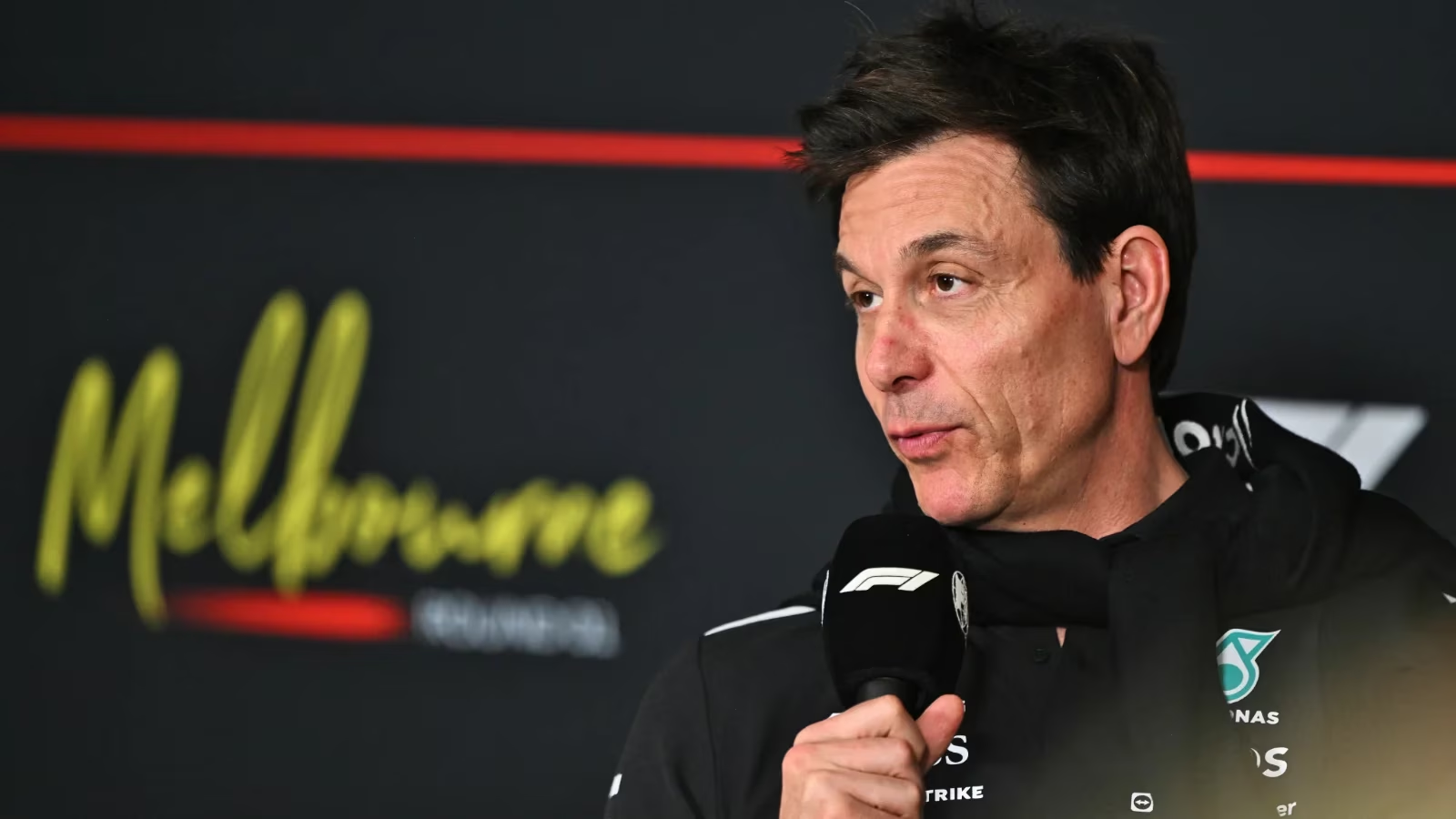
Despite Toto Wolff’s protestations that “the learning curves are steep” and that Mercedes HPP are doing their best to offer a “good customer service” clearly there is a massive deficit in the playing field for Mercedes’ customers.
Andreas Stella talks of comparing Melbourne “overlays” of both Mercedes works team engine performance and presumably Williams. Again this appears magnums of the supplier, but in fact is mandated. Whilst under the revised FIA regulations which insist the same architecture of power unit and same operating software must be offered simultaneously to non-works F1 teams, there is a loophole Mercedes are exploiting in terms of the time they have allowed their customers to get to grips with things.
The manufacturers like Honda begged the FIA to delay the PU homologation (final fixed architecture design lodged with the FIA) to March 1st 2026, to ensure they could deliver the most reliable powertrains possible. But Mercedes appear to have exploited this as an opportunity to delay the timescale their customers have to get top grips with modelling how to apply the power.
Expected F1 engine rule change. Newey masterstroke could transform Aston Martin
FIA must insist on earlier powertrain homologation
James Vowels spoke about how much more efficient the power application was than he expected, something which Oscar Piastri found out to his peril on the way to the grid. There’s little point giving teams six days of extra testing to get to grips with the new chassis and powertrain regulations when the power units can then be modified after the final test and before the season opener.
The power unit manufacturers have had years to develop these power trains, discussions began all the way back in 2017 at an FIA working party. The naval gazing over the future F1 power has been quite extra-ordinary, with the current powertrains initially pencilled in to debut in 2020.
There’s no excuse for the all new PU’s not to have been homologated before the very first shakedown in Barcelona, and this is something the FIA must act upon before the 2026/7 winter PU development work and next season’s upgrades become finalised.
NEXT ARTICLE – Why Aston Martin’s difficult 2026 start could turn around after expected F1 engine rules change
Aston Martin’s troubled start may hide a bigger opportunity – The team’s challenging start to the 2026 Formula 1 season has raised serious concerns about their competitiveness. Technical issues related to the Honda power unit have hindered performance, resulting in premature retirements and highlighting vulnerabilities in the AMR26 package.
However, beneath the immediate crisis, there is a growing belief within the paddock that a fundamental change in how the new power unit regulations are interpreted could dramatically reshape the competitive landscape.
If this change materialises, particularly with regard to the balance between internal combustion engine output and electrical power, Aston Martin could find itself in a strong position. For now, however, the Silverstone-based team is preparing for another challenging weekend…. continue reading


A.J. Hunt is Senior Editor at TJ13, where Andrew oversees editorial standards and contributes to the site’s Formula 1 coverage. A career journalist with experience in both print and digital sports media, Andrew trained in investigative journalism and has written for a range of European sports outlets.
At TJ13, Andrew plays a central role in shaping the site’s output, working across breaking news, analysis, and long-form features. Andrew’s responsibilities include fact-checking, refining editorial structure, and ensuring consistency in reporting across a fast-moving news cycle.
Andrew’s work focuses particularly on the intersection of Formula 1 politics, regulation, and team strategy. Andrew closely follows developments involving the FIA, team leadership, and driver market dynamics, helping to provide context behind the sport’s biggest stories.
With experience covering multiple seasons of Formula 1’s modern hybrid era, Andrew has developed a detailed understanding of how regulatory changes and competitive shifts influence the grid. Andrew’s editorial approach prioritises clarity and context, aiming to help readers navigate complex developments within the sport.
In addition to editorial duties, Andrew is particularly interested in how media narratives shape fan perception of Formula 1, and how reporting can balance speed with accuracy in an increasingly digital news environment.

In truth, I haven’t bothered to read the WHOLE article on this occasion but – it appears to me – that – yet again! – Mercedes have been less than honest and sporting with their customers. MAYBE it’s time for customers to revolt and decide, at the end of this season, they will NOT use Mercedes engines in the future, and go elsewhere … ? And if their current contracts say they must continue, cite Mercedes’ breach of the FIA rules as a reason to cancel such contracts without penalties.
I can’t believe 0.9 seconds PER LAP has been gained simply from more practice time either – FIA should be checking those cars MUCH earlier than June!
Is TW prepared to flout any rule to win another title? Seems so!
Name me a Team Principle who WOULDN’T be “prepared to flout any rule to win another title”, and I will show you a fairy on a stick