

Aston Martin’s troubled start may hide a bigger opportunity – The team’s challenging start to the 2026 Formula 1 season has raised serious concerns about their competitiveness. Technical issues related to the Honda power unit have hindered performance, resulting in premature retirements and highlighting vulnerabilities in the AMR26 package.
However, beneath the immediate crisis, there is a growing belief within the paddock that a fundamental change in how the new power unit regulations are interpreted could dramatically reshape the competitive landscape.
If this change materialises, particularly with regard to the balance between internal combustion engine output and electrical power, Aston Martin could find itself in a strong position. For now, however, the Silverstone-based team is preparing for another challenging weekend.

Honda confirms timeline for fixes
The most pressing issue for Aston Martin is vibrations within the Honda power unit, damaging the battery systems.
Honda Racing Corporation president Koji Watanabe has confirmed to Autosport Japan that these countermeasures will not be ready until the Japanese Grand Prix later this month at the earliest. This effectively means that Aston Martin is likely to endure another suboptimal performance at the upcoming Chinese Grand Prix.
Watanabe explained that engineers are still evaluating how best to address the issue.
According to the Honda chief, the priority is to ensure that the power unit can operate reliably before introducing a permanent fix. Engineers at Honda’s Sakura facility are continuing development work in collaboration with Aston Martin’s engineering team in Silverstone.
The hope is to have a stable solution in place by the time the championship reaches Suzuka, Honda’s home race, where the manufacturer will be keen to avoid further embarrassment.
Until then, Aston Martin’s problems remain unresolved.
Would you like to see more TJ13 Formula 1 coverage? Add us to your favourites list on Google to receive trusted F1 news.
Australia exposed the scale of the problem
The first race of the new regulatory era quickly revealed the severity of the issue.
Fernando Alonso was forced to retire his AMR26 after just 14 laps, while his teammate Lance Stroll managed only 38 before the team withdrew his car as a precaution. The vibration problem threatened not only the integrity of the battery system, but also caused physical discomfort for the drivers.
Reports from the garage suggested that the vibrations were strong enough to cause numbness in the drivers’ fingers during the race.
For a project that has absorbed enormous investment from team owner Lawrence Stroll and carries the technical prestige of designer Adrian Newey, the result was a difficult start to the season.
However, the wider story unfolding around Formula 1’s new engine regulations could ultimately reshape Aston Martin’s prospects.
Debate intensifies over 2026 power unit balance
The 2026 Formula 1 regulations introduced a dramatically different power unit philosophy. Electrical power now plays a far larger role in overall performance, with energy harvesting and battery deployment becoming critical elements of race strategy.
Although this was intended to modernise the sport and bring it closer to road-car technology, the early races have sparked widespread debate about whether this has gone too far.
Drivers and teams have complained that battery management dominates the racing experience. Rather than attacking on the track, competitors are often forced to lift and coast in order to conserve energy.
Critics argue that the result is a driving style that feels unnatural and is difficult for fans to follow.
Reigning world champion Lando Norris voiced some of the strongest concerns during the opening weekend of the season. He warned that Formula 1 has gone from producing some of its best racing machines to potentially producing its most problematic ones.
Despite the criticism, championship organisers are resisting the temptation to make immediate changes.
MORE F1 NEWS – F1 project “botched”: Adrian Newey and Aston Martin mocked by the Italian press
Evaluation is planned after the Chinese Grand Prix
Discussions between Formula 1, the FIA and the teams have established a clear review timetable.
Rather than reacting hastily after the first race, the governing bodies have agreed to collect more data from the opening rounds before considering any adjustments. The Australian Grand Prix was considered an atypical circuit for energy management, meaning that its results alone were not representative.
Instead, officials will conduct a comprehensive review after the Chinese Grand Prix.
Any urgent modifications could then be introduced for the Japanese Grand Prix, with further refinements potentially arriving later in the season.
The almost certain postponement of several Middle Eastern races due to geopolitical tensions may also give teams and regulators additional time to evaluate potential rule changes before the championship resumes in Miami.
At the heart of the debate lies the question of how energy should be distributed between electrical systems and the internal combustion engine.
MORE NEWS – Verstappen put on notice by Red Bull rookie: “I’m here to fight”
Rumours of a deeper rule shift
Publicly, discussions have focused on adjustments to energy harvesting and deployment levels. Options include increasing the effectiveness of energy recovery systems or reducing the maximum power that can be deployed from the battery.
However, there are increasing whispers within the paddock that a more fundamental change may eventually be considered.
Several insiders suggest that Formula 1’s long-term objective could be to revisit the balance between electrical and combustion power in the 2026 regulations. This would alter the performance profile of the power units more fundamentally than simply tweaking energy management parameters.
Currently, the electrical component contributes a substantial portion of the overall power output. If the regulators decide that the balance should shift slightly back towards the internal combustion engine, this could significantly reshape the competitive landscape.
For teams grappling with battery efficiency or power units that rely heavily on electrical deployment, such a shift could be transformative.
This is why some observers believe that Aston Martin’s situation may not be as bleak as it appears. Join the discussion below

Why a rule shift could help Aston Martin
Despite the early reliability issues, Aston Martin’s collaboration with Honda could actually put the team in a strong position if the regulations evolve to place greater emphasis on combustion engines.
Honda’s engineering philosophy has historically prioritised strong internal combustion performance. If Formula 1 were to increase the relative importance of the engine compared with the electrical system, the manufacturer’s strengths could become more prominent.
Furthermore, Aston Martin’s aerodynamic and chassis development programme, overseen by Adrian Newey, was reportedly designed with flexibility in mind. Engineers anticipated that the initial interpretation of the 2026 regulations might change once real-world data was available.
If this proves to be the case, the AMR26 concept could be better suited to a revised balance of power between the engine and the electrical systems.
For now, this remains speculation, but it is being discussed more openly as teams analyse the opening races.
NEWS – McLaren F1 boss Stella demands Mercedes powertrains to improve transparency with customers
Mercedes teams are urging caution before changes are made
Despite mounting criticism of the current regulations, many senior figures in the sport are calling for caution.
Williams team principal James Vowles has warned that premature adjustments could easily make matters worse rather than better
“I think the worst thing we can do is change it and make it worse,” he said.
In his view, it is crucial that Formula 1 collects sufficient race data before amending the technical framework.
Even Toto Wolff, whose team performed strongly in the season opener, acknowledged that rule changes may ultimately be necessary.
“I didn’t hear any of the drivers speaking particularly good of the last cars and saying it was the best car,” Wolff said. “So we tend to be very nostalgic in looking at past events.”
However, he emphasised that the sport’s decisions should primarily be guided by the quality of the spectacle for fans, rather than by competitors’ complaints.
Formula 1 chief executives have echoed these sentiments, suggesting that the priority is to ensure that the new generation of cars delivers exciting racing while maintaining technical credibility.
F1 NEWS – Max Verstappen started Australian Grand Prix with no battery power: What really happened?
Safety concerns are also driving discussions
Beyond the sporting spectacle, safety has also emerged as a key concern during the early races.
Large differences in energy levels between cars can result in significant disparities in closing speed. Drivers with fully charged batteries may approach competitors travelling at much slower speeds once their energy reserves have been depleted.
Several drivers have warned that such speed differences could lead to serious accidents if left unaddressed.
This issue has been particularly evident at the start of races, where cars with energy deployment issues have occasionally accelerated much more slowly than those around them.
While no major incidents have occurred yet, the situation has increased pressure on the FIA to evaluate whether adjustments are required.
Would you like to see more TJ13 Formula 1 coverage? Add us to your favourites list on Google to receive trusted F1 news.
A difficult present, but an uncertain future
The immediate outlook remains challenging for Aston Martin. The vibration issue affecting the Honda power unit is unlikely to be fully resolved before the Japanese Grand Prix, so the team may struggle in China too.
However, the broader technical debate surrounding the 2026 regulations suggests that the competitive order could change significantly as the season progresses.
If Formula 1 ultimately decides to prioritise internal combustion performance in the power unit formula, teams currently struggling with electrical systems may suddenly find themselves in a stronger position.
For Aston Martin, this possibility offers a rare glimmer of optimism amid a troubled start to the season.
The next few races, and the subsequent regulatory discussions, may be far more important than the early championship standings suggest.
NEXT ARTICLE – 2026 Australian GP: Exciting or Whacky races as perilous dangers become apparent
Probably the most debated change in technical and sporting regulations in the history of Formula One finally was born into reality in Melbourne on Sunday 8th March. On the way to the grid, local hero Oscar Piastri slammed his McLaren car into the wall as an apparent torque spike took control of the MCL40.
The Australian was to take no further part in the days action. Previously in qualifying on his first flying lap, the driver considered a generational talent and maestro of car control, Max Verstappen suffered a similar fate sending his RB22 skipping across the gravel trap at turn one and into the barrier.
Max would start the Grand Prix down in in 20th place. The all new 2026 F1 cars have enormous amounts of torque available at the push of a button to the drivers, delivered from the hybrid powertrains which now sport 50% electrical power output alongside the internal combustion engines (ICE).
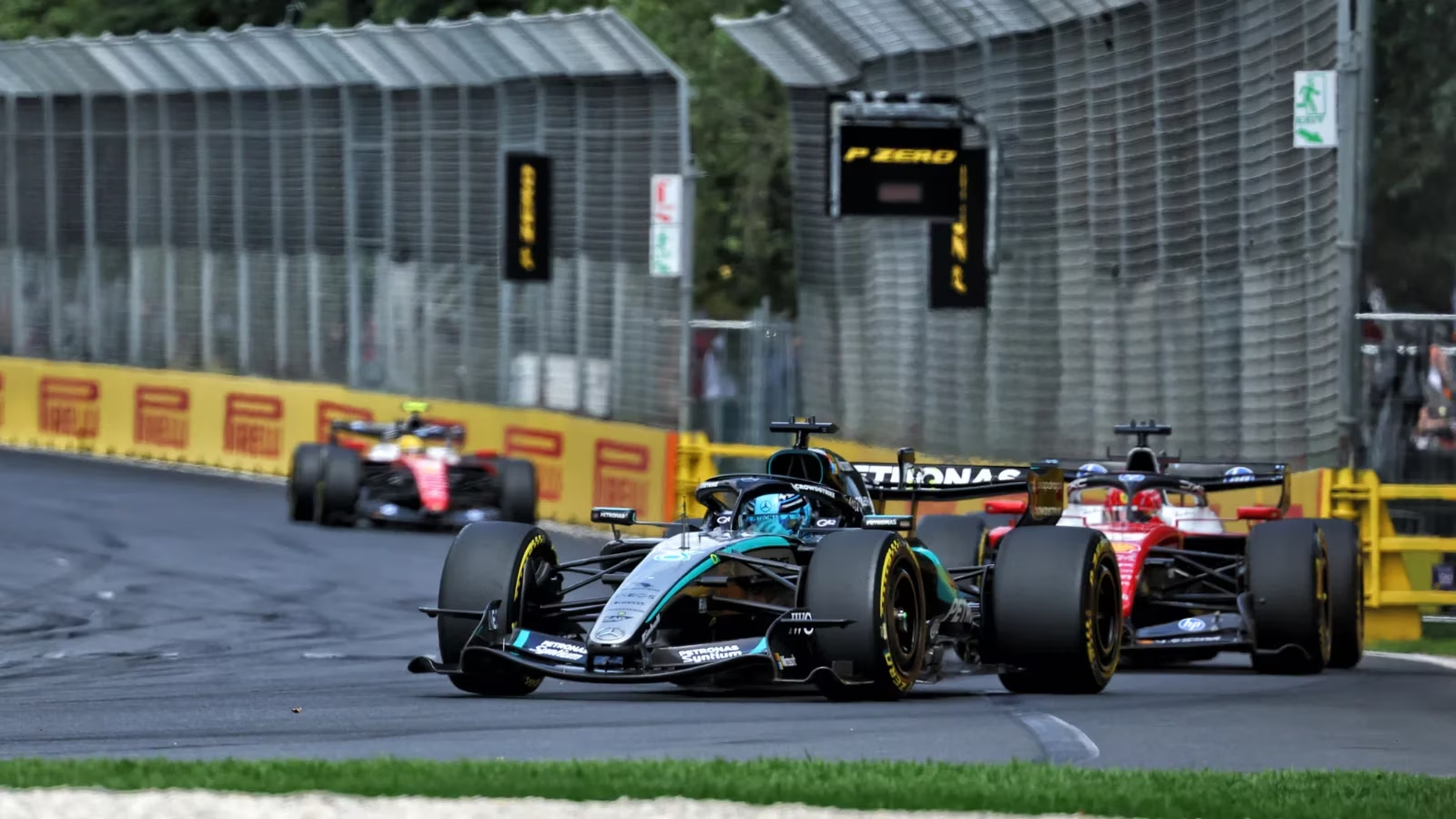
New cars, new rules, new kind of F1 racing
Torque from the electric motors unlike from the ICE is instant and uncontrolled will spin up the wheels at the rear of the car, leaving the driver helpless to control what follows. Add into the mix that the 2026 cars have lost a huge amount of downforce and ride on tyres which have a smaller contact patch meaning less grip.
Throughout the weekend, F1 analysts and broadcasters were marvelling at the fact the F1 cars were no longer on rails and that the drivers were being forced to wrestle control of their machines. Another improvement to the spectacle was the fact that the new aerodynamics and powertrains were allowing the cars to follow more closely without the driver behind destroying his tyres.
At the start of the race, George Russell on pole position reported his battery pack appeared empty and with the lights going out almost instantaneously he and a number of drivers were caught by surprise. Charle Leclerc in his fast starting Ferrari weaved between Hadjar ahead and then Russell to…CONTINUE TO READ THIS ARTICLE

The Judge, a nom de plume of an experienced F1 journalist and site founder with long-standing sources across the paddock. With over 30 years of experience in Formula 1 as an insider journalist, I have built trusted connections across the paddock, from race engineers and mechanics to senior team figures. At The Judge 13, I and a handful of trusted colleagues share exclusive Formula 1 news, expert analysis and behind-the-scenes stories you will not find in mainstream motorsport media.
