
The opening race of the new Formula 1 era at the Australian Grand Prix produced plenty of drama, but few could have predicted that one of the biggest talking points would be Max Verstappen starting the race with an empty battery.
For Red Bull Racing, the weekend in Melbourne was a strange mix of disappointment and resilience. While rookie Isack Hadjar retired from a promising grid position, Verstappen somehow managed to drag his car from the back of the field to finish sixth at Albert Park Circuit.
Team principal Laurent Mekies later revealed that both Red Bull cars had suffered a bizarre problem before the race had even begun: they had started with almost no electrical energy available.
This has sparked fresh debate about Formula 1’s radical 2026 regulations and whether the sport has taken its hybrid technology too far.
MORE F1 NEWS – Paddock Revolt in Melbourne: Teams Furious with FIA as Mercedes Stuns the Field

A Chaotic Start to Formula 1’s New Era
The 2026 season marks one of the most dramatic technical resets in Formula 1 history. The new power units feature a near 50–50 split between internal combustion and electric power, forcing teams and drivers to manage energy in unprecedented ways.
Speaking after the race, Mekies acknowledged the scale of the challenge: “This weekend was very important for Formula 1,’ he said. ‘It’s the first race of a completely new era for the sport. After weeks of speculation, the fans were rewarded with a captivating race here in Melbourne.”
Radical rule changes always come with growing pains, and the season opener proved exactly that.
“With such a dramatic shift in technical regulations, some retirements were inevitable,” Mekies admitted. “Unfortunately, Isack was one of them, despite doing such a strong job all weekend.”
Hadjar had qualified impressively in third place, but his race ended prematurely due to engine failure.
There were at least some positives for Red Bull, however. All but one of the cars powered by the Red Bull Powertrains and Ford Motor Company partnership reached the finish line, with two finishing inside the top ten.
Then there was Verstappen’s recovery drive.
“If anyone needed reminding of what an exceptional driver Max is, he delivered a fantastic performance,” said Mekies.
The Strange Case of the Empty Battery
Yet Verstappen’s race was compromised even before the start. In a surprising admission, Mekies revealed that both Verstappen and Hadjar had started the race with depleted batteries.
“Yes,” the Frenchman confirmed. “Isack and Max both started with no power in their batteries.”
In modern Formula 1, that is a major problem. The electric component of the power unit delivers a significant performance boost, and without it, drivers are dramatically underpowered.
According to Mekies, the issue occurred during the formation lap.
“We encountered unexpected limitations in the way the battery charged during the formation lap,” he explained.
Drivers use that lap to prepare their cars by accelerating, braking, weaving, and heating their tyres and brakes. However, the new 2026 power systems appear far more sensitive to the way in which this energy cycle works.
“Because of the unusual driving behaviour during the formation lap, accelerating, braking and then accelerating again while warming the tyres and brakes, we reached a point where we could no longer optimise the battery status,” said Mekies.
In other words, Red Bull miscalculated the energy flow. The consequences were immediate
“For Max, it meant we had to charge the battery during the first lap of the race,” Mekies admitted. “That’s obviously not very pleasant for the driver.”
Verstappen effectively had to sacrifice performance early on just to recharge the system.
Where Red Bull Stands in the 2026 Peaking Order
Even without the battery issue, Red Bull was bracing itself for a difficult start to the season.
Before the race weekend, Mekies predicted that his team would be the fourth-fastest outfit at the start of the year.
After Melbourne, that assessment appears accurate.
“I said before the season that we would be the fourth strongest team at the start, “Mekies explained. “That prediction was quite accurate.”
Qualifying suggested that the situation might have been slightly better.
“With Isack starting third and Max potentially in the same region had he completed a normal qualifying session, things looked encouraging.”
However, the race pace told a clearer story. Red Bull appears capable of matching McLaren, but still trails Ferrari and Mercedes.
“That’s not a surprise to me,” said Mekies. For Verstappen, that reality meant damage limitation rather than fighting for victory.
Would you like to see more TJ13 Formula 1 coverage? Add us to your favourites list on Google to receive trusted F1 news.
Verstappen’s sarcastic reaction
After climbing from 19th on the grid to sixth, Verstappen’s post-race comments carried a hint of sarcasm: “It was great. Yes, lots of fun,” he told reporters with a grin.
Despite his recovery drive, the Dutchman remains deeply sceptical about the new generation of Formula 1 cars.
Battery management has become a central element of racing strategy. Drivers must sometimes take their foot off the throttle to recharge energy rather than racing flat out. For Verstappen, this goes against everything he believes Formula 1 should be.
“I love motorsport,” he said. “But you cannot accept everything.”
Verstappen: “Formula E on Steroids”
Verstappen has already voiced his strong criticism during pre-season testing, famously describing the new cars as ‘Formula E on steroids’. His concern is that the increased electric power forces drivers to manage their energy constantly rather than attacking every lap.
This shift comes from the new engine balance. With a 50:50 split between combustion and electrical power, running out of battery energy can dramatically slow a car down on straights.
Drivers must therefore plan every lap carefully. Fail to manage energy correctly and you are instantly vulnerable. For a racer like Verstappen, who is known for his relentless aggression, this feels unnatural.
“We’re not criticising for the sake of it,” he explained. “Drivers and fans want the best for the sport. We want it to remain real Formula 1.”
F1 Results Today: Russell Wins as Piastri’s Home Race Ends in Pre-Start Disaster
Norris raises safety concerns
Even the reigning world champion, Lando Norris, has voiced his concerns about the new racing dynamics.
While the Melbourne race delivered plenty of action, Norris warned that the underlying mechanics of energy management could create dangerous situations. Drivers sometimes slow down suddenly to recharge their batteries, which could cause trailing cars to close in rapidly.
“That’s not a good situation,” he admitted.
Rear-end collisions are now a real possibility if drivers misjudge these energy cycles. For now, however, the system remains part of the sport’s new technical direction, but rumours suggest that this could well change sooner rather than later READ MORE ON THAT TOPIC

A Learning Race for Red Bull
Despite the frustrations, Mekies insists that Melbourne was primarily a learning exercise.
“This was a development race for us,” he said. “We collected a huge amount of data that we can use very quickly.”
The next opportunity comes in just a few days at the Chinese Grand Prix. As for Red Bull, solving the battery puzzle will be a top priority. If Verstappen can climb from the back of the grid with an empty battery, the rest of the field will realise just how dangerous he could be once everything is working properly.
NEXT ARTICLE – 2026 Australian GP: Exciting or Whacky races as perilous dangers become apparent
Probably the most debated change in technical and sporting regulations in the history of Formula One finally was born into reality in Melbourne on Sunday 8th March. On the way to the grid, local hero Oscar Piastri slammed his McLaren car into the wall as an apparent torque spike took control of the MCL40.
The Australian was to take no further part in the days action. Previously in qualifying on his first flying lap, the driver considered a generational talent and maestro of car control, Max Verstappen suffered a similar fate sending his RB22 skipping across the gravel trap at turn one and into the barrier.
Max would start the Grand Prix down in in 20th place. The all new 2026 F1 cars have enormous amounts of torque available at the push of a button to the drivers, delivered from the hybrid powertrains which now sport 50% electrical power output alongside the internal combustion engines (ICE).
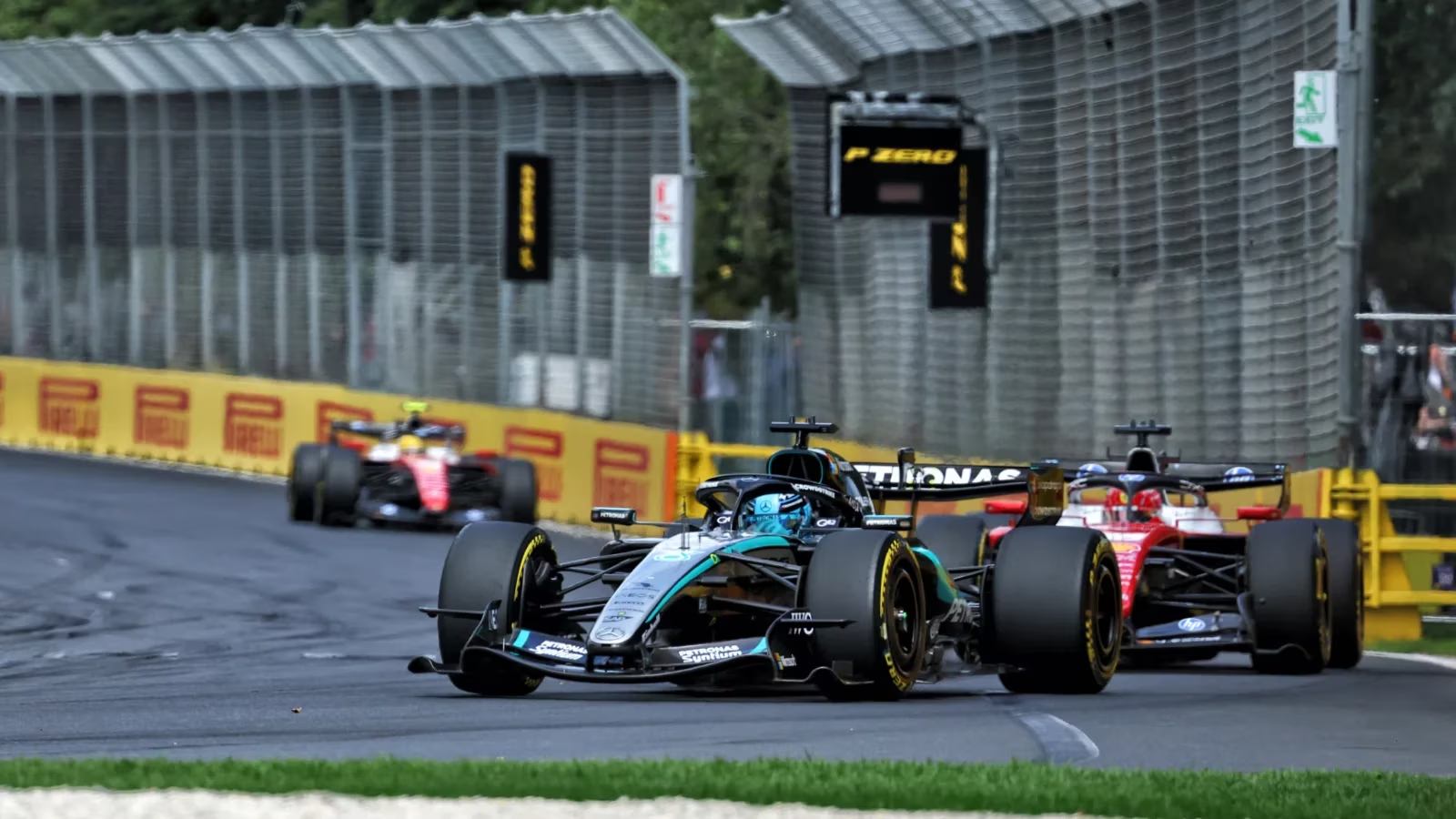
New cars, new rules, new kind of F1 racing
Torque from the electric motors unlike from the ICE is instant and uncontrolled will spin up the wheels at the rear of the car, leaving the driver helpless to control what follows. Add into the mix that the 2026 cars have lost a huge amount of downforce and ride on tyres which have a smaller contact patch meaning less grip.
Throughout the weekend, F1 analysts and broadcasters were marvelling at the fact the F1 cars were no longer on rails and that the drivers were being forced to wrestle control of their machines. Another improvement to the spectacle was the fact that the new aerodynamics and powertrains were allowing the cars to follow more closely without the driver behind destroying his tyres.
At the start of the race, George Russell on pole position reported his battery pack appeared empty and with the lights going out almost instantaneously he and a number of drivers were caught by surprise. Charles Leclerc in his fast starting Ferrari weaved between Hadjar ahead and then Russell to…CONTINUE TO READ THIS ARTICLE

Craig Alderson is Senior Editor at TJ13, where Craig oversees newsroom operations and coordinates editorial output across the site. With a background in online sports reporting and motorsport magazine editing, he plays a key role in maintaining consistency, speed, and accuracy in TJ13’s coverage.
During race weekends, Craig acts as desk lead, directing contributors, prioritising breaking stories, and ensuring timely publication across a fast-moving news cycle.
Craig’s work focuses heavily on real-time developments in the paddock, including team updates, regulatory decisions, and emerging controversies. This role requires a detailed understanding of Formula 1’s operational flow, from practice sessions through to race-day strategy and post-race fallout.
With experience managing editorial teams, Craig ensures that TJ13 delivers structured, reliable coverage while maintaining the site’s distinctive voice.
Craig has a particular interest in how information moves within the paddock environment, and how rapidly developing stories can be accurately translated into clear, accessible reporting for readers.
