
“They’ve pulled the wool over our eyes.”: Uncertainty looms over Renault’s historic Viry-Châtillon site – The future of Renault Sport’s historic base in Viry-Châtillon, long regarded as the cradle of the group’s Formula 1 engine programme, has been thrown into serious doubt. According to the town’s mayor, Renault is preparing to abandon the commitments it made following the planned end of its F1 power unit development, raising fears that the site could ultimately be dismantled entirely.
Jean-Marie Vilain, the mayor of Viry-Châtillon in the Essonne department, said he had learned with “astonishment” of Renault’s intention to abandon plans for an engineering centre of excellence. This project was intended to offset the conclusion of Formula 1 operations at the Alpine Racing facility, a cornerstone of French motorsport for nearly five decades.

The Potential End of the Hypertech Alpine Project
If confirmed at the social and economic committee (CSE) meeting scheduled for Thursday 12 February, Renault’s apparent change of course would effectively spell the end of the “Hypertech Alpine” project. This initiative was presented as a centre of technological excellence, focusing on advanced research and motorsport activities, including Alpine’s endurance racing programme and Dacia’s rally-raid efforts.
The project was intended to secure the future of the site after the shutdown of F1 engine development, safeguarding jobs and expertise. However, local officials and unions are now concerned that it may never materialise.
“Textbook Betrayal”, Says the Mayor
In a statement published on Sunday 8 February, Mayor Vilain strongly condemned what he described as Renault’s withdrawal from its previous commitments. Speaking to AFP, he accused the manufacturer of misleading local authorities and employees alike.
“They’ve tricked us. They make commitments, then back out,” he said, calling the situation a “betrayal”.
According to the mayor, the announcement could be formally confirmed during the upcoming works council meeting, intensifying concerns among the workforce.
MORE F1 NEWS – FIA call last minute powertrain crunch meeting in Bahrain
From National Pride to National Shock
In September 2024, Renault officially confirmed that it would end its activities as a Formula 1 engine supplier. At the time, the group sought to soften the blow by unveiling an ambitious redevelopment plan for the Viry-Châtillon site. The site was to become a cutting-edge engineering hub, with research programmes focused on hydrogen engines, next-generation batteries, and advanced electric powertrains.
The project was also intended to support Alpine’s endurance racing ambitions and Dacia’s participation in rally-raid competitions, establishing Viry as a laboratory for the future of mobility and motorsport innovation. Today, however, these promises appear increasingly fragile.
Fears of an ’empty shell’
Despite the establishment of two monitoring committees under the supervision of the Essonne prefecture, confidence has steadily eroded.
“The employees sense that something is going wrong,” warned Mayor Vilain, echoing concerns voiced by trade unions.
As early as September 2024, unions described Hypertech Alpine as a ‘shell’ or a ‘vague project’, warning that delays and a lack of clarity could lead to key talent leaving. They cited competitors such as Audi and Ferrari as potential destinations for engineers whose expertise remains highly sought after.

Alpine and Dacia Programmes Under Threat?
Renault had pledged that the Viry site would retain an ‘F1 monitoring unit’ to ensure continued connection to Formula 1 technological developments. The site also houses key sporting operations for Alpine’s endurance programme and Dacia’s rally-raid activities, as well as major R&D work.
However, the mayor’s comments have reignited rumours that Alpine could eventually withdraw from the World Endurance Championship, while Dacia’s involvement in the World Rally-Raid Championship could also be scaled back as Renault refocuses on its core industrial priorities.
When contacted by AFP, Alpine management confirmed that the CSE meeting would take place, but declined to comment on its agenda.
MORE NEWS – Red Bull shake-up deepens as four more employees sacked ahead of the 2026 F1 season
A Call for State Intervention
Faced with what he views as the planned dismantling of a historic industrial site, Jean-Marie Vilain is now appealing directly to the French state, which remains a shareholder in Renault. He is urging the government to intervene to ensure the manufacturer honours its commitments.
For the roughly 500 employees at Viry-Châtillon, the stakes extend beyond job security. At stake is the survival of a unique concentration of expertise built up since the site’s foundation in 1969 by Amédée Gordini.
All eyes are now on Thursday’s meeting, which could determine whether Viry-Châtillon remains a pillar of Renault’s technological future or fades into the history books of French motorsport.
MORE F1 NEWS – Williams Forced to Cancel Testing After ‘Extreme’ Pre-Season Shock
NEXT ARTICLE – Safety concerns raised over dramatic closing speeds in new F1 era
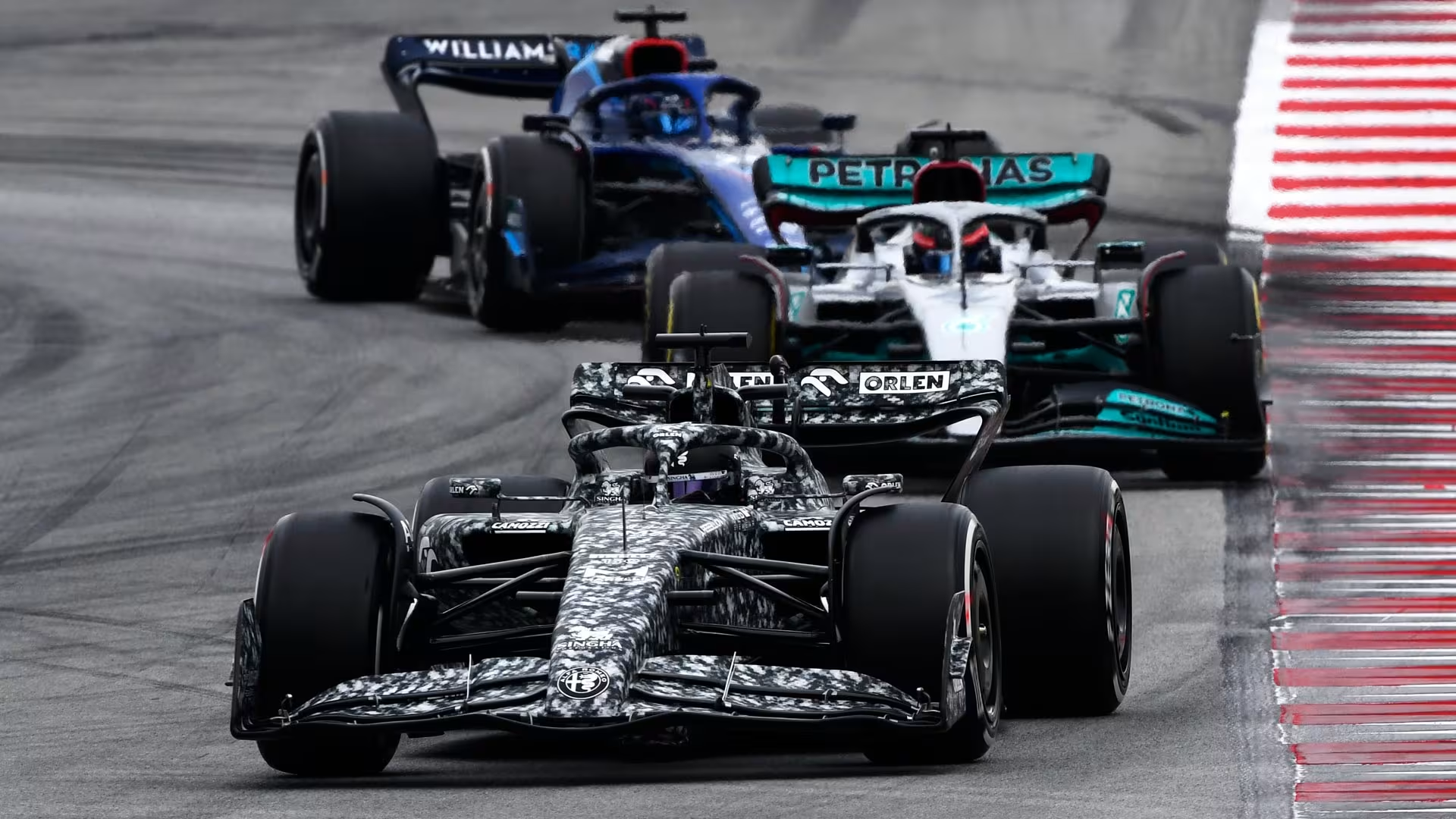
The all new Formula One era has been eagerly anticipated although the recent test in Barcelona behind closed doors has kept fans and F1 analysts alike guessing as to who will come out on top. Following drivers having tested their new machines in the simulator before the five days at the Circuit de Catalunya, the consensus was that in 2026 there will be a lot more overtaking.
Gone is the Drag Reduction system in use since 2011, which was introduced to improver overtaking although its usefulness came under fire in recent years. At certain circuits a car wishing to overtake the one in front needed to be as much as a second a lap quicker then its prey even with the DRS engaged.
In, is an Indycar style push to pass system which will allow a driver to deploy extra energy from the battery to either make a pass or to defend a potential overtake. With the electrical energy available more than three times that of the previous F1 era, harvesting energy will become a critical part of the drivers armoury.
Massive closing speeds in Barcelona test
However, what is clear from Barcelona is that a number of the cars were running out of charge before the end of the front straight. This means the driver will then either lift and coast or more likely shift down through the gears to increase the engine revs and use the internal combustion engine as a generator for the battery pack.
With one driver harvesting on the straight, whilst the one behind is deploying their battery power the closing speeds between the cars will increase dramatically compared to last season. Toto Wolff revealed that…CONTINUE READING

The Judge, a nom de plume of an experienced F1 journalist and site founder with long-standing sources across the paddock. With over 30 years of experience in Formula 1 as an insider journalist, I have built trusted connections across the paddock, from race engineers and mechanics to senior team figures. At The Judge 13, I and a handful of trusted colleagues share exclusive Formula 1 news, expert analysis and behind-the-scenes stories you will not find in mainstream motorsport media.
