

Williams returned after an “extreme” pre-season setback, explaining that they “had to go through it” – The team endured one of the most disruptive pre-season episodes in recent Formula 1 history after discovering serious issues with the new FW48 car prior to the first official test runs in Barcelona.
Although the team was forced to cancel an entire test week as a result of the setback, team principal James Vowles insists that the problems have now been fully resolved and believes that the experience may ultimately strengthen the Grove-based outfit.
Speaking to f1.com, Vowles struck a calm and confident tone despite the turmoil. “I have absolutely no concerns about anything that comes from here on out,” he said. ‘As strange as it sounds, we had to go through this phase as a team.”

Critical flaws were discovered at Grove
The problems emerged in mid-January, when Williams engineers identified that several components on the FW48 were not performing as intended. With the car failing to meet internal standards, Vowles made the decision to stop preparing for the Barcelona test and cancel it entirely.
While all ten rival teams were evaluating their 2026 challengers for the first time, Williams was forced to start again. For Vowles, who joined the team from Mercedes in 2023, it was a painful but necessary decision. He later described it as “one of the toughest decisions” of his career.
“I wish it hadn’t been so extreme,” he admitted. “But we have to go through it to make sure that we thoroughly uncover every area of our business that isn’t up to standard or fulfilling its purpose.”
MORE NEWS – Red Bull shake-up deepens as four more employees sacked ahead of the 2026 F1 season
A painful reset with long-term intent
Rather than treating the setback as a one-off technical failure, Vowles framed it as a broader reality check for the entire organisation. This pause enabled Williams to re-examine its internal processes, communication structures, and quality controls with the aim of preventing similar situations in future.
According to the team principal, the focus has been on learning quickly and applying those lessons immediately. “That’s what we’re doing,” Vowles explained.
“It’s about making changes now that will genuinely move us in the right direction, not just fixing the surface-level problem.”
Team unity strengthened under pressure
Despite the frustration of missing valuable track time, Vowles believes that the crisis has unexpectedly had a positive effect on team morale. He observed that the drivers, senior management and factory staff pulled together during the difficult period, creating a stronger sense of unity.
“I’ve seen that the drivers, the board and the entire team have grown closer together,” he said. Even as preparations for the Bahrain tests intensified, Williams continued to review what could be improved immediately rather than deferring changes to later in the season.
Back on track and looking ahead
Williams finally returned to the track last week at Silverstone, where the FW48 completed its first meaningful run without issue. This successful shakedown has boosted confidence ahead of the official pre-season test in Bahrain, which will be split into two phases from 11 to 13 February.
Although the lost mileage in Barcelona cannot be recovered, the team is now approaching Bahrain with renewed optimism and a clearer understanding of its car and internal systems.
MORE F1 NEWS – FIA call last minute powertrain crunch meeting in Bahrain
Building success through long-term investment
Last season, Williams finished fifth in the Constructors’ Championship with Carlos Sainz and Alex Albon, marking one of its strongest campaigns in years. Vowles is realistic about the team’s current limitations, but remains firmly focused on the long-term project.
“We’re not at championship level in every area,” he acknowledged.
“But we’re moving everything in the right direction, and that includes continuing to invest for the long term.”
He also drew a clear link between past decisions and recent progress.
“That’s why 2025 was successful. It was down to the investments made in 2023. And that’s why our future will be successful, too.”
While the pre-season crisis may have been extreme for Williams, if Vowles’ confidence proves justified, it could mark a defining step in the team’s long-term revival rather than derailing it.
MORE NEWS – Lewis Hamilton and Kim Kardashian: ‘Everything seemed very romantic’
NEXT ARTICLE – Safety concerns raised over dramatic closing speeds in new F1 era
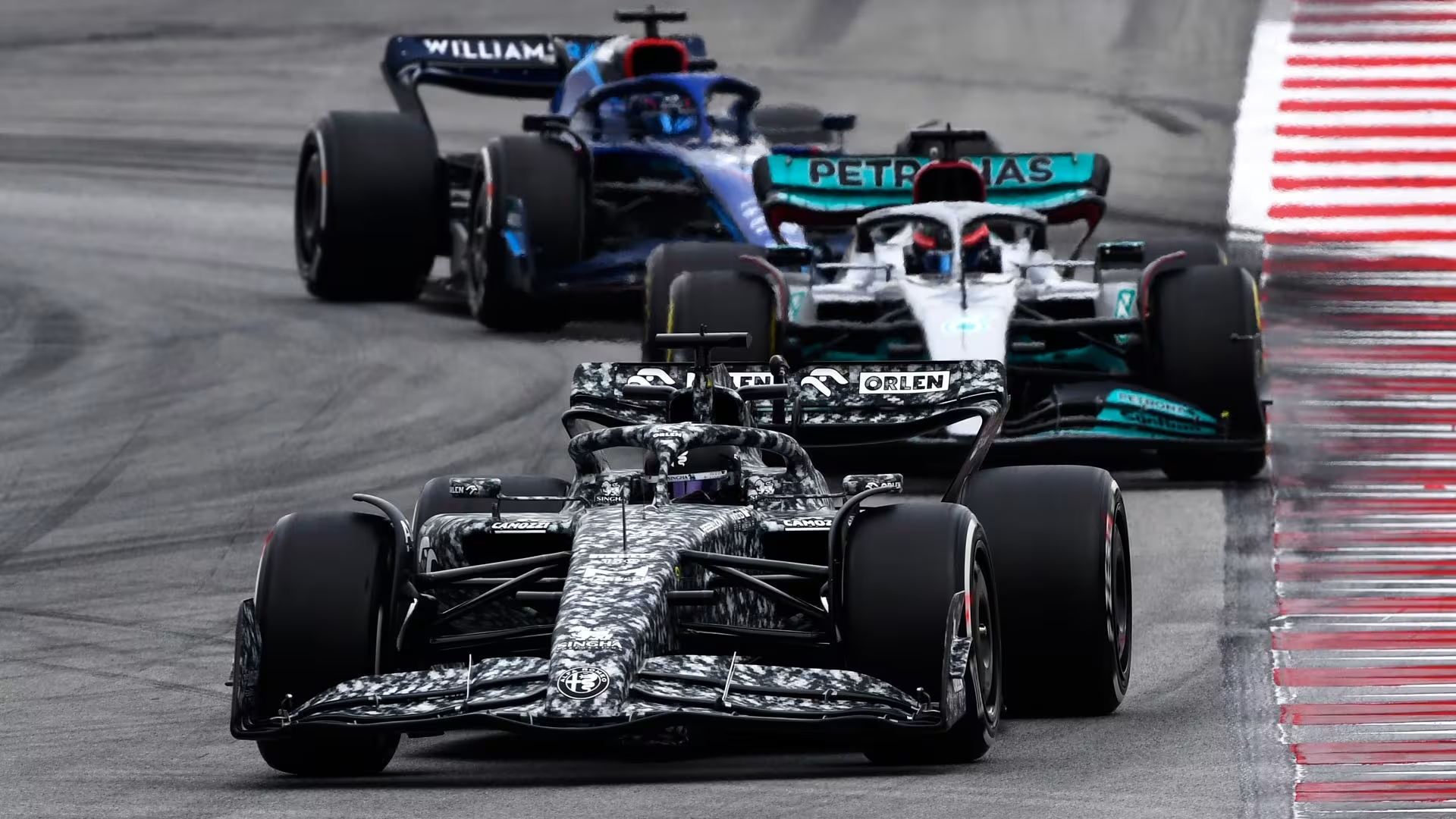
The all new Formula One era has been eagerly anticipated although the recent test in Barcelona behind closed doors has kept fans and F1 analysts alike guessing as to who will come out on top. Following drivers having tested their new machines in the simulator before the five days at the Circuit de Catalunya, the consensus was that in 2026 there will be a lot more overtaking.
Gone is the Drag Reduction system in use since 2011, which was introduced to improver overtaking although its usefulness came under fire in recent years. At certain circuits a car wishing to overtake the one in front needed to be as much as a second a lap quicker then its prey even with the DRS engaged.
In, is an Indycar style push to pass system which will allow a driver to deploy extra energy from the battery to either make a pass or to defend a potential overtake. With the electrical energy available more than three times that of the previous F1 era, harvesting energy will become a critical part of the drivers armoury.
Massive closing speeds in Barcelona test
However, what is clear from Barcelona is that a number of the cars were running out of charge before the end of the front straight. This means the driver will then either lift and coast or more likely shift down through the gears to increase the engine revs and use the internal combustion engine as a generator for the battery pack.
With one driver harvesting on the straight, whilst the one behind is deploying their battery power the closing speeds between the cars will increase dramatically compared to last season. Toto Wolff revealed that…CONTINUE READING

Craig Alderson is Senior Editor at TJ13, where Craig oversees newsroom operations and coordinates editorial output across the site. With a background in online sports reporting and motorsport magazine editing, he plays a key role in maintaining consistency, speed, and accuracy in TJ13’s coverage.
During race weekends, Craig acts as desk lead, directing contributors, prioritising breaking stories, and ensuring timely publication across a fast-moving news cycle.
Craig’s work focuses heavily on real-time developments in the paddock, including team updates, regulatory decisions, and emerging controversies. This role requires a detailed understanding of Formula 1’s operational flow, from practice sessions through to race-day strategy and post-race fallout.
With experience managing editorial teams, Craig ensures that TJ13 delivers structured, reliable coverage while maintaining the site’s distinctive voice.
Craig has a particular interest in how information moves within the paddock environment, and how rapidly developing stories can be accurately translated into clear, accessible reporting for readers.
