
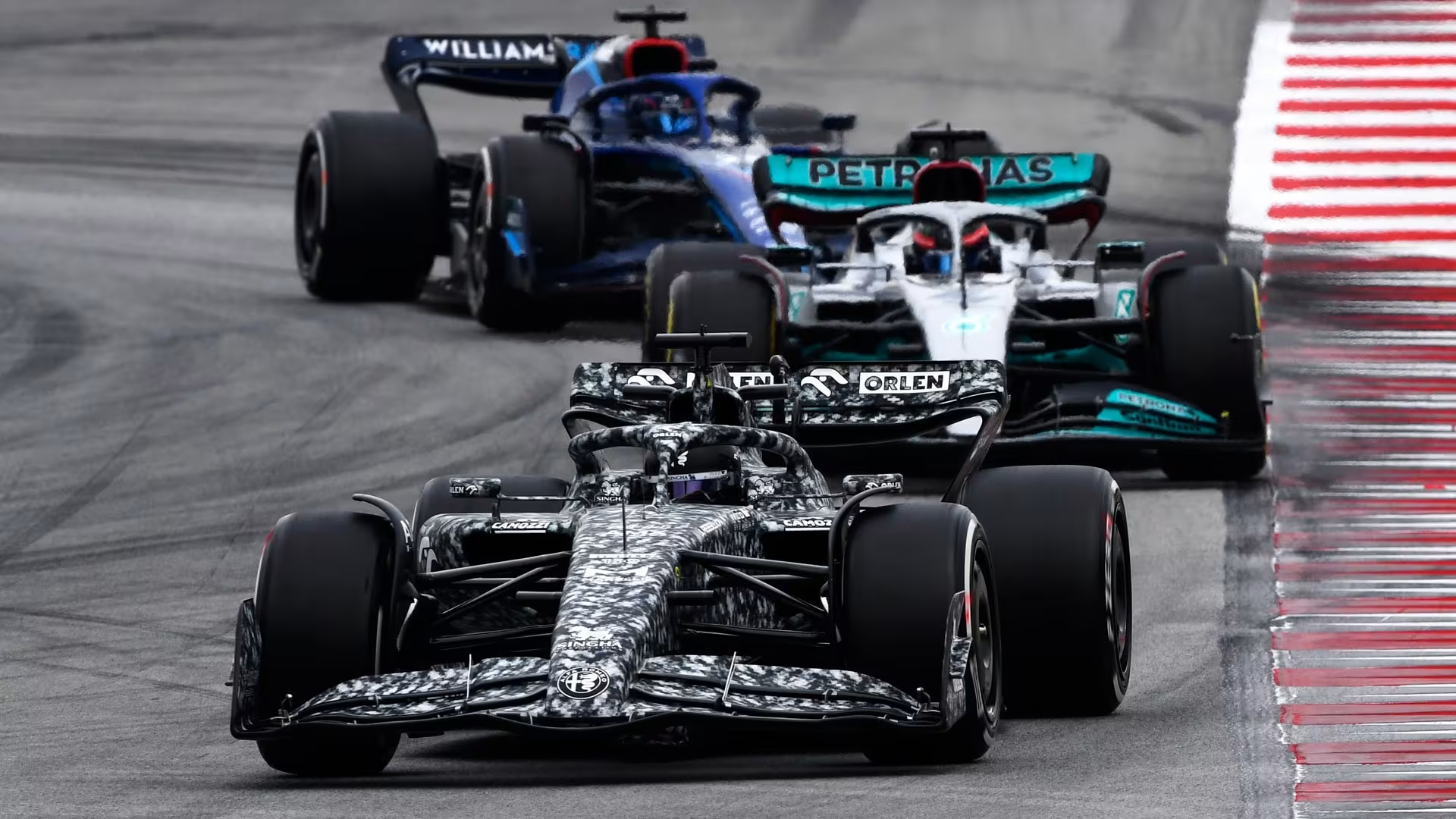
Safety concerns raised over dramatic closing speeds in new F1 era – The all new Formula One era has been eagerly anticipated although the recent test in Barcelona behind closed doors has kept fans and F1 analysts alike guessing as to who will come out on top. Following drivers having tested their new machines in the simulator before the five days at the Circuit de Catalunya, the consensus was that in 2026 there will be a lot more overtaking.
Gone is the Drag Reduction system in use since 2011, which was introduced to improver overtaking although its usefulness came under fire in recent years. At certain circuits a car wishing to overtake the one in front needed to be as much as a second a lap quicker then its prey even with the DRS engaged.
In, is an Indycar style push to pass system which will allow a driver to deploy extra energy from the battery to either make a pass or to defend a potential overtake. With the electrical energy available more than three times that of the previous F1 era, harvesting energy will become a critical part of the drivers armoury.

Massive closing speeds in Barcelona test
However, what is clear from Barcelona is that a number of the cars were running out of charge before the end of the front straight. This means the driver will then either lift and coast or more likely shift down through the gears to increase the engine revs and use the internal combustion engine as a generator for the battery pack.
With one driver harvesting on the straight, whilst the one behind is deploying their battery power the closing speeds between the cars will increase dramatically compared to last season. Toto Wolff revealed that during the Barcelona test, one of his drivers had encountered such a scenario where the speed differential was significant.
“George passed Colapinto, whilst Colapinto was doing his long runs. I think it was like 60km/h or 50km/h straight-line speed difference,” revealed the Mercedes team boss after the Barcelona shakedown. “We are going to see much more overtaking, we’re going to see it in areas that we wouldn’t expect. So, apart from the fact of the quickest cars with the best drivers, it’s also going to have this additional dimension of intelligent driving and tactics that are going to be easy to understand, in my opinion, for Formula 1.”
MORE F1 NEWS – Red Bull shakeup continues as 4 employees sacked
Brown calls on FIA to “refine the rules”
The speed differential between cars harvesting and those deploying is of concern to some in the paddock with McLaren CEO Zak Brown suggesting, “I still think there’s some work to be done with the FIA to refine the rules to make sure that while there’s strategy in how you deploy the battery and the energy, that we’re not running out of energy at the end of straits and getting into lift and coast.”
Even before the introduction of the new F1 cars and their power units there are certain circuits where closing speeds have been problematic. In Canada the pit lane entrance is directly at the end of the longest straight and on the racing line into the final chicane.
At the 2009 Canadian Grand Prix, Robert Kubica was reprimanded by stewards for a dangerous pit entry while battling with Adrian Sutil, cutting across the Force India driver to enter the pits and narrowly avoiding a collision. This scenario is now even more likely should a driver be harvesting towards the end of the straight, whilst another is deploying energy before entering the pit lane.
MORE NEWS – Mercedes 2nd engine “trick” reported
Russell describes “flying through the air”
The track in Jeddah is also of a concern with its frighting high speed sections which include numerous blind corners, then there’s Monza where the speeds entering parabolic and the first chicane are monumental. George Russell explains the new cars have much less downforce on the straights which will add to the risk of a collision.
“It’s going to have so little downforce in the straights,” said the Mercedes driver. ”It’s almost going to feel like you’re just flying through the air. You can imagine in a race that it starts raining and you’re on slick tyres, and you’re doing 250 mph on a street circuit, that’s going to be a bit of a sketchy place to be, so these are questions that need to be answered,” Russell warns.
He goes on to caution that history suggests it is only after a serious incident happens changes are made. Despite the FIA inviting the manufacturers to agree a reduction in the percentage of electrical power available – which wold prevent drivers running out of energy – the manufacturers stubbornly refused to countenance the proposal.
MORE NEWS – Oscar Piastri “McLaren made significant mistakes”
FIA can reduce electrical power on safety grounds
However, should the FIA decide there is an issue of safety to consider, they can unilaterally change the regulations without agreement from the teams or manufacturers. The real risk in terms of dramatic closing speeds is more the case when the conditions are dry. In wet conditions the drivers will be travelling more slowly and with longer breaking distances, harvesting for longer, so they’ll be spending less energy around the lap.
Oscar Piastri revealed he had a moment in Barcelona where the speed differential between him and another driver was immense. “I got close to a couple of cars, and I made one overtake, which was a pretty big speed difference,” said the McLaren driver before joking, “but I think that person was just being nice and letting me pass.
“I think the speed differences will be maybe a little bit bigger than what we had with DRS,” added the Australian, “but I don’t think there’s going to be any dangerous scenarios of cars doing wildly different speeds.
“With such a big difference in power, when you don’t have the battery deploying at full power, it’s 350 kilowatts, it’s a lot of horsepower difference, so we kind of need some indication,” suggested Piastri. The previous cars display flashing rear lights when they are harvesting energy and presumably this warning system will continue.
MORE NEWS – Horner breaks silence on ‘cheating’ Red Bull engine trick
NEXT ARTICLE – Zak Brown confirms Horner’s “Frankenstein” F1 cars prediction
The much anticipated big F1 technical regulation changes are now upon us, with all the teams bar Williams having tested their all new 2026 cars and powertrains behind closed doors in Barcelona. From the scant information released by the teams, the big four Red Bull, Mercedes, McLaren and Ferrari remain out front, although Aston Martin failed make it out on track until the dying sessions of the week.
However, despite the hundreds of laps being completed at the Circuit de Catalunya suggesting the all new power trains are on the whole reliable, big questions remain over how the new hybrids which are powered 50% from the battery and 50% from the internal combustion engine will perform during qualifying and racing.
Back in the summer of 2023 when the power unit specifications were broadly finalised, the then Red Bull team principal, Christian Horner, raised concerns that the specifications were in fact impractical. Simulations delivered back in Milton Keynes projected at a number of circuits, the energy recovery would not be sufficient to recharge the battery leaving the cars lacking in power….. CONTINUE TO READ MORE


A.J. Hunt is Senior Editor at TJ13, where Andrew oversees editorial standards and contributes to the site’s Formula 1 coverage. A career journalist with experience in both print and digital sports media, Andrew trained in investigative journalism and has written for a range of European sports outlets.
At TJ13, Andrew plays a central role in shaping the site’s output, working across breaking news, analysis, and long-form features. Andrew’s responsibilities include fact-checking, refining editorial structure, and ensuring consistency in reporting across a fast-moving news cycle.
Andrew’s work focuses particularly on the intersection of Formula 1 politics, regulation, and team strategy. Andrew closely follows developments involving the FIA, team leadership, and driver market dynamics, helping to provide context behind the sport’s biggest stories.
With experience covering multiple seasons of Formula 1’s modern hybrid era, Andrew has developed a detailed understanding of how regulatory changes and competitive shifts influence the grid. Andrew’s editorial approach prioritises clarity and context, aiming to help readers navigate complex developments within the sport.
In addition to editorial duties, Andrew is particularly interested in how media narratives shape fan perception of Formula 1, and how reporting can balance speed with accuracy in an increasingly digital news environment.
