
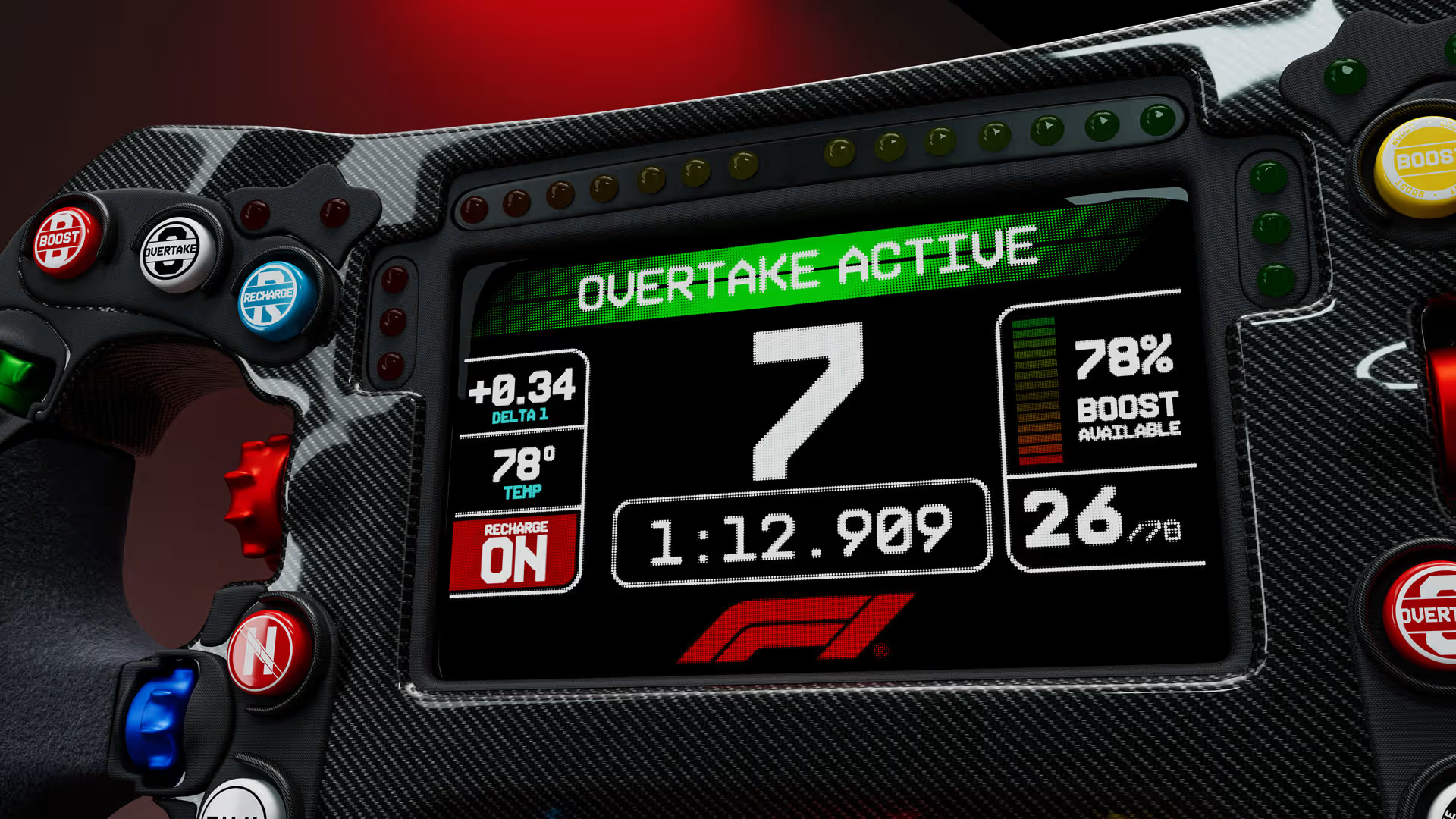
Formula 1’s new-for-2026 Overtake Mode is officially shaping the dynamic of on-track battles, according to Mercedes’ head of trackside operations Andrew Shovlin.
Introduced this season as a direct replacement for the traditional Drag Reduction System (DRS), the impact of the proximity-based energy boost has been difficult to isolate alongside other major 2026 changes—such as drastically varied team deployment strategies, altered aero maps, and smaller, lighter chassis.
Like its predecessor, Overtake Mode triggers when a driver is within one second of the car ahead, allowing them to harvest extra electrical energy to deploy a higher top-speed threshold.
Inside F1’s New Proximity Weapon
According to Shovlin, this mechanism explains why drivers who lost a position at the Canadian Grand Prix were immediately able to hook onto the back of their passer rather than dropping back.
“The regulations make it quite hard to break away because the car behind can harvest a bit more energy,” Shovlin explained in a post-race debrief video.
“Also in Montreal, because it was really cold and there are low-speed corners, the cars actually followed really well. So you could sit within less than a second, sometimes even half a second from the car in front.
“The two cars get a little bit locked together in a battle. The energy does help the one behind keep up. It’s just quite hard for [the leader] to break away.”
The Rubber-Band Effect in Action
This rubber-band effect was on full display in the opening stints of the race as George Russell and Andrea Kimi Antonelli traded the lead before Russell’s eventual retirement.
Antonelli even noted over the team radio that he actively relied on the Overtake Mode to make his moves, strategically using the lapped McLaren of Lando Norris to trigger the proximity boost and keep his momentum alive.
The real power of the system was illuminated in the closing stages of the Grand Prix when Lewis Hamilton hunted down Max Verstappen. Though Hamilton successfully executed the pass on the Red Bull, he lacked the ultimate pace to break the one-second barrier, instantly locking Verstappen into the chasing Overtake zone.
Strategic Value Over Outright Lap Time
Shovlin clarified that while the mode isn’t a silver bullet for pure pace, its strategic value in wheel-to-wheel combat is immense.
“It’s not particularly powerful in terms of lap time. You’re only getting a tenth, tenth and a half [of a second],” Shovlin noted.
“But what it does allow a driver to do, because they can harvest more, is deploy more. There’s also an effect where the car with the Overtake Mode can ultimately go faster because they get into a region of the map where it starts to tail off the power at a certain speed, and the car behind has a higher threshold. So they ultimately have a higher top speed.
“In Montreal, it’s very much about making one big move with a lot of energy down one of the long straights. And that was allowing them to get through.”
The War on Dirty Air
Yet it is not merely the Overtake Mode which is allowing the cars to follow more closely this season without destroying their tyres, but a clever reworking of the aerodynamics by technical officers at the FIA that has created 2026 cars which produce much less dirty air.
In any form of racing, “dirty air”—technically known as aerodynamic wake—is the turbulent, disrupted, and low-pressure air left in the wake of a racing car as it drives at high speed. To understand why it is the enemy of close racing, it helps to look at how an F1 car works and how dirty air disrupts it.
An F1 car is essentially an upside-down airplane. It uses complex wings, floors, and bodywork to slice through “clean air” (smooth, undisturbed air) to generate downforce—the aerodynamic force that pushes the tires hard into the track, allowing the car to corner at mind-bending speeds.
As the air passes over, under, and around the lead car, it gets violently chopped up, thrown upward, and swirled around. The air left behind the car becomes a chaotic, swirling mess of low-pressure eddies.
When a trailing car drives into this pocket of turbulent wake, its aerodynamic features suffer instantly. Because the air entering the wings of the trailing car is already chaotic and moving slower, the aerodynamic surfaces cannot function properly. Cars can lose up to 30% to 50% of their downforce when following closely, making them slide around uncontrollably in corners.
When a car loses downforce, it loses grip. The car begins to slide through the corners, which rapidly overheats the surface of the tires, causing them to degrade and lose performance within just a few laps. Further, F1 cars rely on a clean ram-air effect to force air into their sidepods and brake ducts to cool the power unit and carbon brakes. Dirty air is hotter and less dense, causing temperatures under the bodywork to spike dangerously.
Ground Effect: Lessons From the Past Era
In 2022, the new ground-effect regulations for F1 car designs were expected to reduce dirty air significantly and aid closer racing. Fifty percent of the downforce generation was shifted away from the upper surfaces of the car, and the Venturi tunnels underneath the floor were designed to ‘suck’ the car onto the circuit.
While there was some improvement in the drivers’ ability to follow closely in the first season of the new rules, by the end of 2025 the problem was as bad as ever.
This is partly because the 2022 rules were specifically designed to force air inward and throw it high over the trailing car. However, engineers hate this because slamming air into the car creates massive drag. They want outwash—pushing the turbulent air generated by the front tyres out and away from the car’s sides to clean up the airflow to their own underfloor.
Over four years, teams found clever structural loopholes to weaponise outwash again. Further, the bouncing many of the teams experienced at the start of the ground-effect era led the likes of Mercedes to press the FIA to force the teams to raise the car ride heights by some 15mm.
While this stopped the bouncing, it fundamentally disrupted how the clean ground-effect tunnels worked. To win back that lost downforce, teams were forced to rely much more heavily on top-body aerodynamics (like complex front and rear wings). Because they were using the upper wings to push the car down again, the wake left behind the car became drastically dirty.
Can F1 Outsmart its Own Engineers?
So for now, F1 is enjoying its first era since aerodynamic wings were attached to the cars where the outwash has been restricted and the dirty air mostly eliminated. Whether this remains the case throughout this continued rule set is yet to be seen. F1 engineers are experts in finding loopholes and maximizing the interests of their own cars. If outwash can once again be reinstated by them, it will be.
Would you like to see more TJ13 Formula 1 coverage? Add us to your favourites list on Google to receive trusted F1 news.

The Judge, a nom de plume of an experienced F1 journalist and site founder with long-standing sources across the paddock. With over 30 years of experience in Formula 1 as an insider journalist, I have built trusted connections across the paddock, from race engineers and mechanics to senior team figures. At The Judge 13, I and a handful of trusted colleagues share exclusive Formula 1 news, expert analysis and behind-the-scenes stories you will not find in mainstream motorsport media.

A.J. Hunt is Senior Editor at TJ13, where Andrew oversees editorial standards and contributes to the site’s Formula 1 coverage. A career journalist with experience in both print and digital sports media, Andrew trained in investigative journalism and has written for a range of European sports outlets.
At TJ13, Andrew plays a central role in shaping the site’s output, working across breaking news, analysis, and long-form features. Andrew’s responsibilities include fact-checking, refining editorial structure, and ensuring consistency in reporting across a fast-moving news cycle.
Andrew’s work focuses particularly on the intersection of Formula 1 politics, regulation, and team strategy. Andrew closely follows developments involving the FIA, team leadership, and driver market dynamics, helping to provide context behind the sport’s biggest stories.
With experience covering multiple seasons of Formula 1’s modern hybrid era, Andrew has developed a detailed understanding of how regulatory changes and competitive shifts influence the grid. Andrew’s editorial approach prioritises clarity and context, aiming to help readers navigate complex developments within the sport.
In addition to editorial duties, Andrew is particularly interested in how media narratives shape fan perception of Formula 1, and how reporting can balance speed with accuracy in an increasingly digital news environment.
