
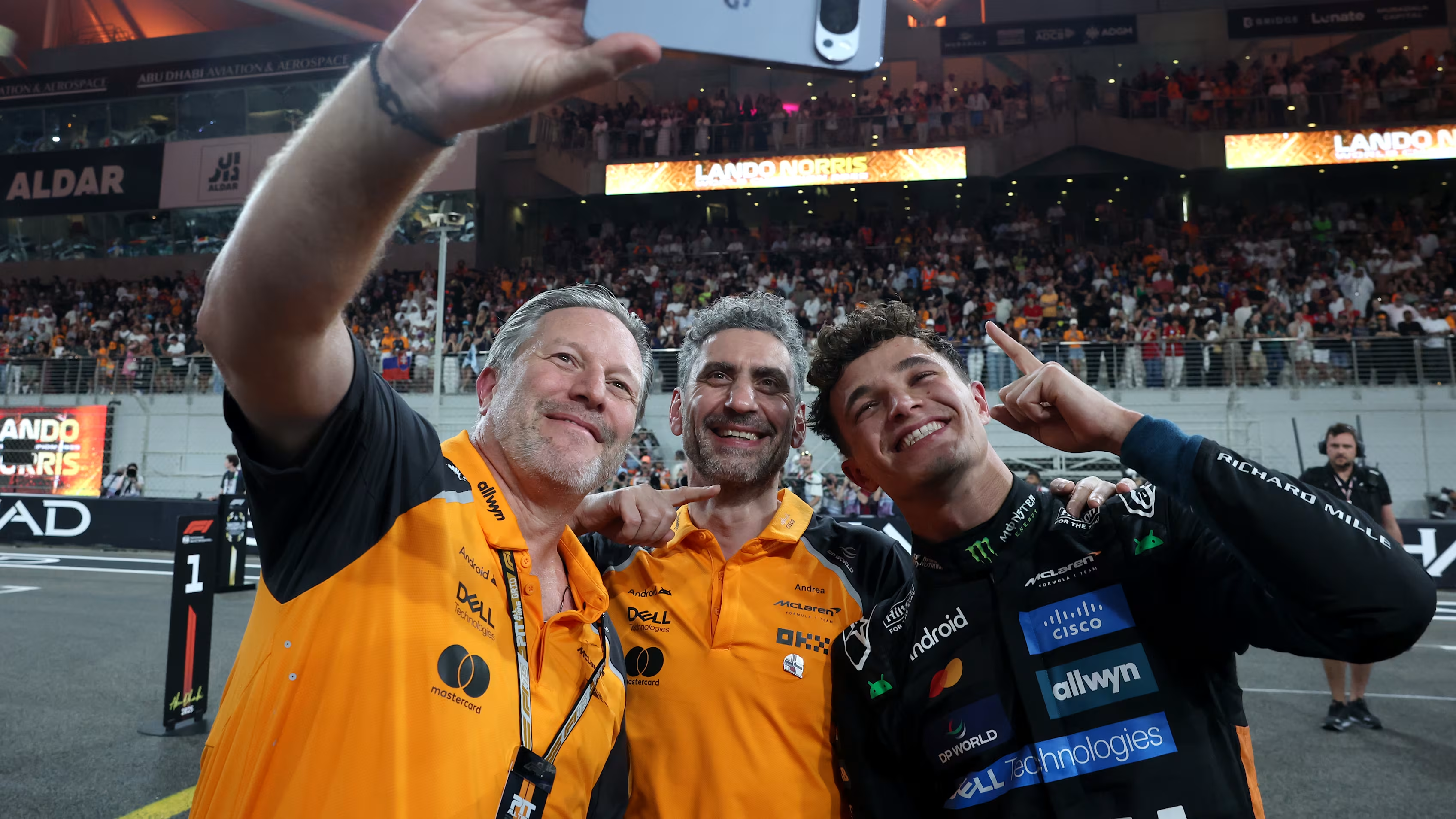
Lando Norris and Oscar Piastri trigger costly F1 licence fees after title success – Winning the Formula 1 World Championship is supposed to be the ultimate reward. A place in history, a trophy and global recognition are usually the defining features of a title-winning season.
However, for McLaren, Lando Norris’ championship success has brought something else as well: a bill of more than one million euros. This is neither a fine nor a hidden penalty. It is the direct cost of enabling the reigning world champion to compete in Formula 1 next season.

Every driver must hold a licence
As most Formula 1 fans already understand, every F1 driver must possess an FIA Super Licence, effectively the sport’s highest-level driving permit. Without it, a driver cannot participate in a Grand Prix weekend. The licence must be renewed annually and is not free. For the 2026 season, the FIA has set a base fee of €11,842. In addition, teams must pay an extra €2,392 for each World Championship point scored by a driver in the previous season.
In short, the more successful a driver is, the more expensive it is to keep them on the grid.
Former F1 boss highlights difference between Verstappen and Hamilton: ‘Max would blow him away’
Why Norris tops the list
Lando Norris scored 423 points on his way to becoming world champion. When these points are added to the base fee, the total cost of his Super Licence for the upcoming season comes to a rather staggering €1,023,658.
This makes him the most expensive driver in terms of licensing. Crucially, however, the bill is paid by McLaren, not the driver himself. While Norris enjoys the rewards of a title-winning campaign, his team is responsible for covering a cost that offers no performance advantage but rather is a bill invoiced for success on the track.
Ex-F1 official slams 2026 powertrains as a “camel”
Champions are not alone
Norris is not the only driver approaching the million-euro mark; Max Verstappen’s licence fee also exceeds €1 million, while Oscar Piastri’s sits just below that threshold. Together, the sport’s top performers generate several million euros in Super Licence revenue for the FIA.
Further down the grid, the numbers fall sharply. Drivers with fewer points incur significantly lower fees, and newcomers and returning drivers such as Arvid Lindblad, Valtteri Bottas and Sergio Pérez pay only the basic fee of €11,842.
This highlights the stark contrast in the system: winning a world title can make a driver’s licence fee nearly 100 times higher than that of a driver who has simply qualified to race.
Kimi Antonelli: How Mercedes suspension gamble ruined my year
Outside the cost cap, but not outside reality
Perhaps rather ironically, Formula 1 prides itself on financial discipline, especially under the current budget cap rules. Teams often have to argue over minor expenses, accountants scrutinise catering bills, and entire upgrades are delayed to ensure compliance with the cost cap. Every screw, sensor and sandwich is monitored with near-forensic attention.
And then there’s the Super Licence fee.
Michael Schumacher: The long-awaited official announcement?
FIA’s invoice for success outside its own cost cap rules
Conveniently, this seven-figure expense sits entirely outside the cost cap. It is not classed as performance spending, development investment or operational overhead. It is simply a bill that arrives as a reward for doing your job exceptionally well.
From a regulatory perspective, this arrangement is elegant. From a team’s point of view, however, it is less so. After months of careful budgeting, McLaren can celebrate winning the world title and then authorise a payment that could fund a small aerodynamic programme, several junior drivers or a very respectable wind tunnel upgrade. None of which, of course, is permitted within the cost cap regulations. Just ask Williams’ boss James Vowles.
You win, you pay
The irony is hard to miss. Formula 1 works tirelessly to prevent teams from spending their way to success, yet it quietly allows success itself to generate substantial, unavoidable costs. There is no loophole, no creative accounting and no clever workaround. You win, you pay.
This fee offers no competitive advantage, additional testing time or flexibility elsewhere. It exists purely as an administrative necessity, albeit one priced like a premium performance part. In a sport obsessed with marginal gains, this is a rare expense that delivers none whatsoever.
For McLaren, the cost is manageable, albeit slightly absurd. For smaller teams, however, the idea that sporting excellence comes with an invoice attached may feel like a reminder that, in Formula 1, even victory comes with terms and conditions.
The Super Licence system was designed to scale with performance, but in the modern era of Formula 1, it also highlights an unusual reality: Every point scored, every podium finish and every dominant weekend has a hidden monetary value. Success is celebrated publicly, but accounted for privately.
Could former Ferrari test driver Zhou Guanyu soon be on board at Cadillac?
License fees 2025
-
01. Lando Norris (GB): 1,023,658
-
02. Max Verstappen (NL): 1,018,874
-
03. Oscar Piastri (AUS): 999,562
-
04. George Russell (GB): 774,890
-
05. Charles Leclerc (MC): 590,706
-
06. Lewis Hamilton (GB): 384,994
-
07. Kimi Antonelli (I): 370,642
-
08. Alex Albon (T): 184,458
-
09. Carlos Sainz (E): 164,930
-
10. Fernando Alonso (E): 145,794
-
11. Nico Hülkenberg (D): 133,834
-
12. Isack Hajar (F): 133,834
-
13. Oliver Bearman (GB): 109,104
-
14. Liam Lawson (NZ): 102,738
-
15. Esteban Ocon (F): 102,738
-
16. Lance Stroll (CDN): 90,778
-
17. Pierre Gasly (F): 64,466
-
18. Gabriel Bortoleto (BR): 57,290
-
19. Franco Colapinto (RA): 11,842
-
Arvid Lindblad (S): 11,842
-
Valtteri Bottas (FIN): 11,842
-
Sergio Pérez (MEX): 11,842
MORE F1 NEWS – Hamilton Walks, Mercedes Moves On: How His Successor Became ‘Perfect’ Replacement
NEXT ARTICLE – Aston Martin’s head start for 2026

For the next three weeks until the cars hit the Circuit de Catalunya for pre-season testing, the Formula One news will be dominated by speculation over which team has aced the all new engine and chassis design regulations.
Mercedes is persistently everyone’s favourite to build the most competitive power unit, but much of that opinion is based on their efforts last time an new era of F1 power was ushered in. The Brackley/Brixworth combination went on to dominate the sport, with the Mercedes team winning a record eight consecutive constructor championships together with seven consecutive driver titles.
Yet Mercedes this time around are restricted like all the manufacturers in terms of the amount they can spend on research and development unlike in 2014 when they outspent the field. Further, other resource restrictions are in place which also level the playing field like bench testing time allowed.
One F1 fuel supplier is going fully synthetic
The FIA has also initiated a ‘catch up’ programme to prevent long term domination by one new power unit manufacturer, but there are other variables in play which Mercedes do not control.
In the autumn of 2025 a report circulated in Germany that one of the suppliers of the all new bio fuel was in trouble, having been the only one to elect to create a completely synthetic product. The requirement for Formula One for the coming season does not require fully synthetic fuel and the other manufacturers have erred on the side of caution creating bio based fuels from agricultural waste and other non-food based products.
Fully synthetic fuel would be created from a combination of green hydrogen and carbon capture but as yet there is no deadline in Formula One for this transition to occur. Formula Two, which has been running 100% sustainable fuels in 2025 will move to fully synthetic in 2027.
In F2 and F3 there is a single fuel supplier which is intended to drive costs for the teams down. The supplier is Saudi oil giant Aramco who have been developing synthetic based fuels for F2 and F3 for three seasons. Of course Aramco are Aston Martin’s fuel supplier and named sponsor and many F1 analysts believe their role in the lower Formula racing series this year…READ MORE ON THIS STORY

Alex Stanton is a Formula 1 journalist at TJ13 with a focus on the financial and commercial dynamics that underpin the sport. Alex contributes reporting and analysis on team ownership structures, sponsorship trends, and the evolving business model of Formula 1.
At TJ13, Alex covers topics including manufacturer investment, cost cap implications, and the strategic direction of teams navigating an increasingly complex financial environment. Alex’s work often examines how commercial decisions translate into on-track performance and long-term competitiveness.
With a strong interest in the intersection of sport and business, Alex provides context around Formula 1’s global growth, including media rights, expansion markets, and manufacturer influence.
Alex’s reporting aims to explain the financial realities behind headline stories, helping readers understand how money, governance, and strategy shape the competitive order in Formula 1.

Craig Alderson is Senior Editor at TJ13, where Craig oversees newsroom operations and coordinates editorial output across the site. With a background in online sports reporting and motorsport magazine editing, he plays a key role in maintaining consistency, speed, and accuracy in TJ13’s coverage.
During race weekends, Craig acts as desk lead, directing contributors, prioritising breaking stories, and ensuring timely publication across a fast-moving news cycle.
Craig’s work focuses heavily on real-time developments in the paddock, including team updates, regulatory decisions, and emerging controversies. This role requires a detailed understanding of Formula 1’s operational flow, from practice sessions through to race-day strategy and post-race fallout.
With experience managing editorial teams, Craig ensures that TJ13 delivers structured, reliable coverage while maintaining the site’s distinctive voice.
Craig has a particular interest in how information moves within the paddock environment, and how rapidly developing stories can be accurately translated into clear, accessible reporting for readers.
