
There’s an old adage which goes like this: “A camel is a horse designed by a committee.” This metaphorical notion suggests that a design or a solution created by a large and desperate group often results in a poor, inefficient or award outcome rather than one which is streamline and superior.
The conflicting input from the committee is one of compromises and conflict inherent in a committee process leading to a flawed product i.e. the camel ( functional but ungainly animal instead of a graceful, powerful racehorse.
This is the accusation now being made by one of F1’s most senior engineers of the process by which the all new 2026 Formula One power units were brought about. The current F1 powertrains were introduced back in 2014 with the expected life cycle of each era of F1 power expected to last between 5 and 7 years.
New F1 engines working party set up in 2017
Yet the V6 turbo hybrids which in their final year of 2025 broadly the same architecture now as they were in 2014 have lingered for twelve long years. How did this happen?
It all began in 2017 when the FIA set up a working party to debate the next generation of F1 power. Existing and potential manufacturers were included in the group along with senior technical engineers from each of the teams.
Given the chaos of the previous decade where manufacturers had come and gone due to the global banking crisis, the FIA were keen to broaden the base of those producing engines as a bulwark against further future withdrawals. The intention was to introduce the next era of F1 power in 2021. The proposal set to the group was to simplify the engine designs and reduce the eye watering costs and make F1 attractive to new manufacturing entrants.
However, the committee effect failed miserably to maintain this priority and inordinate and lengthy discussions then began. The FIA proposed retaining the 1.6L V6 configuration but for the highly complex heat recovery element (MGU-H) be dropped.
Where F1 drivers split from team bosses in 2025
Manufacturers dominated the vision of the future
The MGU-K (kinetic recovery system) was to become more powerful with a greater emphasis on the capability for the driver to deploy the electrical power and a more flexible way for it to be used in a tactical fashion. At the time in the world of auto manufacturing, the perceived wisdom was that hybrids would be the future for the global car industry.
Yet the political landscape was to shift from under the greatest minds in car building with Europe and the UK deciding to ban petrol and diesel powered new cars from 2030 and hybrids by 2035. When this was decided, the FIA were too far down the road to shift the vision for the next generation of F1 power.
There were suggestions made in 2021 that the sport should return to much simpler V8 engines with a KERS style add on as was the case in 2009. Yet the committee was now in full flow and the proposition was derided suggesting F1 wold be abandoning its high principles of pushing the engineering limits.
The original 2017 proposal called for more standardised components allowing teams to buy in more of the elements comprising the power side of the cars together with an idea which would replace the lost power from the MGU-H. Allowing the cars to recover kinetic energy from the front axle would be a solution to this issue although some reports misrepresented this idea as making the cars four wheel drive.
Ford latest update on RBR power unit
Porsche jealousy stalled innovation
Porsche were already utilising this technology on their WEC 919 hybrid car which had dominated the Le Mans LMP1 category from 2014-2017. Of course Mercedes were unhappy with this proposrlbelueving their German rivals wold have a significant advantage given they had been beating their rivals hands down in one of the world’s other premier motorsport categories.
COVID-19 was blamed for further delays in the introduction of the new powertrains, yet the reality was that the FIA was already becoming frustrated with the elongated process in agreeing the next F1 power era. In light of this they decided to freeze any power unit development from 2021-2025 setting a deadline for the new engines.
Even now there are significant question marks over whether the coming 2026 PU’s will create “Frankenstein monsters” as Christian Horner famously described them in 2023. Yet here we are on the brink of what may prove to have been an epic failure in F1’s history.
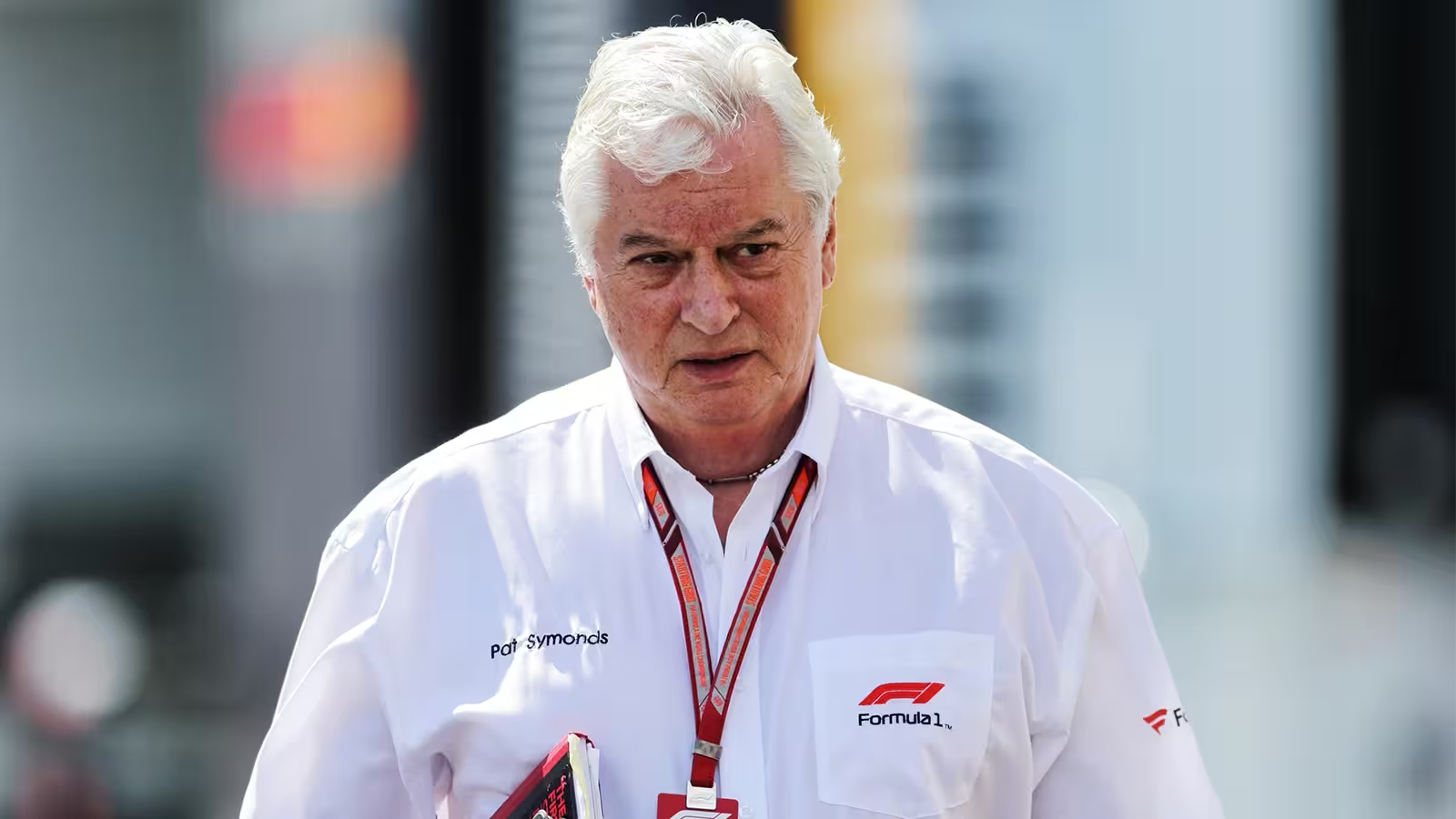
Pat Symonds who was the technical wizard behind the Toleman team which famously became the championship winning Benetton outfit before being sold to Renault, has now called the new V6 hybrid power units ‘the camel’ which resulted from the process set up to decide the future of F1 power. He was recruited by FOM in 2017 to act as their chief technical officer, in effect an advisor to the owners of the commercial rights to ensure the technical decisions made by the FIA were in line with their future interests of the sport.
FIA plans to reduce manufacturers power
Ex-Technical F1 official spills the beans
Now acting as Cadillac’s executive engineering consultant he has broken ranks on the elongated journey for the new era of F1 power, claiming the process was fundamentally flawed.
“With the ’26 power unit, the FIA said it wanted to involve the manufacturers more. Unfortunately, I think it’s like when you get a committee to design a racehorse, you end up with a camel,” Symonds reveals. He is concerned that the failure to embrace front axle regeneration technology means the new F1 powertrains will suffer from a lack of electrical stamina.
“I think that’s happened a little bit, because one of the briefs for the ’26 engine was to remove the MGU-H, because that was something that certainly improved the efficiency of the engines massively, but it was quite complex,” he adds. Yet Symonds claims without replacing the power generated the new PU’s would always be short on power.
“But once you remove that energy source, if you keep everything else similar, we’ve increased the power of the motors and things, the idea was to replace it with recovering energy from the front axle. If you did that, everything balanced out quite nicely, you weren’t short of energy, you could have a lot more electrification on the car.”
Ferrari allege Red Bull and Mercedes are cheating
FIA ‘ready to act’
However the roadblocks came when Mercedes threatened to withdraw from the sport and the FIA crumbled in the face of their opposition. Symonds is blunt in his assessment of how the process was managed, “unfortunately, because of this committee approach to things, one team was very much against front axle recovery.
“I think the president of the FIA at the time, Jean Todt, thought we were talking about four-wheel-drive, which we weren’t, we were talking about energy recovery. Maybe drive once you’re on the straight but certainly not in the corners, so not a four-wheel-drive, classic, car.
“So, because of this sort of very democratic approach, one of the times when democracy is not good, we ended up with this camel. We’ve ended up with a power unit that’s sparse on energy. Okay, there are ways around it, but they’re not good ways around it.”
One solution suggested by the FIA at a power meeting in Bahrain 2025 was that the architecture of the new PU’s remain the same, but the 50% contribution to power by the hybrid be dialled down to 35-40%. This was rejected by Audi and Honda, although interestingly having made the original power play which created the mess, Mercedes were willing to play ball.
Its telling that the FIA have agreed to the first test of these new powertrains this year, will be behind closed doors in Barcelona. Clearly some are expecting some kind of shocking publicity and wish to manage the news flow from a pre-season testing which may be like none other in F1 history.
Kimi Antonelli: ‘How Mercedes’ suspension gamble ruined my season’
Kimi Antonelli blames Mercedes for his mid summer 2025 slump – Rookie Kimi Antonelli had a bright start to his Formula One career in 2025, but come the European racing season he fell off a cliff. He now blames a decision take by the Mercedes team for his collapse in form on a decision made during the opening flyaway races.
The bright Italian racing star scored points in five of his first six race weekends averaging a P5 finish with the exception of Bahrain. Yet his P5 start resulting in a P11 finish in the Arabian Kingdom was not all his fault.
Mercedes elected to start Antonelli on the medium tyre at the Sakhir International Circuit which meant he lost out on lap one to Lando Norris and Max Verstappen who both began the Grand Prix on the quicker soft tyre….READ MORE

A.J. Hunt is Senior Editor at TJ13, where Andrew oversees editorial standards and contributes to the site’s Formula 1 coverage. A career journalist with experience in both print and digital sports media, Andrew trained in investigative journalism and has written for a range of European sports outlets.
At TJ13, Andrew plays a central role in shaping the site’s output, working across breaking news, analysis, and long-form features. Andrew’s responsibilities include fact-checking, refining editorial structure, and ensuring consistency in reporting across a fast-moving news cycle.
Andrew’s work focuses particularly on the intersection of Formula 1 politics, regulation, and team strategy. Andrew closely follows developments involving the FIA, team leadership, and driver market dynamics, helping to provide context behind the sport’s biggest stories.
With experience covering multiple seasons of Formula 1’s modern hybrid era, Andrew has developed a detailed understanding of how regulatory changes and competitive shifts influence the grid. Andrew’s editorial approach prioritises clarity and context, aiming to help readers navigate complex developments within the sport.
In addition to editorial duties, Andrew is particularly interested in how media narratives shape fan perception of Formula 1, and how reporting can balance speed with accuracy in an increasingly digital news environment.
