
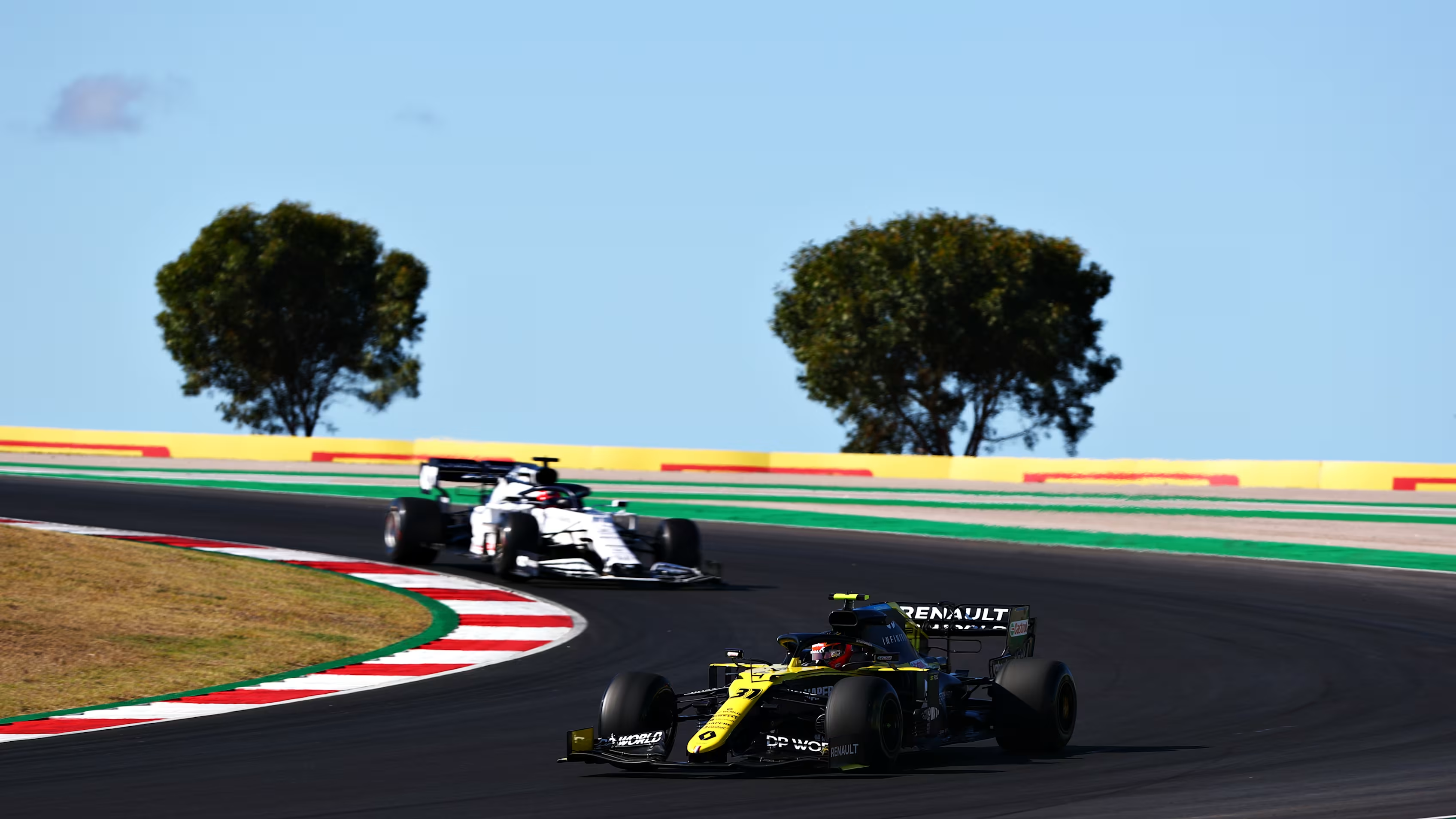
Formula 1 has confirmed its return to Portugal, with the Portuguese Grand Prix set to feature on the calendar in both 2027 and 2028, as direct replacements for the Dutch Grand Prix in Zandvoort. The announcement was made on December 16, 2025, following the signing of a two-year agreement between Formula 1 and the Portuguese Government.
The races will be held at the Autódromo Internacional do Algarve in Portimão, replacing the Dutch Grand Prix in Zandvoort. This marks a significant moment for Portuguese motorsport and underlining the country’s renewed role within the Championship’s global expansion.
The return of Formula 1 to Portugal comes after a six-year absence, and reflects the growing demand among host nations to stage a Grand Prix. Portugal last welcomed the sport in 2020 and 2021, when Portimão played a crucial role in allowing the championship to continue during the COVID-19 pandemic.

Portimão’s role during a critical period for Formula 1
The Autódromo Internacional do Algarve emerged as a key venue at a time when Formula 1 was forced to rapidly restructure its calendar. With many traditional hosts unable to stage races due to travel restrictions and health regulations, Portimão stepped in and successfully delivered two Grands Prix, behind closed doors and later with limited attendance.
Those events were widely praised for their organisation, racing quality, and atmosphere, even under challenging circumstances. The circuit’s flexibility, and the support of local and national authorities, strengthened Portugal’s standing with Formula 1’s leadership, laying the groundwork for the long-term return now confirmed for 2027 and 2028.
A circuit defined by elevation and technical challenge
Located in Portugal’s southernmost region, the Algarve Circuit is known for its dramatic elevation changes and flowing layout. Measuring 4.6 kilometres, the track offers a unique challenge for drivers, with blind crests, fast sweepers, and heavy braking zones that demand precision and confidence.
One of the circuit’s defining features is the rapid downhill run to the final right-hand corner, which feeds onto the start–finish straight. This section has consistently created overtaking opportunities and unpredictable racing, particularly when tyre degradation and changing wind conditions come into play.
Marko’s RBR exit raises “suspicion” over their 2026 F1 car
Portimão to replace Zandvoort on the Formula 1 calendar
Formula 1’s return to Portugal will come as part of a direct calendar change, with the Algarve race replacing the Dutch Grand Prix at Zandvoort. The event in the Netherlands is scheduled to drop off the calendar after next year, bringing an end to Zandvoort’s most recent spell as a Formula 1 host. As a result, Portimão will take over that calendar slot from 2027, ensuring no net increase in the total number of races, while maintaining the sport’s strong European presence.
Zandvoort made its return to Formula 1 in 2021 and quickly became known for its unique banking and vibrant atmosphere, driven largely by the success of Max Verstappen. However, with the Dutch Grand Prix set to conclude after next season, Formula 1 has opted to shift its focus back to Portugal, a venue that has already proven its capability to host the championship at short notice and deliver competitive racing. The move allows Formula 1 to balance continuity with renewal, replacing one established European event with another that carries both historical significance and modern appeal.
Wolff’s threat to restrict Mercedes F1 engine supply examined
Portugal’s long and varied Formula 1 history
Portugal has a deep-rooted connection to Formula 1, dating back to the championship’s early years. The country first hosted a Grand Prix in Porto in 1958, with subsequent races held at Monsanto and, later, Estoril. Across more than seven decades, Portugal has been a regular, if intermittent, presence on the calendar.
Some of the sport’s most iconic drivers have claimed victories on Portuguese soil. Stirling Moss, Alain Prost, Ayrton Senna, and Nigel Mansell all stood on the top step of the podium during races held in Portugal. One of the most memorable moments came in 1985, when Senna claimed his first Formula 1 victory in wet conditions at Estoril, a performance that marked the beginning of his rise to legendary status.
Wolff’s threat to restrict F1 engines examined
Recent milestones at the Algarve circuit
The modern era of the Portuguese Grand Prix has been closely linked with Portimão. In 2020 and 2021, the circuit produced competitive races and several significant milestones. Most notably, Lewis Hamilton secured his 92nd Formula 1 victory at Portimão in 2021, surpassing Michael Schumacher’s long-standing record for career wins.
Hamilton also won at the circuit in 2020, making him the only driver in the current Formula 1 field to have claimed victory at the Algarve venue. Those results further cemented Portimão’s place in recent Formula 1 history, and highlighted the circuit’s ability to deliver landmark moments.
Results from Indycar star’s F2 testing
Strong backing from Formula 1 leadership
Formula 1 CEO Stefano Domenicali welcomed the announcement, highlighting both the sporting and commercial value of returning to Portugal.
“I am delighted that Portimão is returning to the Formula 1 calendar and that the sport continues to ignite the passion of our incredible Portuguese fans. The track offers thrilling action from the first corner to the checkered flag and has fans on the edge of their seats.” said the CEO.
Domenicali also emphasised the growing global interest in hosting Formula 1 races, thanking the Portuguese Prime Minister, Luís Montenegro, and Minister for Economy and Territorial Cohesion, Manuel Castro Almeida, for their support. He additionally acknowledged the contributions of national and regional tourism bodies, as well as the management of the Algarve International Circuit, in securing the agreement.
“The interest and demand for hosting a Formula 1 Grand Prix are greater than ever before. Therefore, I would like to thank Prime Minister Luís Montenegro and the Portuguese Minister for Economy and Territorial Cohesion, Manuel Castro Almeida.” said Domenicali.
“I would like to thank the Secretary of State for Tourism, Trade and Services, Pedro Machado, the President of Turismo de Portugal, Carlos Abade, the President of the Algarve Tourism Association, André Gomes, and the CEO and Chairman of the Algarve International Circuit, Jaime Costa, for their support in bringing Formula 1 back to Portugal. I look forward to continuing our collaboration to ensure that Portimão makes a triumphant return to the racing calendar.”
Hamilton defiant amidst calls for him to retire
Economic and regional impact for Portugal
The Portuguese government has framed the return of Formula 1 as a strategic opportunity for economic growth. Minister for Economy and Territorial Cohesion Manuel Castro Almeida stated that the Portuguese Grand Prix will have a direct and wide-ranging impact, benefiting tourism, trade, services, and small and medium-sized enterprises.
“Hosting the Grand Prix in the Algarve strengthens our regional development strategy, increases the value of the area, and creates opportunities for the local economy. This event will not only bring prestige to our country but also enhance Portugal’s global image.” said Almeida.
“Nobody talks about it”: Prost on Renault’s quiet F1 exit
Confidence from circuit management
Jaime Costa, Chairman and CEO of the Autódromo Internacional do Algarve, expressed confidence that the Portuguese Grand Prix will deliver, both on and off the track. He highlighted the passion of local fans and the quality of the circuit, describing the return of Formula 1 as a major boost for tourism and the wider region.
Costa also pointed to the circuit’s distinctive layout as a guarantee of challenging racing and memorable moments. With long-term planning now possible, the Algarve venue aims to set high standards for event delivery and fan experience when Formula 1 returns in 2027 and 2028.
Damning summing up of Norris by ‘F1 expert’
NEXT ARTICLE: Dr Marko’s blatant lies, exposed

The clearcut of the nigh on twenty year senior management structure at Red Bull Racing was complete just days after the 2025 Formula One season finale in Abu Dhabi.
Dr. Helmut Marko revealed he was leaving his role as special advisor to the team and the head of the Red Bull junior driving academy with immediate effect.
Whilst the Austrian claimed he had jumped rather than been pushed, the hasty nature of his exit suggests otherwise to some F1 observers. Marko claimed he would have quit on a high note had Verstappen completed the most remarkable F1 comeback of all time.
Marko stabbed in the back
Yet despite admitting he felt something had been lost in Abu Dhabi, the former Red Bull advisor failed to give a reasoned explanation as to why he was leaving even though Max had failed in his pursuit of a record fifth consecutive F1 drivers championship.
When Christian Horner was exited from the team, he kept his counsel over many of the skeletons in the Red Bull closet. Newey too refused to do anything but be thankful for his time in Milton Keynes, but Dr. Marko chose to use his exit as the platform for a rant.
First up he criticised the Red Bull press release describing there sentiment he wished to leave on a high as “nonsense.” He went on to suggest he may have ultimately been stabbed in the back by those who used him to discredit Christian Horner.
“Let’s just say that a lot has changed at the team in a short period of time. You think you know people well, but in the end that turns out not to be the case… No, I really won’t say more,” he told Dutch publication De Limburger…READ MORE ON THIS ARTICLE

Alex Stanton is a Formula 1 journalist at TJ13 with a focus on the financial and commercial dynamics that underpin the sport. Alex contributes reporting and analysis on team ownership structures, sponsorship trends, and the evolving business model of Formula 1.
At TJ13, Alex covers topics including manufacturer investment, cost cap implications, and the strategic direction of teams navigating an increasingly complex financial environment. Alex’s work often examines how commercial decisions translate into on-track performance and long-term competitiveness.
With a strong interest in the intersection of sport and business, Alex provides context around Formula 1’s global growth, including media rights, expansion markets, and manufacturer influence.
Alex’s reporting aims to explain the financial realities behind headline stories, helping readers understand how money, governance, and strategy shape the competitive order in Formula 1.
