


Whilst the hype over the ‘decider in the desert’ built to a crescendo coming into the 2025 season finale in Abu Dhabi, the final result for Max Verstappen was all too predictable.
On a circuit where both McLaren and Red Bull cars were expected to dominate, the 12 point deficit between the Dutch driver and Lando Norris proved impossible for the four times champion to overcome.
Whilst a season’s final results are never based on one moment alone, the mistake by Kimi Antonelli in the penultimate round of the year at the time felt divisive. Following McLaren’s huge strategy blunder Norris found himself in fifth place entering the final lap of the Qatar Grand Prix, but his pass on the Mercedes driver gave him the two points he ultimately required to claim the 2025 drivers’ title.

Marko’s shock exit from Red Bull announced
As the dust settled during the post season Pirelli test, it became apparent that Dr. Helmut Marko – long term servant from the Red Bull team – would be leaving the Milton Keynes based outfit ahead of the 2026 campaign.
Whilst the Red Bull advisor claimed he jumped rather than being pushed, his explanation was found wanting. The Austrian claimed he wold have quit his role with the team had Max Verstappen won the drivers championship and that leaving on a high was his plan all along.
“I then stayed in Dubai on Monday. That’s when I made my decision. Even if we had won, it would have been a good reason to leave this job. But now, in hindsight, because we lost, it’s also a good point,” claimed the man who had run the Red Bull junior racing programme for more than a quarter of a century.
Marko was the last pillar of the Red Bull team founders, with Adrian Newey having left for Aston Martin and Christian Horner finally sacked after the 2025 British Grand Prix. Since the death of the energy drinks entrepreneur Didi Mateschitz a power struggle ensued between the new directors at the parent company in Austria and Horner who had been given carte blanche to run the F1 team as he saw fit.
McLaren’s decision proved decisive in Piastri’s title fight
The proposal for Marko to stay could not be agreed
There was talk during the summer of Marko bringing in Sebastian Vettel as a potential successor with the Red Bull juniors, although the four times champion with the team revealed in Brazil nothing had come of the idea. “I don’t know, I read as well there was a lot of talk about it and so on, and I did speak with Helmut a little bit, but it never got anywhere, never gained any traction,” Vettel admitted.”
Despite Marko claiming the Dickson was his alone to leave Red Bull Racing, is explanation left a lot to be desired. He spoke of a meeting with the new director responsible for Red Bull’s F1 involvement – Oliver Mintzlaff – “We discussed for a while whether a partial solution was still possible. I said that if we were going to do it, we had to do it completely,” Marko revealed.
Clearly, there was no agreement on Marko’s proposal and with just a year to run on his contract, Dr. Helmut Marko believed there were no future pans to include him beyond 2026. Now his departure has led to further speculation that Red Bull are behind the curve in their efforts for 2026.
Ex-F1 driver and now expert F1 pundit in Germany, Christian Danner has now revealed Marko’s swift exit suggests there remains conflict within the F1 team. He notes via Motorsport-Magazin the Austrian’s previous resilience when internal disputes have arisen at Red Bull: “Well, I think it’s a resignation. Helmut Marko has survived so many, let’s say, highs and lows, battles and fights there, very cleverly.”
The new Audi F1 car breaks cover
Potential Red Bull conflict forced Helmut’s hand
Danner does not believe Marko was dismissed, but cold see the writing on the wall now the leadership within the team had been overhauled. “There was a restructuring, the whole thing, all that noise from Horner and everything with Mekies. I mean, there was quite a bit of unrest.
“The car wouldn’t perform, Verstappen was unhappy, and I have a suspicion that, this year with the new engine, with all the new regulations, I’m saying now, to put it mildly, he sees a certain potential for conflict arising and says, well, then, that’s enough,” concludes the German.
Red Bull are undertaking the unprecedented challenge of becoming the first ever Formula One customer team to build their own engine – with at the assistance of Ford. Marko quitting may be viewed as a vote of no confidence in the project, despite him backing Christian Horner when the plan was devised.
Even more strange was Marko’s revelation that his decision to quit was made in the absence of Max Verstappen. Flight delays were blamed and Dr. Marko revealed he had explained his decision by telephone later, to his protege.
“nobody talks about it”: Prost breaks silence on Renault F1 exit
Verstappen in the dark over his mentor’s departure
Verstappen came to Marko’s aid in 2024, when it was widely reported he was facing suspension from his role within the team. On hearing the rumour of Marko’s enforced absence, Max immediately held a press conference where he stated Marko’s future within the team was vital to him.
“My loyalty to (Marko) is very big. I’ve always expressed this to everyone within the team, everyone high up, that he’s an important part in my decision-making for all the time in the future as well within the team.” The message was clear. No Dr. Helmut Marko – no Max Verstappen.
Verstappen is yet to comment on Marko’s departure but regardless he will be assessing which team has mastered the huge change in car design specifications the best in 2026. He was heavily linked with a move to Mercedes in the summer, with team boss Tot Wolff publicly court him.
Should genius aerodynamicist bring Aston Martin to the fore, a seat for Verstappen would be available in Silverstone for the 2027 campaign. Yet for now, nobody knowns who will ace the new era of F1 next season and given Red Bull’s remarkable in season development this year, it could even be them who finish top of the pile next year.
Hamilton defiant amidst calls for him to retire from F1
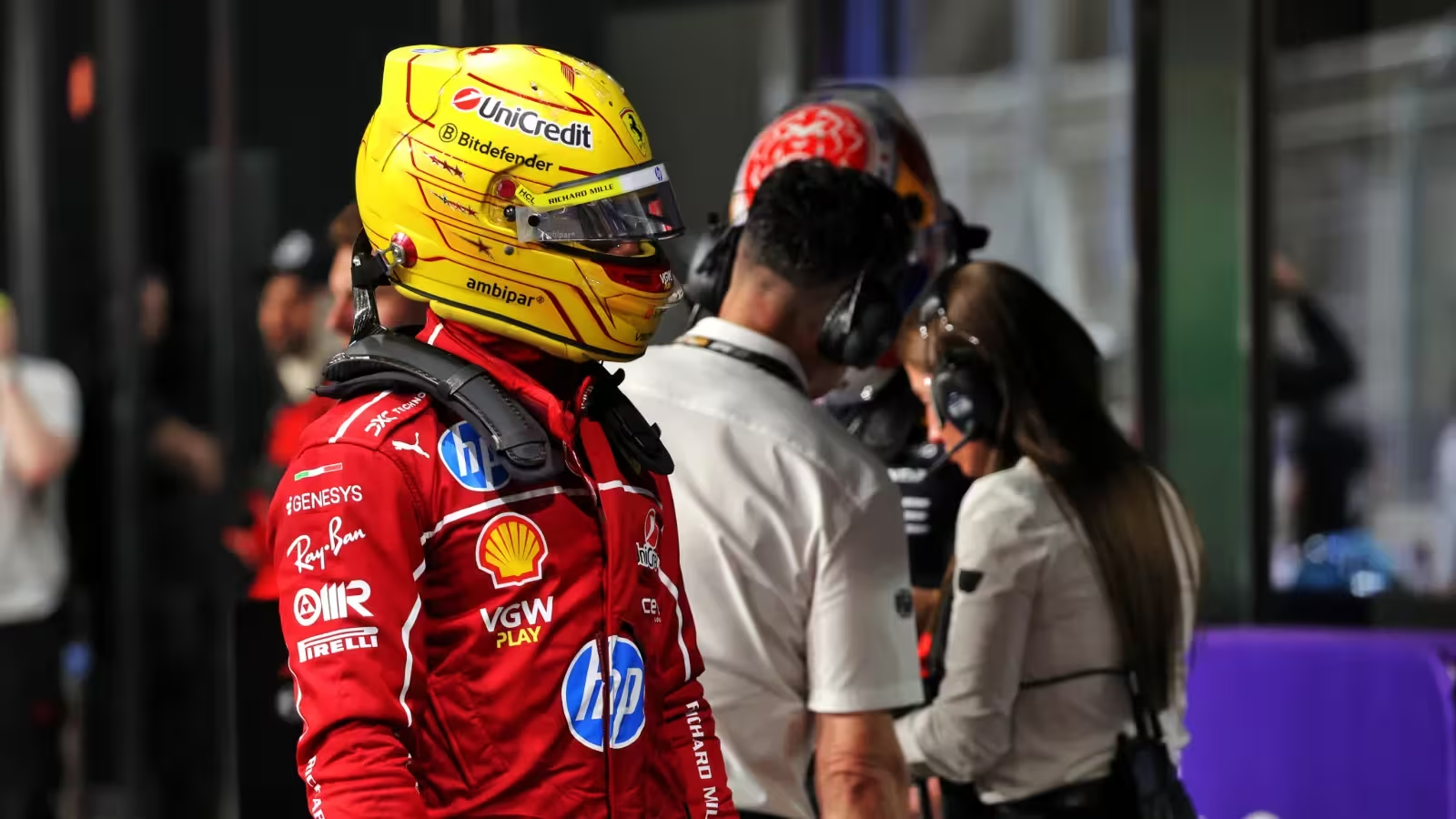
Lewis Hamilton in his nineteenth season in Formula One has endured his annus horribilis following a dream move to Ferrari. The fanfare which awaited him on his first day in Maranello now feels like some medieval jesters prank.
The police in the northern Italian town declared a sate of emergency given the expectations of a huge crowd turnout and Lewis was treated to a tour of the Scuderia’s facilities by none other than the Ferrari group president himself.
Come pre-season testing in Bahrain, hopes were high that Ferrari would continue their strong showing from the end of 2024. And whilst the irony of Carlos Sainz having been forced to move to Williams topping the time sheets was lost on no one, Lewis Hamilton was second quickest across the three days of testing with his team mate one place further back…. READ MORE

A.J. Hunt is Senior Editor at TJ13, where Andrew oversees editorial standards and contributes to the site’s Formula 1 coverage. A career journalist with experience in both print and digital sports media, Andrew trained in investigative journalism and has written for a range of European sports outlets.
At TJ13, Andrew plays a central role in shaping the site’s output, working across breaking news, analysis, and long-form features. Andrew’s responsibilities include fact-checking, refining editorial structure, and ensuring consistency in reporting across a fast-moving news cycle.
Andrew’s work focuses particularly on the intersection of Formula 1 politics, regulation, and team strategy. Andrew closely follows developments involving the FIA, team leadership, and driver market dynamics, helping to provide context behind the sport’s biggest stories.
With experience covering multiple seasons of Formula 1’s modern hybrid era, Andrew has developed a detailed understanding of how regulatory changes and competitive shifts influence the grid. Andrew’s editorial approach prioritises clarity and context, aiming to help readers navigate complex developments within the sport.
In addition to editorial duties, Andrew is particularly interested in how media narratives shape fan perception of Formula 1, and how reporting can balance speed with accuracy in an increasingly digital news environment.
