

Audi sets Berlin date for Formula 1 team unveiling – Audi Formula 1 team has confirmed that it will officially unveil the racing livery of its future Formula 1 car on January 20, 2026, in Berlin. The presentation marks a major step toward the manufacturer’s long-awaited entry into the Formula 1 World Championship, and will introduce the ‘Audi Revolution F1 Team’ to the public for the first time.
The German manufacturer describes the event as an “important milestone” on its path to the pinnacle of motorsport. Taking place just days before the start of official pre-season testing, the Berlin premiere is intended to showcase not only the team’s visual identity, but also the ambition and structure behind Audi’s factory programme.

Immersive presentation ahead of first tests:
The Berlin event has been designed as an immersive experience, with a strong focus on technology and ‘digital engagement’. Audi has confirmed that virtual reality elements will allow invited guests and partners to experience the team and its design philosophy in a more interactive way.
Following the exclusive unveiling on January 20, a public fan event will take place on January 21, giving supporters the chance to experience the presentation in person. Audi hopes the two-day format will ensure the launch resonates beyond the Formula 1 paddock and connects with a broader, international audience.
The Berlin presentation comes less than a week before the first official pre-season test, which runs from January 26 to 30 in Barcelona. The opening race of the 2026 season will follow on March 8 in Melbourne.
F1 Civil War: FIA and Teams Locked in a Shock Power Struggle Behind Closed Doors
Audi Revolution F1 Team officially confirmed
At the same time as announcing the launch event, Audi confirmed the official name of its Formula 1 operation: Audi Revolut F1 Team. Revolut, the London-based global fintech company, was announced as title partner in July 2025.
Audi describes the partnership as a strategic alliance that goes beyond traditional sponsorship. Revolut will be closely integrated into the team’s operations, including financial processes through Revolut Business, and online transactions via Revolut Pay in the team’s merchandise shop. Fans are also expected to benefit from exclusive promotions, race access, and special offers linked to the Revolut app.
Audi CEO Gernot Döllner said the unveiling of the name and logo represents a defining moment for the project.
“The unveiling of the name and logo of the Audi Revolut F1 Team is another important milestone on our journey to the pinnacle of motorsport,” Döllner explained. “Both give our ambitions a clear identity and reflect a strong vision and an innovative spirit.”
Results from Indycar star’s first 2 day test in F2
From concept car to final racing livery
So far, Audi has only shown a concept version of its 2026 challenger, the Audi R26, which was presented in Munich in November. The Berlin event will mark the first official unveiling of the final racing livery that will compete on the Formula 1 grid.
According to Audi, the visual identity will reflect the brand’s core pillars of clarity, technical intelligence, and emotion. With fewer than 50 days remaining until the first race, the presentation will demonstrate how Audi’s design language translates into a striking and recognisable presence on the Formula 1 stage.
Mattia Binotto, Head of the Audi F1 Project, underlined the symbolic importance of the launch.
“This announcement gives a name and a face to the incredible work of the team,” he said. “The presentation in Berlin will be the first moment we all stand together as a team and invite our global fan base to join us, ahead of our debut in 2026.”
Norris surprises everyone with a huge break away from Formula 1 next year
Factory team built on Sauber foundations
Audi is one of three manufacturers entering Formula 1 under the new 2026 regulations. To support its factory effort, the Volkswagen Group subsidiary acquired the Swiss-based Sauber team, which will form the backbone of the operation.
As part of the transition, Sauber Motorsport AG will be renamed Audi Motorsport AG, while the team’s UK base in Bicester will become the Audi Motorsport Technology Centre UK. The historic Sauber name will remain in place through Sauber Holding AG and Sauber Technologies AG, preserving the organisation’s heritage.
The power unit for the Audi Formula 1 project is being developed in Neuburg an der Donau. Under the new regulations, engines will produce 50 percent of their power from the combustion engine and 50 percent from electrical energy, using fully sustainable fuels.
The McLaren decision that derailed Oscar Piastri’s title fight
Driver line-up and leadership structure
Audi has confirmed Nico Hülkenberg and Brazilian rookie Gabriel Bortoleto as its driver pairing for the debut season. Hülkenberg will be the only German driver on the 2026 grid, bringing experience and continuity, while Bortoleto represents a long-term investment in young talent.
Jonathan Wheatley, Team Principal of the Audi Revolut F1 Team, said the confirmation of the team’s identity unites its international workforce. “The name Audi Revolt F1 Team symbolizes the combined strength of our teams in Germany, Great Britain and Switzerland,” Wheatley said. “It energizes the entire project and makes our long-term ambitions tangible.”
With the Berlin presentation approaching, Audi’s Formula 1 project is now entering its final and most visible phase before the lights go out for its first Grand Prix.
FIA battle with F1 teams to change regulation
Lessons from the BMW era: a cautionary chapter
Sauber’s current transformation into Audi’s factory Formula 1 team comes with a long memory of a previous manufacturer-led project that ended abruptly. In the mid-2000s, the Hinwil-based squad became BMW Sauber, after the German manufacturer acquired a majority stake ahead of the 2006 season. The partnership initially appeared to validate the factory-team model, delivering steady progress, podium finishes, and a breakthrough victory at the 2008 Canadian Grand Prix.
However, despite on-track success, the project was increasingly shaped by shifting corporate priorities, rather than long-term sporting stability. As Formula 1 costs rose and the global financial crisis took hold, BMW’s commitment wavered. Strategic disagreements and a lack of alignment between the road-car business and Formula 1 ambitions began to undermine the programme, even as the team remained competitive.
Results from Indycar’s star 2 day F2 test
Sauber name returns to Formula 1
In late 2009, BMW announced it would withdraw from Formula 1 entirely, pulling the plug on the project with little warning. The decision left the future of the Hinwil operation in serious doubt, placing hundreds of jobs at risk and forcing the team into a fight for survival ahead of the 2010 season.
The team’s rescue came through its founder. Peter Sauber stepped in to buy back the operation from BMW, regaining control and restoring the Sauber name. The transition was far from straightforward, with tight budgets, delayed development, and a late confirmation of the team’s entry, but Sauber survived and re-established itself as an independent competitor.
That chapter remains a defining moment in the team’s history, and has surely not been forgotten by the long standing employees of the Swiss based Formula 1 team.
“Nobody talks about it”: Prost breaks silence on Renault shock F1 exit
NEXT ARTICLE: Hamilton defiant amidst calls for him to retire from F1
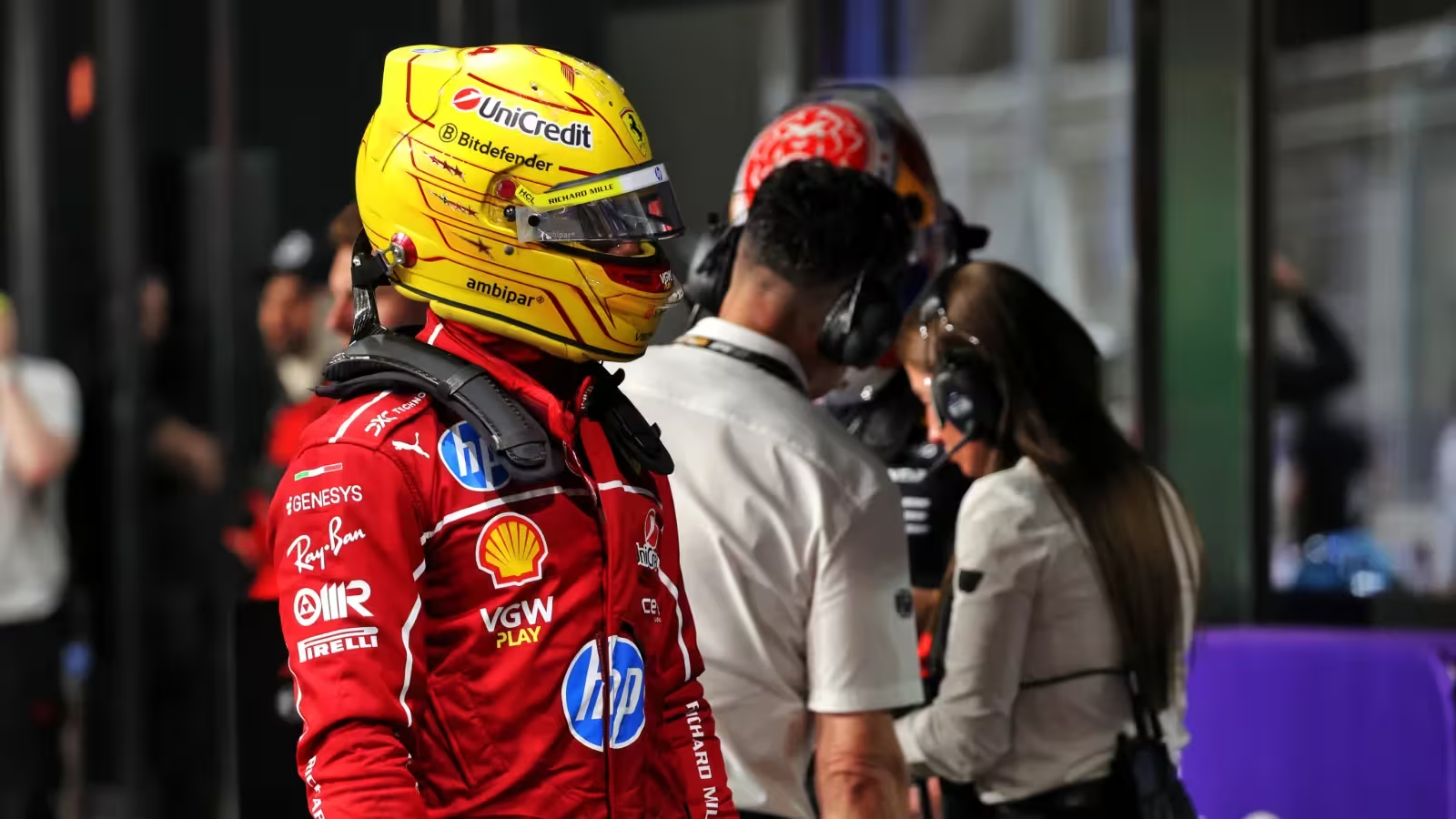
Lewis Hamilton in his nineteenth season in Formula One has endured his annus horribilis following a dream move to Ferrari. The fanfare which awaited him on his first day in Maranello now feels like some medieval jesters prank.
The police in the northern Italian town declared a sate of emergency given the expectations of a huge crowd turnout and Lewis was treated to a tour of the Scuderia’s facilities by none other than the Ferrari group president himself.
Come pre-season testing in Bahrain, hopes were high that Ferrari would continue their strong showing from the end of 2024. And whilst the irony of Carlos Sainz having been forced to move to Williams topping the time sheets was lost on no one, Lewis Hamilton was second quickest across the three days of testing with his team mate one place further back.
The huge shock of China for Ferrari
The first signs of weakness for Ferrari appeared at round one in Australia when both Ferrari’s qualified more than seven tenths off the pace in P7 and P8 and the wet race day exposed further weaknesses in the SF-25. Leclerc finished the race in P8 whilst Hamilton scraped into the top ten scoring a single point.
Yet the Melbourne circuit can be something of an outlier due to the track’s configuration and hopes remained high for a better outing next time out in China. Hamilton duly claimed pole position in the Sprint going on to win the shortened version of the Grand Prix, but come Sunday spirit’s in the Ferrari garage were rock bottom.
Qualifying for the Grand Prix saw Charles Leclerc a mere 3/10ths of a second behind pole sitter Oscar Piastri and both Hamilton and Leclerc crossed the finishing line in 5th and 6th position respectively. Yet what awaited the Ferrari drivers was to set the tone for the season as the FIA investigated both cars for running at an illegal height during the Grand Prix.
Leclerc and Hamilton were eventually disqualified for excessive wear of the skid block underneath the floor which revealed a fundamental weakness of the SF-25 the team would never resolve during the season. The revised suspension system Ferrari had adopted for the year was badly designed and in the era of the cost cap, not a parable there team would be able to fully resolve…READ MORE ON THIS STORY

Alex Stanton is a Formula 1 journalist at TJ13 with a focus on the financial and commercial dynamics that underpin the sport. Alex contributes reporting and analysis on team ownership structures, sponsorship trends, and the evolving business model of Formula 1.
At TJ13, Alex covers topics including manufacturer investment, cost cap implications, and the strategic direction of teams navigating an increasingly complex financial environment. Alex’s work often examines how commercial decisions translate into on-track performance and long-term competitiveness.
With a strong interest in the intersection of sport and business, Alex provides context around Formula 1’s global growth, including media rights, expansion markets, and manufacturer influence.
Alex’s reporting aims to explain the financial realities behind headline stories, helping readers understand how money, governance, and strategy shape the competitive order in Formula 1.
