
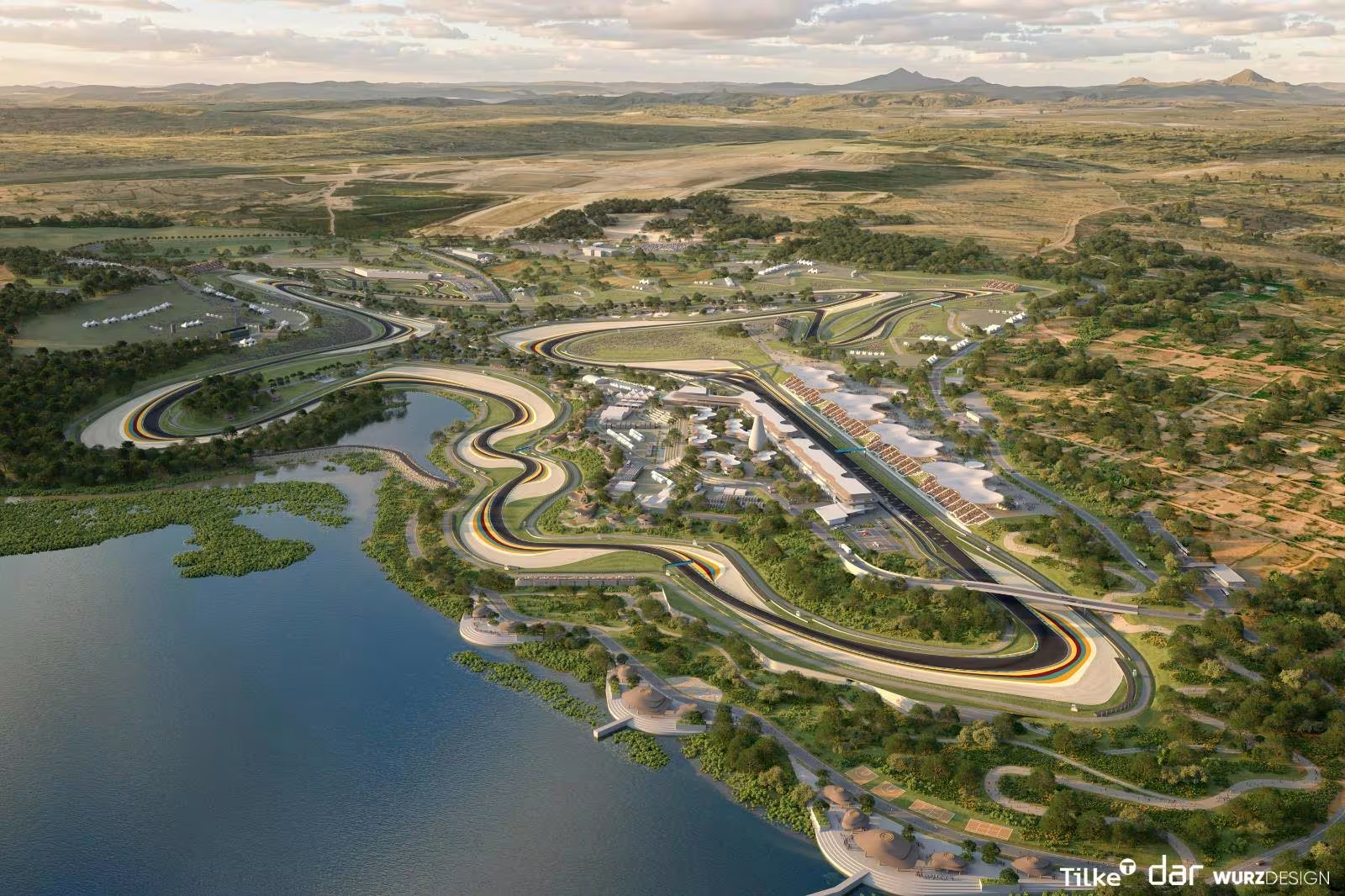
Something new is coming to Formula One. The first-ever circuit designed by a top-flight F1 driver and a Le Mans 24 Hours winner. This week it was announced that Rwanda would join the F1 calendar in 2030 with a ten-year contract, which means the sport will return to the continent of Africa for the first time since 1993.
Controversial Partnerships and Human Rights Concerns
There was some controversy over the choice of country, with human rights organization Amnesty International accusing Formula 1 of handing Rwanda a “sports-washing prize.” Meanwhile, an F1 spokesman was quoted by the BBC as claiming: “We have the opportunity to inspire and bring the passion of F1 to 100 million people across Africa, and sport can be a positive force for good.”
However, Felix James, Amnesty International UK’s head of campaigns, said: “A 10-year Grand Prix ‘presented by Visit Rwanda’ is a sports-washing prize for the Rwandan authorities. Arsenal, Aston Villa, the cycling world championships, and now Formula 1 – Rwanda is buying into the world’s biggest sports to polish its image and deflect from its appalling human rights record.
“Formula 1 says sport can be ‘a positive force for good’. That rings hollow if F1 shrugs off who it is partnering with. Rwanda’s authorities are prolific in arbitrary detention, torture, and the repression of free speech – these are abuses at home.”
The United Nations has accused the Rwandan authorities of supporting the rebel M23 group in the Democratic Republic of Congo (DRC). A report from the UN claimed last year the M23 had “engaged in a campaign of intimidation and violent repression through a recurrent pattern of summary executions, torture, detention, enforced disappearances, and forced recruitment.”
The result was the UN imposed sanctions on Rwanda earlier this year, while the UK suspended all aid to the country.
Yet Formula One is no stranger to encouraging countries accused of grave human rights abuses to host F1 races. Rwanda is merely now added to the list, which includes Qatar, Abu Dhabi (UAE), Bahrain, Saudi Arabia, China, and Azerbaijan. It seems that money talks more than morality, wherever you look in global sport.
Alex Wurz Breaks the Mold
Yet Rwanda will see a first in F1, with Austrian former F1 racing driver Alex Wurz—who competed in the sport between 1997 and 2007—being responsible for the complete design of the Rwanda circuit. The track will be located alongside a new international airport outside the capital city, Kigali.
Many of the modern circuits over the past thirty years have been designed by Hermann Tilke, who competed in some lower-level racing, and have been criticized for their lack of inspirational feel and poor design making overtaking difficult.
Speaking to The Race, Wurz claims this circuit has been years in the theoretical design, and work began on the concept long before Rwanda was considered as a host. When the Rwanda F1 deal was announced, a render was issued alongside, but it fails to deliver the real feel of how the circuit will look.
Elevation, Compression, and Sim Joy
Firstly, it will contain the biggest amount of elevation change of all the current F1 tracks. This aspect of the design does rely on the natural topography of the location of the circuit. After thousands of laps refining the design, Wurz reveals: ”To give you a little flavour, in Turn 2, we are coming downhill with top speed. It is a 10.8% [gradient] exactly. We’re going into a very high compression with 12% banking, and then going 14% uphill, so you will only see sky. Towards the end of the corner from the 12% banking, we are going to 6%, and then 4%. And in the sim, this feels just like pure joy.”
Wurz goes on to describe what he feels to be the best section of the track where elevation, banking, compressions, and gradient have all been meticulously calculated and refined over thousands of laps in the simulator.
“My favourite section is coming out of the canopy corner over the crest into the lake. The timing of it is that you just get light [as the car rises over the crest], and then suddenly you get a 10% compression, and from there you know your mind has to engage into the fast Esses. Those are the corners I think should resonate with the fans in the simulator, on your computer games, but hopefully with the big dogs—the F1 drivers themselves.”
The Esses appear to have some similarity with the classic Becketts and Maggots high-speed corners at historic Silverstone, although the camber and gradient will set them apart from some of the most famous turns on the F1 calendar.
Designing for Overtaking and Driver Battles
Of course, the F1 regulations often dictate whether cars can overtake each other or not, and with advances in technology—for example, late braking is now less delivered by the brave but more available to all the drivers—Wurz claims the track has been designed to allow the drivers to battle with each other, which comes from how the entry and exits to the corners are designed.
“We have wide-open corners with corner sequences 1/2/3, where it means attack, defend, attack, defend. Now if I defended too much, I might be overtaken, or I’m so slow that the next guy is catching up. So, it is initiating fighting.
“If it finally is the track where the most overtakes are going to happen, to be honest, that’s random. It depends which tyre manufacturer, and what tyre degradation on that day will happen. But it’s a drivers’ and riders’ circuit. It’s made for overtaking and fighting, and I think it should tick all those boxes,” adds Wurz.
The 197 metres of elevation change has enhanced the original concept of the circuit, and along the back straight, the drivers will plunge down a steep hill before hitting a compression and a steep rise into the braking zone.
Wurz claims to have consulted many drivers during the design, and the final draft has received nothing but positive input from them. Many of the corners are designed so that if a driver makes a mistake on entry line, they will suffer lost time across the next sequence of turns.
Despite all the noise about human rights, the Rwanda circuit is an exciting prospect, and finally, F1 will have a track designed by a driver who has driven at the highest level of motorsport.
Would you like to see more TJ13 Formula 1 coverage? Add us to your favourites list on Google to receive trusted F1 news.

A.J. Hunt is Senior Editor at TJ13, where Andrew oversees editorial standards and contributes to the site’s Formula 1 coverage. A career journalist with experience in both print and digital sports media, Andrew trained in investigative journalism and has written for a range of European sports outlets.
At TJ13, Andrew plays a central role in shaping the site’s output, working across breaking news, analysis, and long-form features. Andrew’s responsibilities include fact-checking, refining editorial structure, and ensuring consistency in reporting across a fast-moving news cycle.
Andrew’s work focuses particularly on the intersection of Formula 1 politics, regulation, and team strategy. Andrew closely follows developments involving the FIA, team leadership, and driver market dynamics, helping to provide context behind the sport’s biggest stories.
With experience covering multiple seasons of Formula 1’s modern hybrid era, Andrew has developed a detailed understanding of how regulatory changes and competitive shifts influence the grid. Andrew’s editorial approach prioritises clarity and context, aiming to help readers navigate complex developments within the sport.
In addition to editorial duties, Andrew is particularly interested in how media narratives shape fan perception of Formula 1, and how reporting can balance speed with accuracy in an increasingly digital news environment.
