


What should have been a quiet Monday evening for Alpine after the Brazilian Grand Prix turned unsettling when their Viry-Châtillon factory in France was broken into. The incident was first reported by French media, who described it as a “mysterious” intrusion. Although the police have stated that nothing was stolen, the circumstances have sparked discussion across Formula 1 circles and revived fears of industrial espionage reminiscent of past F1 controversies.
A Targeted Intrusion
According to the French authorities, two individuals entered the facility through the entrance hall and proceeded straight to the top floor, where the offices of senior management and key Alpine officials are located. Several rooms were accessed during the brief intrusion, suggesting the intruders were familiar with the building’s layout.
Initial reports indicate that no damage was caused and no items were taken. Alpine confirmed to PlanetF1 that the break-in caused no loss, and that no staff members were present at the time. The team emphasised that all operations are secure and unaffected. Nevertheless, the French police have launched a full investigation to determine the motives behind the incident.
Ferrari engineers new target in ‘the blame game’
Skepticism and speculation
Despite the official reassurances, former F1 pit reporter Jack Plooij has expressed doubt about the conclusion that nothing was stolen being reached so quickly. Speaking on the Ziggo Sport Race Café programme, he asked, “How do you know that after just ten minutes?”
He also noted that the intruders seemed to navigate the building with purpose, opening offices in areas containing sensitive management information.
The break-in has naturally prompted speculation about industrial espionage. Alpine’s Viry-Châtillon factory has long been a hub for engine development and has hosted Renault’s engine production for around forty years. It was also the site of the early development of the 2026 F1 engine, a project that was abandoned when Renault switched to a customer deal with Mercedes.
Why Alpine?
Industrial espionage in Formula 1 is not unprecedented. Scandals such as “Spy-gate” in 2007, where McLaren obtained confidential Ferrari data, highlight the sport’s history of high-stakes technical theft. While comparisons to such cases are inevitable, there is currently no evidence to suggest that Alpine has suffered a similar breach.
Jack Plooij commented on the apparent paradox of Alpine being targeted. “If you’re looking for a competitive advantage, you’d spy on Mercedes or Ferrari first,” he said. “Alpine is not leading the championship, but that doesn’t mean there isn’t valuable information inside their walls.”
What could be at stake?
Although Alpine officially halted its 2026 engine project, significant development work had already been completed. This raises the possibility that intellectual property or technical know-how could still hold value for competitors. F1 commentator Richard Verschoor suggested that, even though Alpine isn’t at the front of the grid, the team could be working on projects that will have an impact in future seasons.
In Formula 1, technical innovation can provide significant performance advantages. Engine details, aerodynamic research and chassis developments are all highly sensitive. Any information gained could give a team a competitive edge, which is why suspicion naturally arises following any unexplained intrusion.
Mekies shares the behind-the-scenes of the Horner phone call: “The connection was terrible”
Responses from Authorities and Alpine
The French police have confirmed that the break-in is still under investigation. They are reviewing security footage, speaking to witnesses and trying to establish whether the incident is connected to any previous security issues.
Alpine has confirmed that all equipment and data remain secure. The team confirmed that no employees were in the building at the time and that no property was taken or damaged. Nevertheless, the precision with which the intruders moved through the facility raises questions as to whether the break-in was opportunistic or targeted.
Echoes of Past Controversies
This incident is reminiscent of other high-profile espionage cases in Formula 1, such as Spy-gate and Stepney-gate. In both cases, confidential technical information was obtained by rival teams, resulting in substantial fines and reputational damage. While it is too early to draw direct comparisons, the Alpine break-in highlights the ongoing need for stringent security measures in Formula 1.
Even teams that are not currently dominating the championship may possess valuable data or have ongoing development projects that could attract attention. Alpine’s factory, with its long history of engine research, could contain information of interest to competitors, even if the team isn’t making headlines on the track.
The investigation is ongoing, and many questions remain unanswered. The authorities are expected to provide updates as they examine the intruders’ identity, motives and methods. Meanwhile, Alpine continues preparations for the upcoming 2026 season using the Mercedes power unit.
NEXT ARTICLE: Red Bull tight lipped over “mystery” Honda engine upgrade
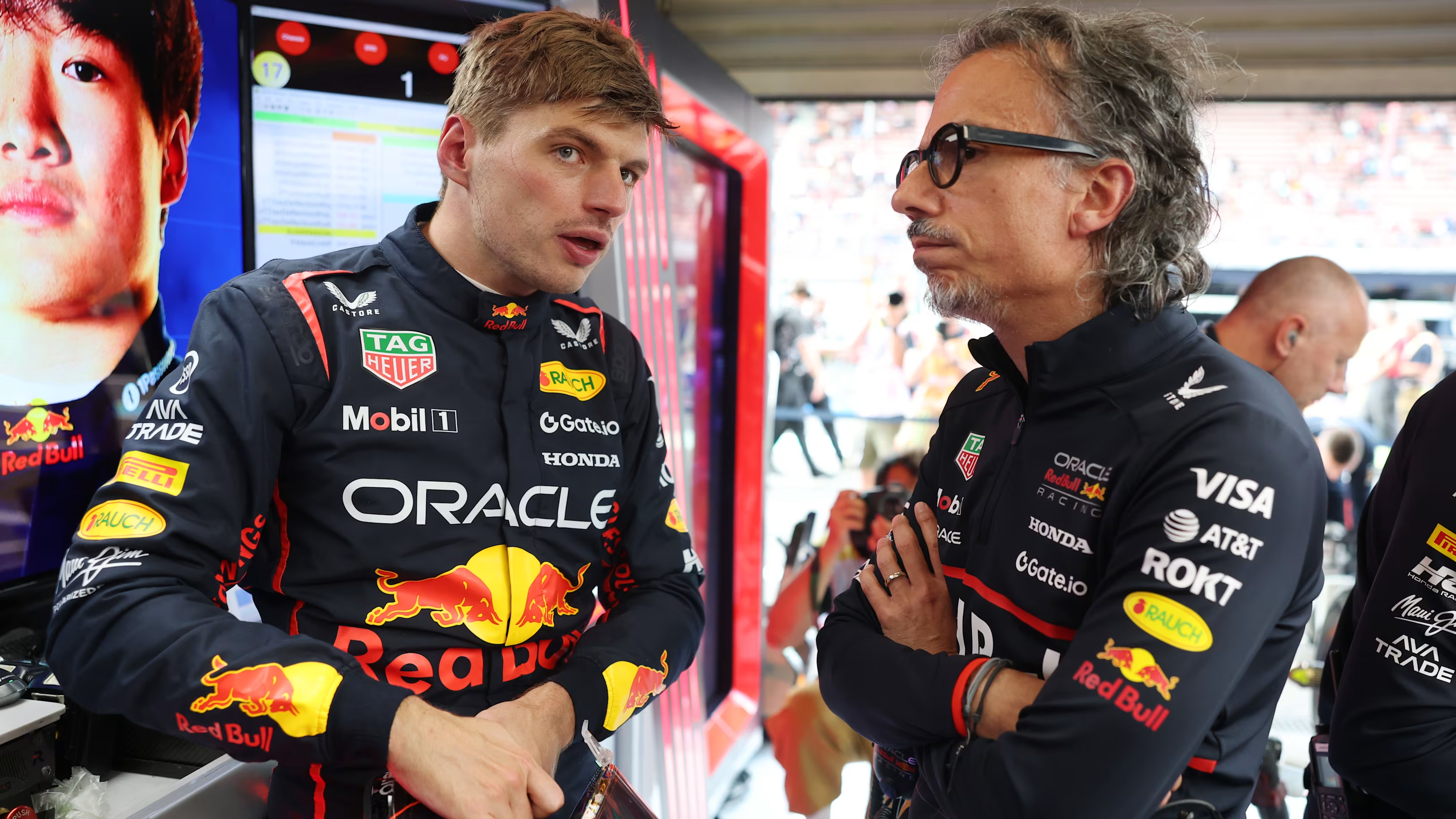
Red Bull’s weekend in Brazil may have looked like a glorious recovery drive on TV, but behind the scenes, there are repercussions. And while Laurent Mekies refused to spill the beans on just how much pace Max Verstappen’s new Honda unit delivered, he made one thing very clear in Sao Paulo: the 2025 grid is now so compressed that “everythingx… is important.”
No kidding.
The timing couldn’t be more convenient — or more suspicious — as McLaren has already been peering over the fence wondering whether this shiny new power unit counts toward Red Bull’s cost-cap spend. The Race even reported that McLaren brought the issue up directly during Friday’s F1 Commission meeting. A gentle nudge? Hardly. More like a raised eyebrow and a sharpened pencil.
A shambles on Saturday, a miracle on Sunday
Red Bull’s qualifying implosion at Interlagos set the stage: Verstappen and Tsunoda dumped out in Q1 the first time both Red Bulls have failed to make Q2 since Japan 2006. ,The RB21 looked allergic to grip. Cue a Saturday night rebuild, a setup reset, and — just to spice things up — a brand new power unit. Parc fermé? Broken. Starting from the pit lane? Accepted.
What followed was Verstappen doing Verstappen things, dragging the car to P3 in a race that shouldn’t have offered him a sniff of the podium. But the engine change raised an obvious question: what’s the price tag, and where does it sit on the FIA accountant’s spreadsheet?
Red Bull have continued developing the RB21 long after their rivals, throwing the kitchen sink at a last gasp effort to gain Verstappen that record consecutive five driver titles – only achieved by Michael Schumacher. However, McLaren cried foul as their team boss Andrea Stella questioned whether the new $5m power unit wold be included in the cost cap.
“These kind of power unit changes challenge the regulations,” he said in Brazil, choosing his words with surgical precision. He went further, asking the very question Red Bull hoped nobody would say out loud: “I will be interested in understanding if the cost of this engine now goes in the cost cap or not. If the engine was changed for performance reasons, it should go in the cost cap.” READ MORE ON THIS STORY

Alex Stanton is a Formula 1 journalist at TJ13 with a focus on the financial and commercial dynamics that underpin the sport. Alex contributes reporting and analysis on team ownership structures, sponsorship trends, and the evolving business model of Formula 1.
At TJ13, Alex covers topics including manufacturer investment, cost cap implications, and the strategic direction of teams navigating an increasingly complex financial environment. Alex’s work often examines how commercial decisions translate into on-track performance and long-term competitiveness.
With a strong interest in the intersection of sport and business, Alex provides context around Formula 1’s global growth, including media rights, expansion markets, and manufacturer influence.
Alex’s reporting aims to explain the financial realities behind headline stories, helping readers understand how money, governance, and strategy shape the competitive order in Formula 1.
