
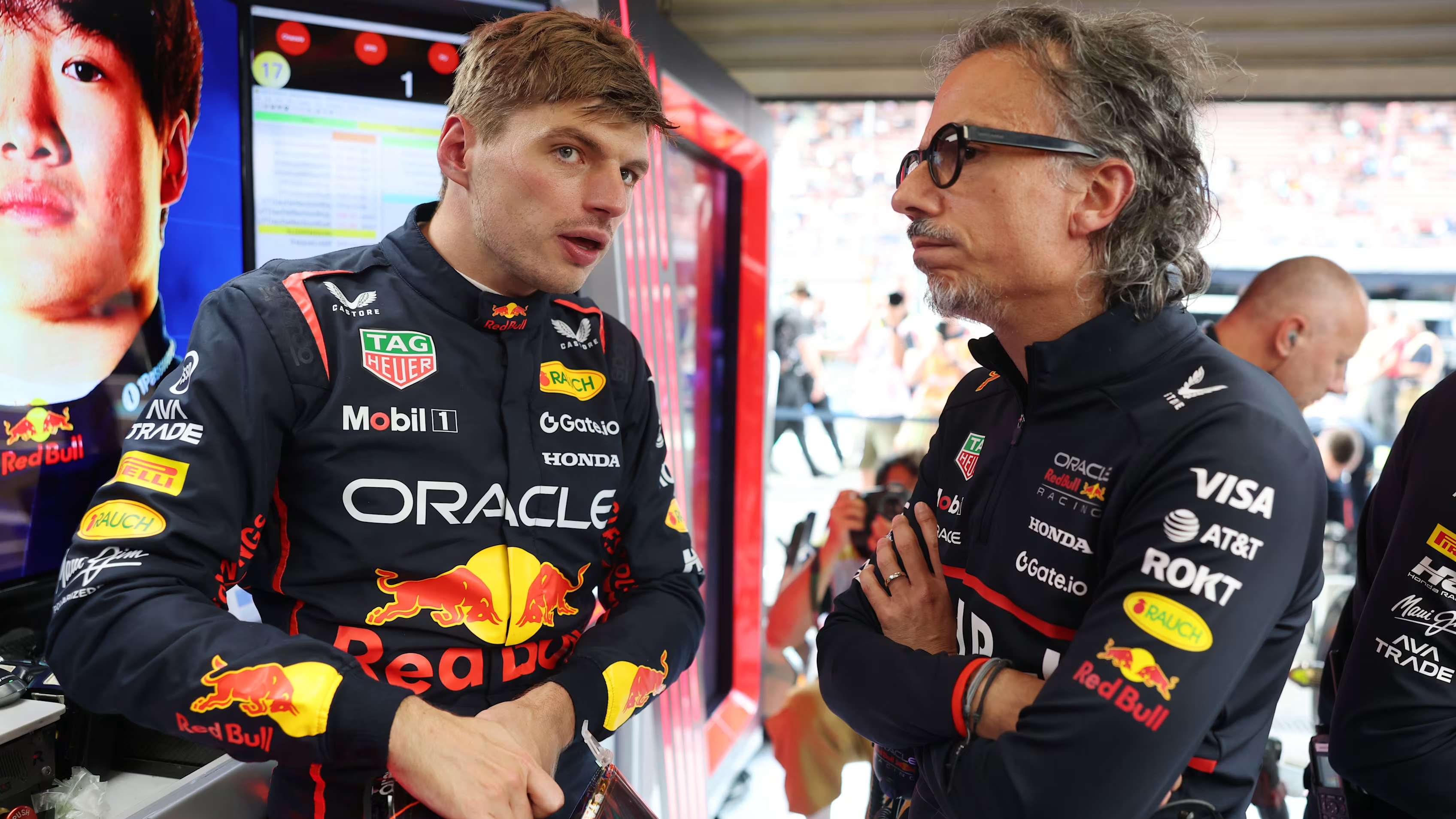
Red Bull’s weekend in Brazil may have looked like a glorious recovery drive on TV, but behind the scenes, there are repercussions. And while Laurent Mekies refused to spill the beans on just how much pace Max Verstappen’s new Honda unit delivered, he made one thing very clear in Sao Paulo: the 2025 grid is now so compressed that “everythingx… is important.”
No kidding.
The timing couldn’t be more convenient — or more suspicious — as McLaren has already been peering over the fence wondering whether this shiny new power unit counts toward Red Bull’s cost-cap spend. The Race even reported that McLaren brought the issue up directly during Friday’s F1 Commission meeting. A gentle nudge? Hardly. More like a raised eyebrow and a sharpened pencil.
A shambles on Saturday, a miracle on Sunday
Red Bull’s qualifying implosion at Interlagos set the stage: Verstappen and Tsunoda dumped out in Q1 the first time both Red Bulls have failed to make Q2 since Japan 2006. ,The RB21 looked allergic to grip. Cue a Saturday night rebuild, a setup reset, and — just to spice things up — a brand new power unit. Parc fermé? Broken. Starting from the pit lane? Accepted.
What followed was Verstappen doing Verstappen things, dragging the car to P3 in a race that shouldn’t have offered him a sniff of the podium. But the engine change raised an obvious question: what’s the price tag, and where does it sit on the FIA accountant’s spreadsheet?
Red Bull have continued developing the RB21 long after their rivals, throwing the kitchen sink at a last gasp effort to gain Verstappen that record consecutive five driver titles – only achieved by Michael Schumacher. However, McLaren cried foul as their team boss Andrea Stella questioned whether the new $5m power unit wold be included in the cost cap.
“These kind of power unit changes challenge the regulations,” he said in Brazil, choosing his words with surgical precision. He went further, asking the very question Red Bull hoped nobody would say out loud: “I will be interested in understanding if the cost of this engine now goes in the cost cap or not. If the engine was changed for performance reasons, it should go in the cost cap.”
Mekies shares the behind-the-scenes of the Horner phone call: “The connection was terrible”
Mekies squirms, but keeps the poker face
Stella is clearly drawing a line between reliability changes and performance changes — a line that suddenly matters a lot when millions of dollars are in play and championships are decided by pocket change. McLaren have now escalated the issue formally, placing it neatly — and loudly — on the F1 Commission’s agenda.
Fresh from Verstappen’s resurrection drive, Mekies was asked the obvious: how much did the fresh engine help?
He wasn’t touching that one. “It’s difficult to say,” he shrugged. “It’s always good to fit a new engine.”
Cryptic? Certainly. Conveniently vague? Absolutely.
He explained the timing as an “opportunity,” not a necessity: “It’s fair to say that in the last part of the season, we were on schedule to finish the year without needing the change, but we just felt that we would take the opportunity, mainly because we wanted to change the car again.”
Ferrari engineers new target in ‘the blame game’
Red Bull: embracing risk or hiding behind it?
Then the kicker — a sentence practically written to keep McLaren’s suspicion alive: “So it’s difficult to give you a number, but you know, everything, the gaps are small enough for everything to be important.”
Everything is important. Including, presumably, the extra horsepower McLaren are now asking the FIA to cost.
With Kimi Antonelli’s iron-willed defence denying Verstappen P2, Mekies was quick to heap praise on his driver. “Credit to Max for the sensational drive,” he insisted. “He won last year here from P16 on the wet, and I think we will probably agree that it was as sensational as last year, to bring it to P3 from the pit lane on a dry, relatively uneventful race.”
But he also admitted Red Bull had boxed themselves into a corner after a middling Sprint: “The simple truth is that we were not happy with where the car was in terms of car balance and drivers feeling, after the Sprint race… We tried our only card at that moment, to change it before the main qualifying.”
Mekies references disastrous Hungarian GP
It backfired — badly. Mekies didn’t deny it: “We obviously got it wrong, but it’s the way we go racing. We take risk, and if we don’t take that amount of risk, we don’t think we’ll be able to win.”He doubled down on the team’s high-risk philosophy, referencing their Budapest implosion as part of the same cycle of swing-for-the-fence adjustments:
“We had our highs and low. We had a very difficult Budapest, I’m sure you recall.” Still, the new PU and setup delivered on Saturday night in Brazil finally delivered something Red Bull could live with: “The car was alive today. That’s the most important thing. The car was probably good enough to fight for the win today… I think in the race, with the different starting positions, I think we would have been in the fight with Lando.”
Verstappen did report back to the team when he pulled out of the pit lane for the formation lap, “this engine has less vibrations – just to let you know.” Whether this was one for the stewards and the FIA accountants or a genuine observation – we may never know.
Cadillac F1 manages expectations
Meanwhile, in the real championship fight…
The FIA regulations are not crystal clear on where the cost for an extra PU over the allowed four per season should sit. If a team is suffering because its PU supplier isn’t doing a good job, the rules exclude extra PU’s from the cost cap. Yet for pure performance reasons the matter is more murky, hence Max’s helpful comments at the start of the Sau Paulo GP.
Honda will presumably have some data which could support Red Bull’s need to change the PU on Max’s car, but by the time that is investigated, it will be nine months from now.
Lando Norris did the Sprint-GP double, extending his lead over Oscar Piastri to 24 points and leaving Verstappen 49 points down heading into the final triple-header.
And now, on top of everything else, Max’s new Honda unit has triggered an FIA political row that could bite Red Bull where it hurts — the bank account. McLaren aren’t letting this one go. And when McLaren start quoting the cost-cap rulebook, it usually means fireworks.
Why McLaren fear Las Vegas
McLaren claimed their first Formula One constructors’ title since 1998 at the 2024 season finale. This year its been a relative stroll in the park for the Woking based team, having retained the championship with six races remaining.
Yet it was not plain sailing on the run in last season, given Ferrari who were 74 points behind after the Singapore Grand Prix closed the gap to just 14 come the chequered fag in Abu Dhabi. McLaren failed to score in the Sau Paulo event and next time out in Las Vegas where the MCL38 struggled in the cold of the Nevada desert night.
The design philosophy of the recent breed of McLaren F1 cars has seen them dominant when the ambient and track temperatures are high, as their car manages the temperatures better than the resit of the field. This means Oscar Piastri and Lando Norris can run longer stints than their rivals which opens up greater strategic options as well as having the effect of giving them the best race pace…. READ MORE


The Judge, a nom de plume of an experienced F1 journalist and site founder with long-standing sources across the paddock. With over 30 years of experience in Formula 1 as an insider journalist, I have built trusted connections across the paddock, from race engineers and mechanics to senior team figures. At The Judge 13, I and a handful of trusted colleagues share exclusive Formula 1 news, expert analysis and behind-the-scenes stories you will not find in mainstream motorsport media.

A.J. Hunt is Senior Editor at TJ13, where Andrew oversees editorial standards and contributes to the site’s Formula 1 coverage. A career journalist with experience in both print and digital sports media, Andrew trained in investigative journalism and has written for a range of European sports outlets.
At TJ13, Andrew plays a central role in shaping the site’s output, working across breaking news, analysis, and long-form features. Andrew’s responsibilities include fact-checking, refining editorial structure, and ensuring consistency in reporting across a fast-moving news cycle.
Andrew’s work focuses particularly on the intersection of Formula 1 politics, regulation, and team strategy. Andrew closely follows developments involving the FIA, team leadership, and driver market dynamics, helping to provide context behind the sport’s biggest stories.
With experience covering multiple seasons of Formula 1’s modern hybrid era, Andrew has developed a detailed understanding of how regulatory changes and competitive shifts influence the grid. Andrew’s editorial approach prioritises clarity and context, aiming to help readers navigate complex developments within the sport.
In addition to editorial duties, Andrew is particularly interested in how media narratives shape fan perception of Formula 1, and how reporting can balance speed with accuracy in an increasingly digital news environment.

SO typical of McLaren … better whinge, because we might not win now, so it MUST be challenged! CAB’T be allowed!
Maybe other teams should be questioning HOW COME Norris is suddenly winning races, when in truth Piastri has been the star performer there for most of the year