


It seems that even Formula 1’s elite must endure the hardship of a ‘pay cut’. The latest financial filings from the Mercedes-AMG Petronas Formula One Team show that the team principal’s remuneration for 2024 dropped from £8 million to £6 million. Tragic, really. But before you light a candle for the struggling Austrian, remember that he still pocketed a staggering £37 million in total, enough to fund half the grid’s (or just a single 2021 Red Bull Racing team’s) catering budget for the next decade.
A Record-Breaking Year in Silver
Mercedes’ financial report for 2024 paints a picture of prosperity that would make most corporate boards blush. The Brackley-based outfit reported £853 million in total revenue, up from £597 million the previous year. Net profit? A tidy £161 million, the highest in Formula 1 history.
Even more astonishingly, this record-breaking performance came after the team finished fourth in the Constructors’ Championship. Imagine losing the race but still setting fire to the scoreboard. Mercedes may not be topping the podium these days, but when it comes to accounting trophies, they’re miles ahead of the competition.
The Business of Speed
Formula 1 is often considered a sport, but Mercedes’ financial reports read like a masterclass in monetisation. While rivals argue over tyre degradation, Pirelli compounds’ degradation and diffuser angles, Toto Wolff and his accountants have found a different kind of compound: compound interest.
A 15.2 per cent share of global television coverage translated into an astonishing £5.7 billion in brand exposure for Mercedes sponsors. This means that every time Lewis Hamilton appeared on camera looking even slightly unimpressed, it was worth approximately the equivalent of a mid-sized bank loan. Sponsors, understandably, couldn’t be happier.
‘Unfixed issues’ Norris warns McLaren
The £93 million dividend dash
Despite finishing fourth, the team’s three owners, Mercedes-Benz Group AG, INEOS, and Toto Wolff, shared a £93 million dividend in 2024. For some historical context, that’s roughly the combined budget of the Haas F1 Team since 2016. Each owner pocketed £31 million, proving once again that it’s better to own the factory than drive the car.
And yet, these dividends were just the opening lap. Reports indicate that an additional £41 million was distributed later in the year, bringing total payouts to £134 million. Wolff’s personal earnings from this would exceed £30 million, and that’s before we consider his six-figure salary for ‘running’ the team. ‘Running’, of course, is loosely defined as managing two world champion wannabes, a small army of engineers and the occasional PR crisis.
Toto’s Pay ‘Cut’ – Or, How to Earn Less by Making More
Let’s address the headline: yes, Toto Wolff technically earned a lower salary in 2024. His annual pay fell from £8 million to £6 million, a 25 per cent drop. In the world of finance, this is referred to as ‘symbolic austerity’.
However, thanks to dividends, his total compensation soared beyond £50 million. So, while Wolff may bemoan the ‘salary decline’ over a glass of vintage Austrian red, it’s safe to say his accountant isn’t losing sleep.
When asked about such figures, Wolff likes to frame success as ‘the result of teamwork’. Indeed, Mercedes’ accountants appear to be working at a championship-winning pace.
Verstappen Threat: McLaren Boss Reveals Hidden MCL39 Concerns
The Empire Toto Built
Buried deep within the 58-page financial report lies the story of Wolff’s true genius, not in team management, but in shareholding. Since joining Mercedes in 2013 and acquiring a third of the team, he has leveraged that equity into a personal fortune reportedly exceeding £2 billion.
Through a blend of foresight, strategy and perhaps a touch of Austrian thrift, Wolff has transformed himself from a former racing driver into one of motorsport’s most successful investors. When he speaks of ‘long-term vision’, it seems likely that he is referring as much to the compound growth of his shares as to Lewis Hamilton’s next race stint.
Big Piastri accusation at McLaren
When Winning Isn’t Everything
The irony of Mercedes’ financial dominance is delicious: the less they win on the track, the more they seem to win on paper. Fourth place in 2024 brought the team unprecedented profits, record exposure and substantial dividends.
Of course, there’s still the matter of racing. But in modern Formula 1, where budget caps exist but branding doesn’t, Mercedes’ model might be the real victory lap. Wolff’s meticulous efficiency ensures that every pound spent on carbon fibre generates ten times the value in sponsorship, licensing and global reach.
Mercedes’ success also reveals a truth about contemporary Formula 1: the sport’s financial engine is now more powerful than its V6 hybrids. While the public still tunes in for the speed, behind every podium celebration is a spreadsheet running hotter than any brake disc.
In that sense, Toto Wolff is less a team boss and more a financial conductor, orchestrating hundreds of millions across borders and brands. While his drivers compete for seconds on the track, Wolff measures success in decimal points of percentage on annual returns.
Shock return of Vettel in Brazil, but its not what you’d expect
A Billion-Pound Balancing Act
It’s easy to joke about Wolff’s wealth, but the Austrian’s leadership has kept Mercedes profitable and competitive. He has navigated the cost-cap era, balanced corporate interests between Mercedes, INEOS and Hamilton, and maintained a brand that continues to dominate global media coverage, even in defeat.
The financial report is, in many ways, a business case study disguised as a racing document. For every gearbox replacement, there’s a paragraph on sustainable investment. For every pit-stop error, there’s a dividend declaration.
So yes, Toto Wolff ‘paid himself’ £37 million in 2024, technically less than before. But when you’ve built a billion-pound empire out of carbon fibre and charisma, who’s counting?
In the strange calculus of modern Formula 1, fourth place on the track and first place on the balance sheet are not mutually exclusive. Wolff’s empire proves that, although Mercedes may have lost its dominance to Red Bull and now McLaren, it remains the world champion of profit margins.
As long as dividends continue to roll in faster than cars can lap the track, Toto Wolff can safely take another pay cut and still have enough left over to buy another team.
Briatore blames ‘corporate meddling’ for Renault’s F1 demise
MORE F1 NEWS – Russell/Verstappen war of words continues behind the scenes
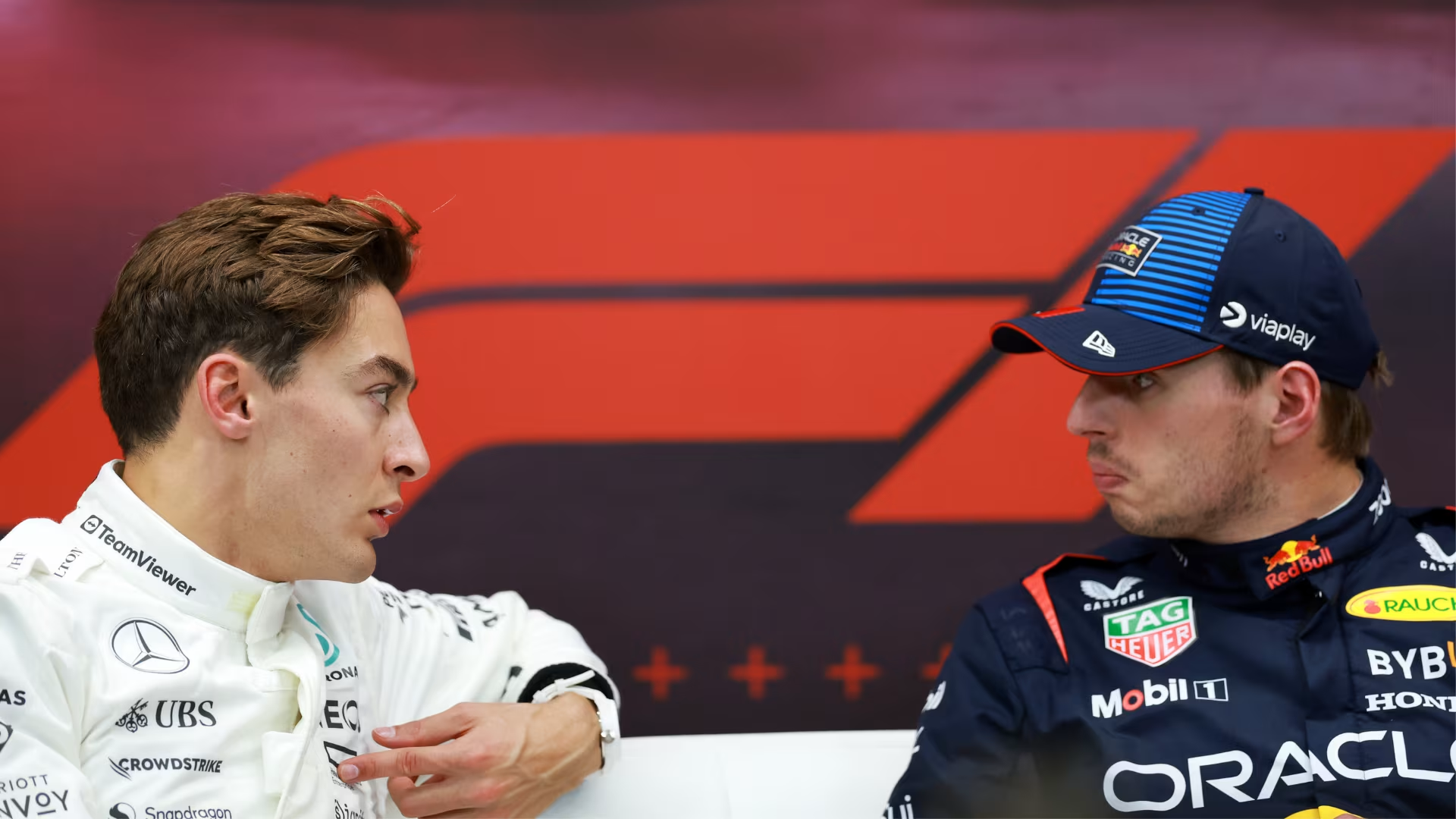
The modern Formula One drivers are media savvy having beenPR trained during their junior racing careers. Long gone are the days of Michael Schumacher storming down the pit lane in an attempt to punch his rival Damon Hill, so too are the warring team mate of Alain Prost and Ayrton Senna.
Yet there is one rivalry which exposed in 2024 at the penultimate race weekend of the year in Qatar. On the high speed circuit of Losail, the drivers find it difficult to find enough space to get clean air for their qualifying laps which is crucial.
In an attempt to prevent drivers dawdling on track, the race director each weekend sets a minimum time for them to complete their non-push laps in qualifying, although transgressions often go unpunished as a driver will explain he was making room for a competitor.
Qatar row from 2024
Verstappen was following Alonso with both on a preparation lap when George Russell also preparing for a push run came flying up behind the Dutchman. He yelled over team radio that the speed Max was travelling was “super dangerous” and the matter was referred to the stewards.
Having claimed his first pole position in five months, Verstappen was demoted one place, with Russell benefitting from the decision. Yet the world champion was not a happy bunny after the meeting with the stewards where he claimed his rival had pleaded with the stewards to issue him with a penalty.
Verstappen went on to win the race with Russell only a disappointing fourth, but after the Grand Prix it became apparent there was an ongoing war of words between the two derivers.
In the post-race FIA press conference, Verstappen said: “Honestly, [it was] very disappointing because I…READ MORE ON THIS STORY

Craig Alderson is Senior Editor at TJ13, where Craig oversees newsroom operations and coordinates editorial output across the site. With a background in online sports reporting and motorsport magazine editing, he plays a key role in maintaining consistency, speed, and accuracy in TJ13’s coverage.
During race weekends, Craig acts as desk lead, directing contributors, prioritising breaking stories, and ensuring timely publication across a fast-moving news cycle.
Craig’s work focuses heavily on real-time developments in the paddock, including team updates, regulatory decisions, and emerging controversies. This role requires a detailed understanding of Formula 1’s operational flow, from practice sessions through to race-day strategy and post-race fallout.
With experience managing editorial teams, Craig ensures that TJ13 delivers structured, reliable coverage while maintaining the site’s distinctive voice.
Craig has a particular interest in how information moves within the paddock environment, and how rapidly developing stories can be accurately translated into clear, accessible reporting for readers.

Alex Stanton is a Formula 1 journalist at TJ13 with a focus on the financial and commercial dynamics that underpin the sport. Alex contributes reporting and analysis on team ownership structures, sponsorship trends, and the evolving business model of Formula 1.
At TJ13, Alex covers topics including manufacturer investment, cost cap implications, and the strategic direction of teams navigating an increasingly complex financial environment. Alex’s work often examines how commercial decisions translate into on-track performance and long-term competitiveness.
With a strong interest in the intersection of sport and business, Alex provides context around Formula 1’s global growth, including media rights, expansion markets, and manufacturer influence.
Alex’s reporting aims to explain the financial realities behind headline stories, helping readers understand how money, governance, and strategy shape the competitive order in Formula 1.
