


Four-time Formula 1 world champion Sebastian Vettel has announced his latest project: a forest. Not a literal one, he’s swapped the roar of engines for the rustle of sketching paper. At the 2025 São Paulo Grand Prix, Vettel will unveil his initiative to create a ‘symbolic forest’ made entirely of tree drawings.
Yes, you read that correctly. The man who once left tyre scorch marks from his grid box on every continent now wants you to pick up a crayon and draw a tree. It’s an unexpected twist in the career of Formula 1’s most eco-conscious retiree, but then again, this is Sebastian Vettel. If there’s one thing he’s proven over the years, it’s that he can make anything, tyre management, bee hotels or doodling, sound like a moral duty.
The Art of Conservation (Literally)
“When you draw a tree,” Vettel explained, “you begin to realise how much we depend on nature, and how much it depends on us.”
In fairness, he’s not wrong. Most of us couldn’t draw a convincing-looking tree without consulting Google Images, which says something about our modern relationship with the natural world. Vettel’s aptly titled campaign, “Forest – Drawn Together”, aims to reconnect people with nature through art, proving that sustainability doesn’t have to come with a carbon offset form attached.
The project will culminate in a giant forest collage assembled beside the racetrack at São Paulo’s Autódromo José Carlos Pace. While Formula 1 cars tear past at 320 km/h, fans will be busy adding their leafy masterpieces to the wall-sized artwork. Think of it as a meeting of performance art and the pit lane.
Vettel himself will also be handing out tree seeds, a thoughtful gesture and a handy backup plan should the drawing part get a little too abstract.
Wolff admits to a curious toilet requirement
Why Brazil? Because symbolism never sleeps
Vettel chose Brazil for this grand artistic gesture after touring the Amazon rainforest last year. There, he visited indigenous communities and was struck by the contrast between the forest’s beauty and its fragile future.
“I didn’t just want to come back and talk about what’s being lost,” he said, “but to do something that brings people together for a hopeful cause.”
And what better way to do that than through art? After all, nothing conveys “hope” quite like a sheeted A4 forest growing beside a high-octane Grand Prix circuit. Brazil, with its vast greenery and equally vast deforestation statistics, offers the perfect backdrop for a statement that is both poetic and slightly ironic.
From Paddock to Pencil Case
In the week leading up to the Grand Prix, Vettel will swap the paddock for schools, community centres and even retirement homes, inviting people of all ages to draw their own trees. It’s an inclusive campaign; young, old, artistically gifted or otherwise, everyone can take part.
Imagine a classroom full of children earnestly sketching oak trees, a retiree adding a pine, and a few die-hard fans sneaking in a palm tree shaped like a Ferrari logo. Vettel hopes the result will be a massive collaborative forest that symbolises unity and creativity, a gentle reminder to plant more real trees, too.
Andrea Stella admits concerns over the MCL39
Fast Cars, Slow Planet
Of course, Vettel’s environmental activism didn’t start with this. Since retiring from Formula 1, he has become the sport’s unofficial conscience, its green ambassador in a sea of exhaust fumes.
In 2023, he co-created ‘Buzzin’ Corner’ at Suzuka, a bee sanctuary near Turn 2 of the circuit. Previously, he cleaned up grandstands after races, proving that even world champions can wield a rubbish bag with purpose. He has also been spotted campaigning for harbour porpoises in the Baltic Sea, an activity that probably raised a few eyebrows in his local harbour, but which has earned him plenty of environmental credibility.
In short, Vettel has turned retirement into a one-man sustainability tour, except instead of selling merchandise, he’s handing out saplings.
Insider: ‘Verstappen will leave Red Bull’
Partnerships and Pit Lanes
For his Brazilian forest project, Vettel has teamed up with botanist and environmental activist Ricardo Cardim, and has the full support of Formula 1 and the FIA, two organisations not exactly renowned for their low emissions. Nevertheless, their support demonstrates progress: even the most turbocharged enterprises can pause to smell (or draw) the roses.
As Vettel likes to remind people, it’s about awareness, not perfection. Formula 1 may still burn fuel, but thanks to Vettel, it’s now doing so with a slightly greener conscience, and possibly some crayons.
The Vettel Paradox
There’s something beautifully ironic about Vettel’s latest venture. The man who once chased tenths of a second now preaches patience and pencil shading. The driver who once burned rubber now cultivates roots, both literally and metaphorically.
But perhaps that’s the point. Vettel’s career has always been about evolution: from ruthless racer to reflective reformer. His ‘forest of drawings’ may sound whimsical, but in a world where cynicism is growing faster than trees, it’s a refreshingly earnest gesture.
Ultimately, Vettel’s symbolic forest is more than just an art project; it’s a statement. It says that you don’t have to save the world all at once; sometimes, you just have to draw one small tree.
And if it inspires even a few people to plant real trees, well, that’s a victory lap Vettel can be proud of I guess, no chequered flag required.
New Seat & Haas F1: Big Jack Doohan News
MORE F1 NEWS – Russell/Verstappen war of words continues behind the scenes
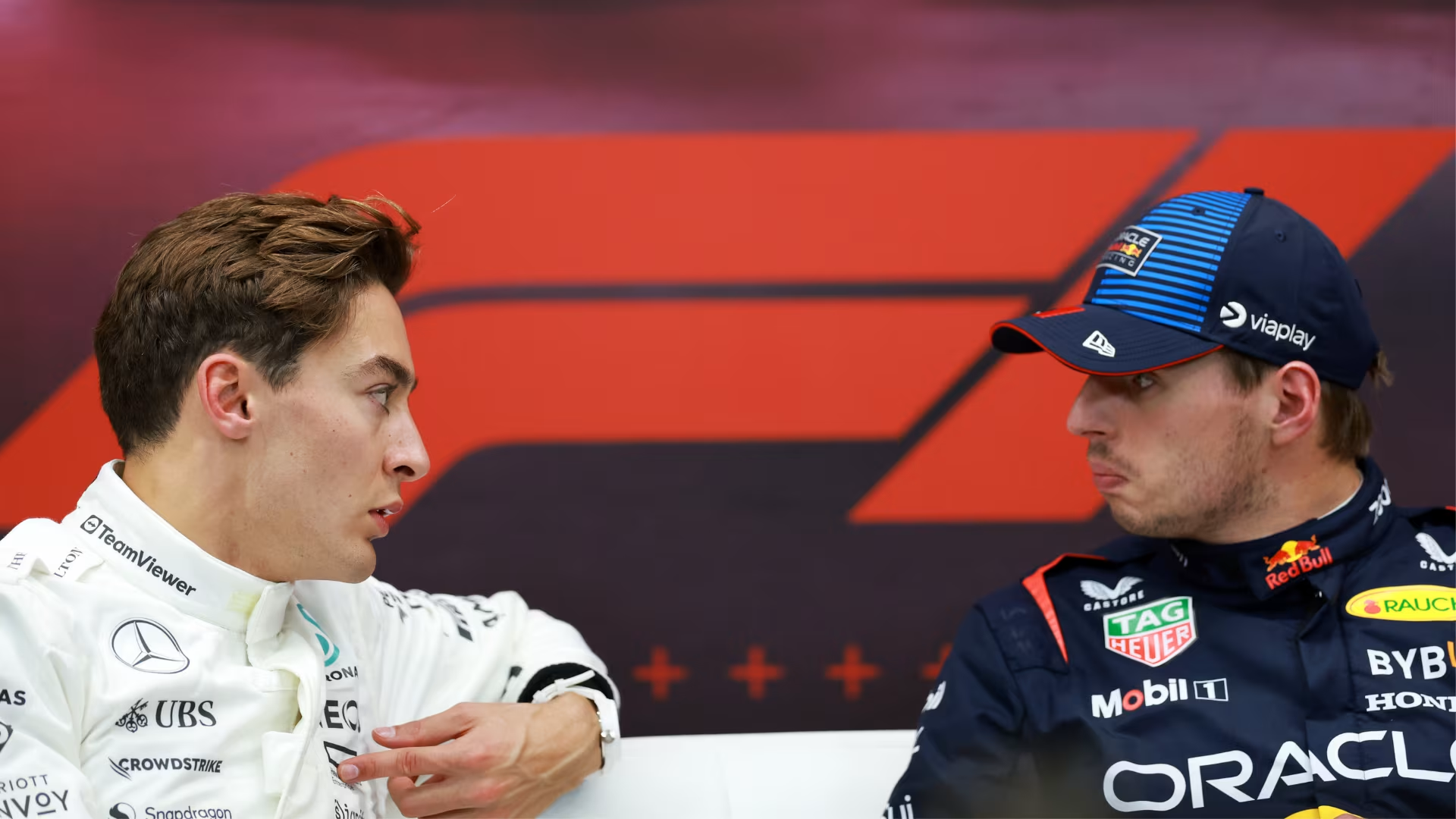
The modern Formula One drivers are media savvy having beenPR trained during their junior racing careers. Long gone are the days of Michael Schumacher storming down the pit lane in an attempt to punch his rival Damon Hill, so too are the warring team mate of Alain Prost and Ayrton Senna.
Yet there is one rivalry which exposed in 2024 at the penultimate race weekend of the year in Qatar. On the high speed circuit of Losail, the drivers find it difficult to find enough space to get clean air for their qualifying laps which is crucial.
In an attempt to prevent drivers dawdling on track, the race director each weekend sets a minimum time for them to complete their non-push laps in qualifying, although transgressions often go unpunished as a driver will explain he was making room for a competitor.
Qatar row from 2024
Verstappen was following Alonso with both on a preparation lap when George Russell also preparing for a push run came flying up behind the Dutchman. He yelled over team radio that the speed Max was travelling was “super dangerous” and the matter was referred to the stewards.
Having claimed his first pole position in five months, Verstappen was demoted one place, with Russell benefitting from the decision. Yet the world champion was not a happy bunny after the meeting with the stewards where he claimed his rival had pleaded with the stewards to issue him with a penalty.
Verstappen went on to win the race with Russell only a disappointing fourth, but after the Grand Prix it became apparent there was an ongoing war of words between the two derivers.
In the post-race FIA press conference, Verstappen said: “Honestly, [it was] very disappointing because I…READ MORE ON THIS STORY

Craig Alderson is Senior Editor at TJ13, where Craig oversees newsroom operations and coordinates editorial output across the site. With a background in online sports reporting and motorsport magazine editing, he plays a key role in maintaining consistency, speed, and accuracy in TJ13’s coverage.
During race weekends, Craig acts as desk lead, directing contributors, prioritising breaking stories, and ensuring timely publication across a fast-moving news cycle.
Craig’s work focuses heavily on real-time developments in the paddock, including team updates, regulatory decisions, and emerging controversies. This role requires a detailed understanding of Formula 1’s operational flow, from practice sessions through to race-day strategy and post-race fallout.
With experience managing editorial teams, Craig ensures that TJ13 delivers structured, reliable coverage while maintaining the site’s distinctive voice.
Craig has a particular interest in how information moves within the paddock environment, and how rapidly developing stories can be accurately translated into clear, accessible reporting for readers.
