
Despite the FIA’s ADUO ruling that Red Bull has the most powerful F1 engine on the grid, it is the Mercedes power unit which is in reality the class of the field. A Mercedes-powered car has won all four of the Sprint races this season, and of the nine Grands Prix completed, they have won seven.
Yet the power unit, while quick, has not been as reliable as Ferrari’s, with a litany of failures across the first third of the season. In China, Lando Norris did not start in his Mercedes-powered McLaren. During preparation laps to the grid, McLaren detected a critical, unfixable electrical error within the hybrid battery. The team attempted to reprogram and swap peripheral components in the garage, but the car could not communicate with the module, preventing him from taking part in the race.
Oscar Piastri also did not start in Shanghai. In a freak coincidence, Piastri’s car successfully reached the grid but completely failed to fire back up when the startup sequence commenced. Team Principal Andrea Stella later confirmed both cars suffered terminal, hardware-related battery component failures supplied by Mercedes HPP.
At the same Grand Prix in qualifying, George Russell suffered a battery-related failure late in the session that forced him to stop on track, nearly missing out on Q3 execution entirely. Next time out in practice at Suzuka, Alex Albon’s Williams was left stranded on circuit due to the aggressive 60-second hardware lockout code following an electrical recovery mismatch.
In Canada, there was heartbreak for George Russell while leading the Grand Prix. During an intense duel with his teammate, Russell suffered a catastrophic battery system failure. The energy store ceased deploying electrical power entirely, forcing him to retire the car from the lead.
Having just pulled off a crucial overtake on teammate George Russell to take second place in Barcelona, it was the turn of Kimi Antonelli’s M17 to suffer a total electrical shutdown at the apex of Turn 5 with only six laps remaining, cutting his five-race winning streak short. Williams’ tough run with car weight and adaptation to the new era took a mechanical blow in Spielberg, Austria, when Carlos Sainz’s power unit suffered a terminal internal combustion engine failure, forcing him into retirement.
The Equal Equipment Rule and TD/005-18
So, it is clear Mercedes HPP were in need of some reliability upgrades, which they brought to the 2026 British Grand Prix. Yet despite FIA rules which state that each engine manufacturer must supply equal equipment to itself and all its customers, McLaren were not afforded the reliability-upgraded power unit.
Back in 2018, it was suspected that certain manufacturers were supplying power units to their customers which were not of the same specification as the ones they themselves were running. In a technical directive, TD/005-18, the matter was clarified: “The purpose of [point] five of Appendix four to the F1 Sporting Regulations is to ensure that all power units supplied by one manufacturer are identical in all respects.”
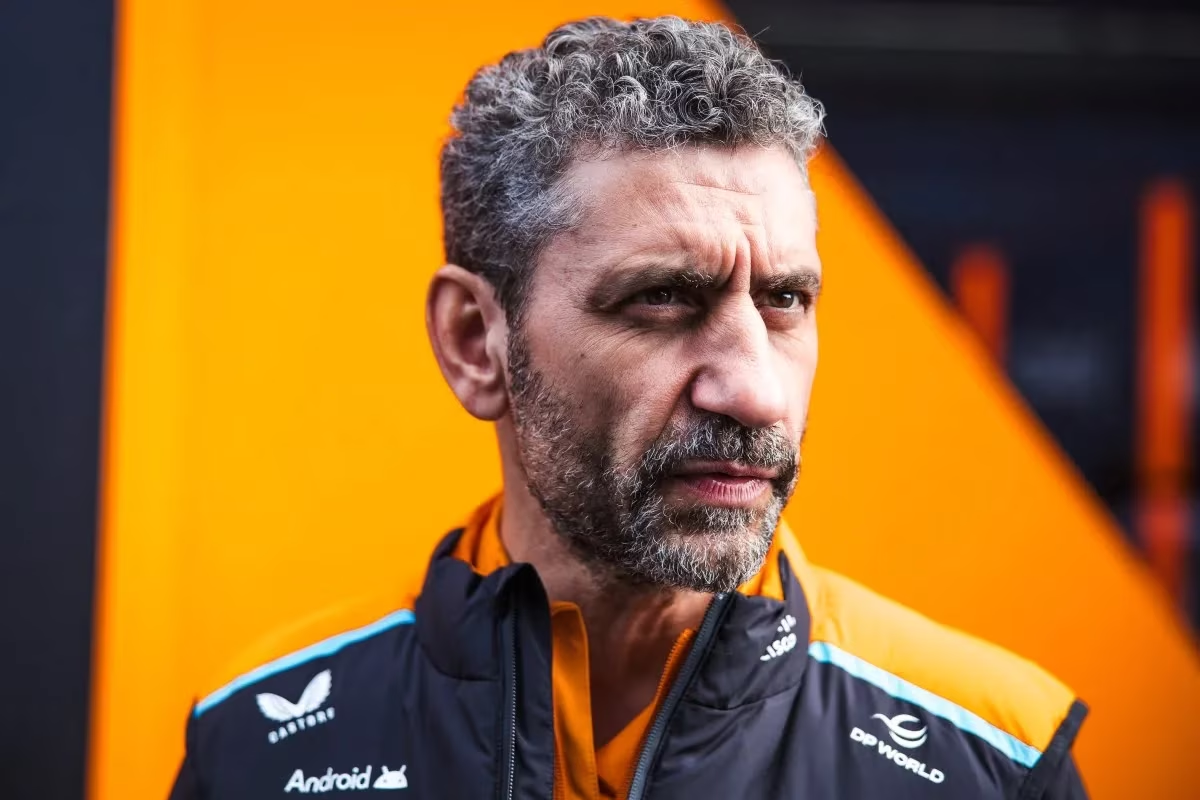
So why were Mercedes allowed to deliver the improved reliability powertrains to themselves, Alpine, and Williams, and not McLaren? Comments from McLaren team boss Andrea Stella appear to suggest this was a fait accompli he and his team were forced to suffer.
Stella Justifies the Parts Allocation Delay
“We discussed with HPP the reason why we are not receiving this specification yet,” Stella told assembled paddock media. “We understand the reasoning, we trust HPP, we’ve had such a great collaboration in previous years, and they’ve been totally instrumental in McLaren becoming world champions twice, so it is not changing the foundation of the relationship, and conversations remain ongoing.”
Stella went on to imply Mercedes simply did not have enough time to manufacture the eight upgraded engines in time along with spares, adding, “Hopefully, it is going to happen at the next event.”
But it was his next comment which raised alarm bells among the TJ13 writers, as Stella stated: “Even the allocation of power units is based on the mileage per car, because it looks like we are not on the latest specification, because Alpine and Williams have accrued more mileage than us, and they were more in need of upgrading their engine.”
F1 Realpolitik: What Did McLaren Get in Return?
This is not an exception allowed for in the FIA’s rules, which state all Mercedes teams must be able to run equal power units. So, McLaren have clearly bailed out Mercedes and accepted that there were others more deserving of the new upgraded powertrain. Yet in F1, nothing comes for free.
It could be that Williams and Alpine have agreed that when Mercedes finally uses their ADUO token and makes a performance-based upgrade, it is McLaren who sits at the front of the queue once homologation has taken place and the factory is chasing its tail to produce enough all-new units.
Further, the decision made by McLaren was a pragmatic one, given their expectations for Silverstone were that it would be a circuit where they could not match the power of Mercedes’ W17 car design, but would remain significantly ahead of both Alpine and Williams.
Stella did emphasize more than once “the excellent relationship we have with HPP,” as if putting them on notice as to the huge favour they have done for them.
Would you like to see more TJ13 Formula 1 coverage? Add us to your favourites list on Google to receive trusted F1 news

A.J. Hunt is Senior Editor at TJ13, where Andrew oversees editorial standards and contributes to the site’s Formula 1 coverage. A career journalist with experience in both print and digital sports media, Andrew trained in investigative journalism and has written for a range of European sports outlets.
At TJ13, Andrew plays a central role in shaping the site’s output, working across breaking news, analysis, and long-form features. Andrew’s responsibilities include fact-checking, refining editorial structure, and ensuring consistency in reporting across a fast-moving news cycle.
Andrew’s work focuses particularly on the intersection of Formula 1 politics, regulation, and team strategy. Andrew closely follows developments involving the FIA, team leadership, and driver market dynamics, helping to provide context behind the sport’s biggest stories.
With experience covering multiple seasons of Formula 1’s modern hybrid era, Andrew has developed a detailed understanding of how regulatory changes and competitive shifts influence the grid. Andrew’s editorial approach prioritises clarity and context, aiming to help readers navigate complex developments within the sport.
In addition to editorial duties, Andrew is particularly interested in how media narratives shape fan perception of Formula 1, and how reporting can balance speed with accuracy in an increasingly digital news environment.
