
What does an F1 team really do? Spend vast amounts of cash each year to build a racing prototype car which travels the world to go racing. And come the following season, it is practically obsolete. So who pays for all this?
Of course, there is the prize money handed out each season, but the majority of the cash generated by the team comes from sponsors who want to be associated with the glamour and glitz that F1 projects.
The Driver Voice Diminishes
Formula One is truly an entertainment business, as the CEO of the sport, Stefano Domenicali, made clear when Lando Norris complained about the annual race schedule growing from 22 to 24 race weekends:
“If you don’t want to drive, you don’t have to. It’s a matter of respect for the fans and for the people who work to make all this possible. Whoever doesn’t want to do it is free to leave.”
Clearly, the views of the drivers on how the sport should be run have seen their weight diminishing in recent years. World champion Norris again criticised F1 before the recent Hungarian Grand Prix:
“All we think about now is maximising profits, and that’s not how a sport should be… It is no longer about how to make the sport as good as possible. It is primarily about how to make more money. That is not how a sport should be run, and I find that regrettable.”
In a slightly softer response this time, Domenicali remained firm on his stance that the all-new rules are here to stay, claiming the fans are enjoying the yo-yo racing more than before:
“You know very well how much I respect the jewels that are our drivers. But of course, they need to understand that there is one path we need to take together. And the fans are always a priority on top of everyone, even me… I have the duty to make a summary of what is the best for the sport.”
Fans Keep Buying Despite Regulatory Flaws
Despite a disastrous change in regulations for 2026, which has seen cars suddenly slow midway along the straight as they run out of battery power, ticket sales are reportedly up 6% this season. Strangely, the TV viewing numbers have not been published as they usually are.
There have been pockets of reporting which suggest in Italy the TV audience is up 27% year-on-year, but then again, Italian driver Kimi Antonelli is favourite to win the drivers’ championship. Brazil too is enjoying a boom, but this in part is due to local hero Gabriel Bortoleto now seeing off veteran F1 teammate Nico Hülkenberg.
The $20 Billion War for F1’s Rights
In light of the increased number of races, surging TV revenue, and ticket sales—together with more and more corporate money piling into F1—valuations have ballooned in recent years. Liberty Media bought the commercial rights for the sport in 2017, paying CVC Capital Partners some $3.05bn in cash. Yet including the debt they inherited, this amounted to a valuation of $8bn.
Less than six years later, Bloomberg reports revealed that the Saudi Public Investment Fund (PIF) had been touting a purchase of F1 from Liberty at a valuation of $20bn. This incensed FIA president Mohammed Ben Sulayem, who sparked a paddock row by claiming this was an inflated sum and threatened to intervene to prevent the acquisition.
The response from Liberty Media was to issue a threat of legal proceedings to the FIA for potential damages to the valuation of their asset.
From Cash-Drain to Multi-Billion-Dollar Assets
The same mega-increase in F1 team valuations has been a feature across the paddock since the Liberty Media takeover. In August 2020, the historic Williams F1 Racing team was sold by the family to Dorilton Capital at a valuation of $179.5m. After the repayment of debt, Frank’s family received just over $100m.
Since then, Dorilton has injected around $550m into the Grove-based F1 team to improve ‘legacy systems’, cover capital expenditure on modernising facilities, and secure talent signings alongside a general commercial overhaul.
As F1 insiders used to say, the best way to become a millionaire in F1 was to start as a billionaire. But this no longer appears to be the case. In the latest round of F1 team valuations, the average valuation of F1 teams was put at around $3.5bn, and the range given for Williams was $2.1–$2.7bn.
The Astonishing $3.5 Billion Alpine Claim
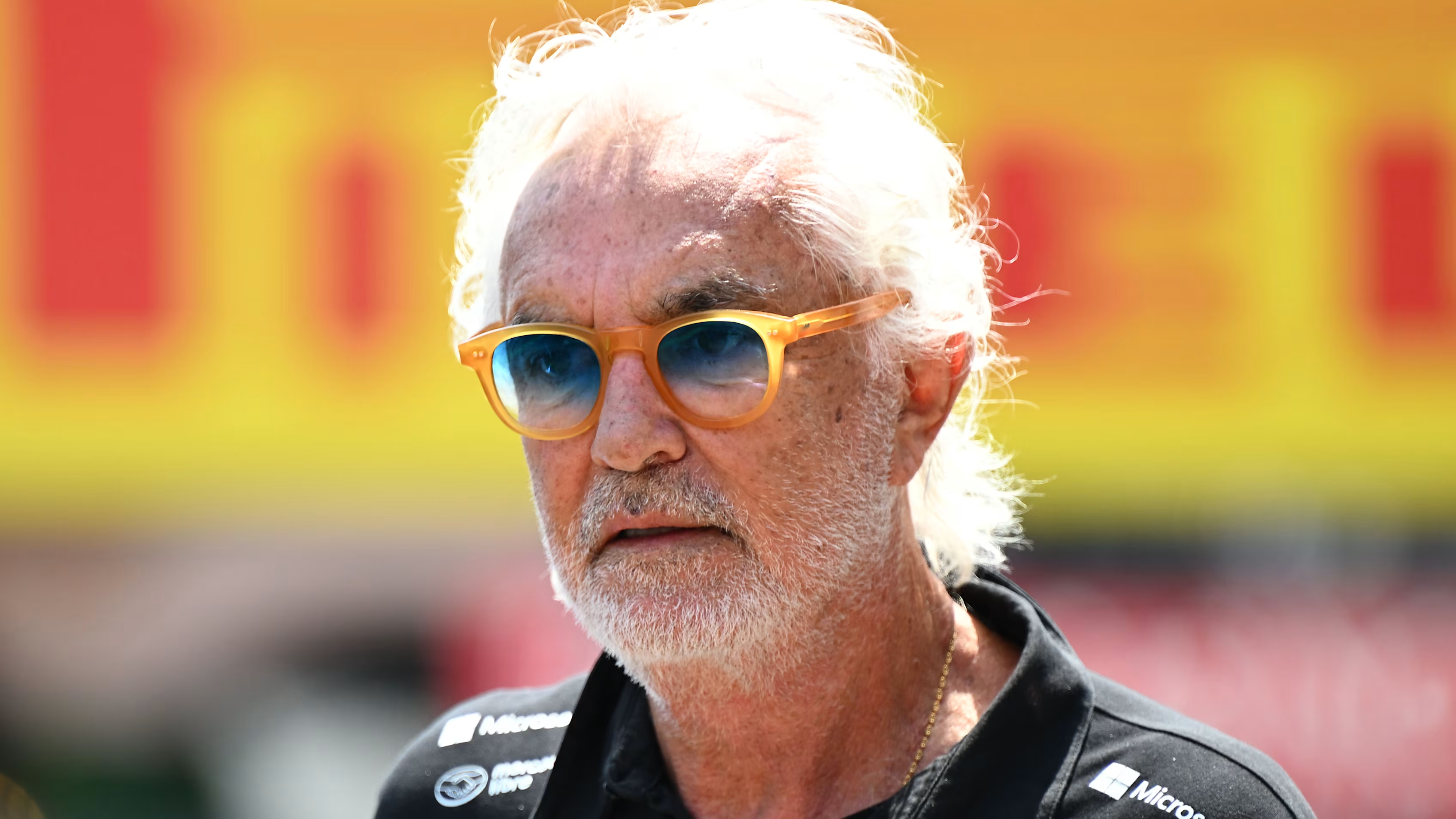
In 2023, Renault sold a minority stake in their Alpine F1 team to Otro Capital for $218m. Now, executive Flavio Briatore claims to have received a bid to buy out those shares for $900m. The French auto manufacturer has the right of veto over any sale of the stake, should they believe the new partners do not fit with the ethos of Alpine F1.
Further, there is an initial lock-up clause where the shares must be retained by the Otro unit until at least September 2026. Speaking on The Race Business in Conversation with… series, Darren Cox put it to Briatore that the team was now valued by Forbes in the region of $2.45bn.
“No, no, we are more,” replied Briatore. “We have an offer for the 24 per cent of Otro, the valuation [is] $3.2 [billion]…. And we’re working at this $3.5 [billion] valuation. So we’re representing 40% or 50% [of the entire Renault global automotive valuation].”
Briatore gives no details of who is behind the bid, although rumours are that Christian Horner has assembled a consortium to acquire the Otro stake. Yet on more than one occasion, Briatore has made it plain they want more from their next investor than just money.
What’s clear is that there will be a new investor coming, as Briatore adds:
“Sure, to have a [new] partner of 24%, I expect somebody to give not only the finance, [but to] give some help in technology or whatever, or whatever in finance.”
Given the monstrous valuations now being placed on F1 teams, the Italian executive joked: “If the team was mine, I’d have sold [it in its entirety] already!”
Outvaluing the Automotive Parent
Alpine have never been placed higher than fourth in the Constructors’ Championship (2022) and were plumb last in 2025 (10th) before Cadillac joined, making the number of teams on the grid now eleven. And there appears little chance they will become a top-four team anytime soon.
Yet should the valuations of F1 teams continue to rise in line with Alpine’s rate of growth in just three years, the Enstone-based squad will soon be valued at more than the entire Renault global automotive manufacturing corporation.
Of course, much of the current valuation boom in F1 relies heavily on private equity interest and corporate venture capital. Any severe macroeconomic event or a severe global downturn could quickly cool such aggressive growth in F1 team valuations.
Would you like to see more TJ13 Formula 1 coverage? Add us to your favourites list on Google to receive trusted F1 news.

A.J. Hunt is Senior Editor at TJ13, where Andrew oversees editorial standards and contributes to the site’s Formula 1 coverage. A career journalist with experience in both print and digital sports media, Andrew trained in investigative journalism and has written for a range of European sports outlets.
At TJ13, Andrew plays a central role in shaping the site’s output, working across breaking news, analysis, and long-form features. Andrew’s responsibilities include fact-checking, refining editorial structure, and ensuring consistency in reporting across a fast-moving news cycle.
Andrew’s work focuses particularly on the intersection of Formula 1 politics, regulation, and team strategy. Andrew closely follows developments involving the FIA, team leadership, and driver market dynamics, helping to provide context behind the sport’s biggest stories.
With experience covering multiple seasons of Formula 1’s modern hybrid era, Andrew has developed a detailed understanding of how regulatory changes and competitive shifts influence the grid. Andrew’s editorial approach prioritises clarity and context, aiming to help readers navigate complex developments within the sport.
In addition to editorial duties, Andrew is particularly interested in how media narratives shape fan perception of Formula 1, and how reporting can balance speed with accuracy in an increasingly digital news environment.
