

Formula 1 is preparing for a subtle but potentially decisive shift in the competitive order. The FIA’s newly introduced Additional Development and Update Opportunities (ADUO) system is designed to help power unit manufacturers close performance gaps, and initial signs suggest that Ferrari could be the biggest beneficiary.
Although multiple teams are set to benefit from the regulatory change, Ferrari is the only team with a realistic chance of using that extra development freedom to compete directly with Mercedes at the front.

What is the ADUO system?
The ADUO mechanism has been introduced to prevent one engine supplier from dominating unchallenged, as has happened in the past. It activates when a power unit manufacturer falls more than 2% behind the performance benchmark.
Rather than allowing complete redesigns, the system provides an additional development budget and controlled opportunities to upgrade existing power units. These upgrades are carefully regulated and assessed over fixed periods, with performance evaluations scheduled every six races.
The FIA originally planned to determine eligibility after the sixth, twelfth and eighteenth rounds of the season. However, the cancellation of races in Bahrain and Saudi Arabia has disrupted this schedule.
Consequently, the first official allocation of ADUO support, initially expected before Miami, has been delayed. This delay could significantly impact how quickly teams like Ferrari can address their current deficits.
Whistle Blower: Did Adrian Newey lie? Fresh doubts emerge at Aston Martin
Mercedes sets the benchmark with the W17
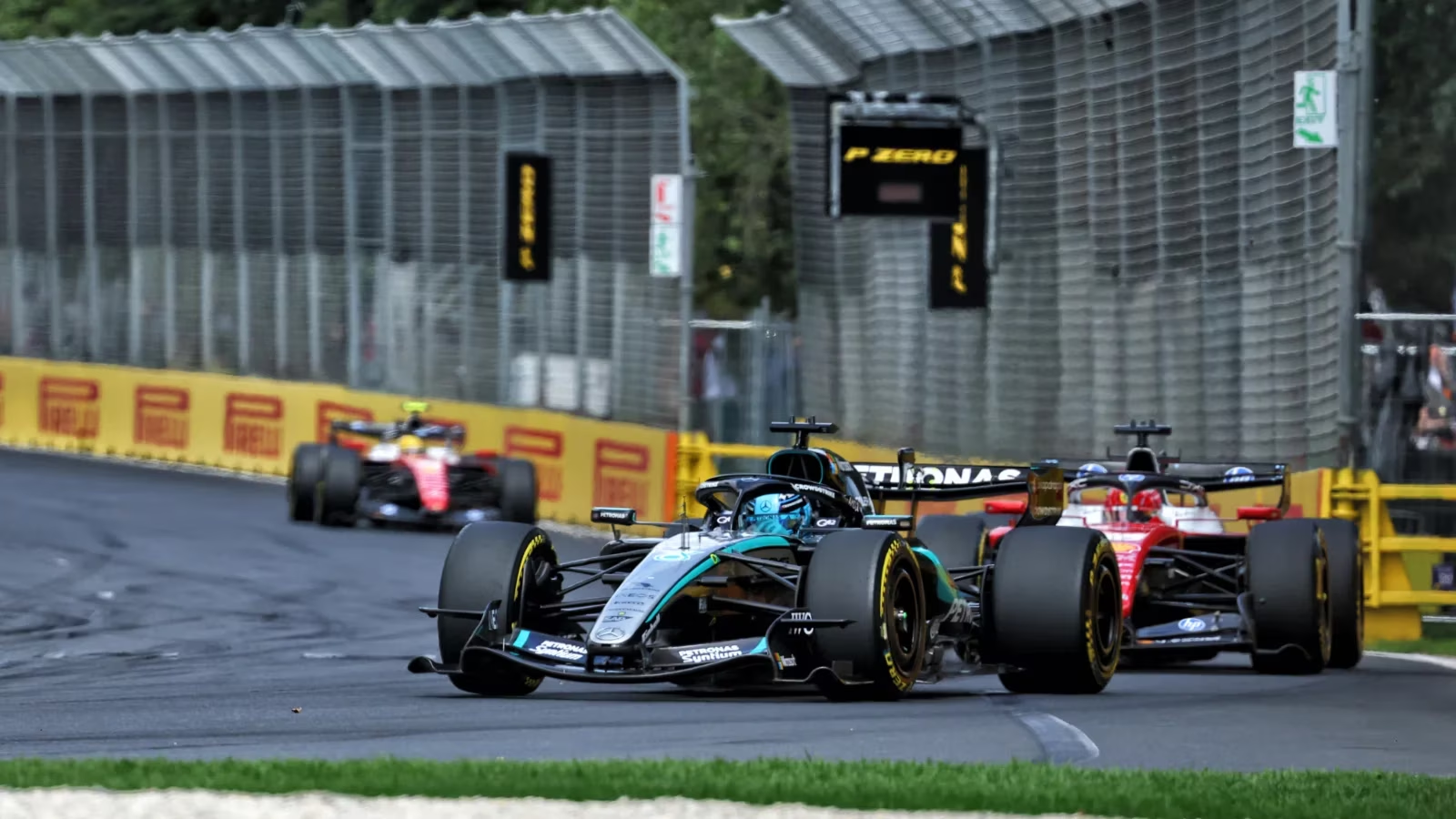
At the heart of this regulatory change is Mercedes, whose current power unit has become the clear benchmark in Formula 1. The W17 package has demonstrated superior efficiency, energy deployment and outright power, firmly placing it at the top of the competitive hierarchy.
While the FIA has yet to confirm the official list of ADUO beneficiaries, there is a clear consensus in the Suzuka paddock that Ferrari, Audi and Aston Martin are all expected to qualify.
Red Bull Powertrains, by contrast, appears to fall within the 2% threshold. Despite experiencing some difficulties on the track, the performance of its power unit remains competitive enough to exclude it from the scheme.
This distinction is crucial. While Red Bull faces performance issues, these are rooted in chassis dynamics, specifically weight distribution and aerodynamic balance, rather than engine output. ADUO offers no solution to these kinds of problems.
Would you like to see more TJ13 Formula 1 coverage? Add us to your favourites list on Google to receive trusted F1 news.
Ferrari’s power unit deficit, and opportunity
Ferrari’s case for ADUO support is clear and compelling. Early-season analysis of the SF-26 reveals that its primary weakness lies in the power unit, particularly in terms of peak combustion power and energy deployment.
This deficit has tangible consequences. On a circuit like Suzuka, a 2% performance gap equates to approximately three tenths of a second per lap. Over a full race distance, this can translate into a deficit of more than 15 seconds — enough to turn a podium contender into a midfield runner.
However, Ferrari’s situation differs fundamentally from that of its rivals. Unlike in previous eras, when teams were locked into flawed engine concepts, Ferrari’s current power unit is considered structurally sound. The shortcomings are specific and measurable, making them ideal targets for incremental improvement under the ADUO framework.
Combined with planned aerodynamic upgrades potentially arriving as early as the Miami Grand Prix, Ferrari has a realistic pathway to significantly reducing the gap to Mercedes.
MORE NEWS – Hamilton: “it warmed my heart…” – The race that changed everything?
Lessons from the turbo-hybrid era
The concept of supporting struggling manufacturers is not new. Back in 2014, when Mercedes introduced its dominant V6 turbo-hybrid engine, rival teams were given a token-based development system to help them catch up, but that approach largely failed.
Restrictions on how and where tokens could be used stifled innovation, and teams with flawed designs found it hard to improve.
The ADUO system is a more flexible evolution. Rather than rigid tokens, teams now receive increased financial flexibility and greater freedom to modify existing components.
For Ferrari, this distinction is critical. The team is not trying to fix a broken concept; it is refining a competitive one. This makes achieving targeted gains far more feasible.
The historical comparison also highlights the scale of Mercedes’ past dominance. During their peak years, drivers such as Lewis Hamilton accumulated most of their victories thanks to a clear engine advantage. Today, Ferrari hopes that ADUO can prevent history from repeating itself.
Why is Red Bull not included?
Red Bull’s exclusion from the ADUO programme highlights an important nuance in the current Formula 1 landscape.
Despite not having the strongest car overall, Red Bull’s power unit performance remains within the acceptable margin. Its problems stem from aerodynamic instability and balance limitations, rather than a lack of engine output.
This reflects a broader shift in how races are won. While Mercedes’ dominance between 2014 and 2020 was heavily engine-driven, Red Bull’s recent success has been built on aerodynamic excellence and driver performance.
Even in late 2025, Red Bull proved that it could win races without the fastest power unit. This explains why ADUO does not apply to its current challenges.
Different outlooks: Audi and Aston Martin
While Ferrari appears to be in the best position to capitalise on ADUO, its fellow beneficiaries face very different scenarios.
In its debut season as a full works team, Audi is still building its competitive foundation. Under Mattia Binotto’s leadership, the focus is on steady progress rather than immediate victories. For Audi, ADUO provides a valuable opportunity to address initial design inefficiencies without the pressure of pursuing victories.
Meanwhile, Aston Martin finds itself at the opposite end of the grid. The team has struggled with significant performance deficits, exacerbated by ongoing vibration issues with its Honda power unit.
As for Aston Martin, ADUO may only provide limited short-term relief. The scale of its challenges suggests a longer-term approach is needed, with 2026 effectively serving as a development platform for future competitiveness, particularly in view of 2027.
Ferrari’s drivers are ready to capitalise
Ferrari’s driver line-up of Charles Leclerc and Lewis Hamilton further strengthens its ADUO opportunity.
Both drivers have already demonstrated that the SF-26 chassis can compete at the front under the right conditions. However, a deficit in the power unit has consistently held them back from converting strong performances into podium finishes.
Historically, Leclerc’s victories have come when Ferrari had a competitive engine package. The current situation is the inverse: a capable chassis is being held back by insufficient power.
If ADUO can close even half of the existing gap to Mercedes, Ferrari could re-emerge as a consistent podium contender, and potentially a race-winning threat.
Timing could be crucial in deciding the title fight
The delayed rollout of the ADUO system may be just as important as the system itself.
With the initial allocation now postponed due to changes to the calendar, Ferrari faces a critical period in which it must minimise losses to Mercedes without the benefit of further development support.
Every race without ADUO represents lost ground in the championship standings. While aerodynamic updates can mitigate some of the deficit, they cannot fully compensate for a disadvantage in the power unit.
For Ferrari, the equation is simple: the sooner ADUO support arrives, the greater their chances of making the season a genuine contest.
A rule that could reshape the season
In theory, the ADUO system is designed to promote parity across the grid. In practice, however, its immediate impact may be far more selective.
Of the teams set to benefit, Ferrari is uniquely positioned at the intersection of need and opportunity. It has a clear performance deficit, but also the technical foundation to address it.
If the system works as intended, Formula 1 could be heading towards a far more competitive landscape. At the centre of this shift, Ferrari may finally have the tools to challenge Mercedes.
NEXT ARTICLE – F1 veteran claims 2026 cars in breach of fundamental F1 regulation
The war in Iran may well hit the owners of Formula One in the pocket hard, but it’s an opportunistic moment for the sport’s regulators to regain control of a runaway beast they have helped to create. Ex-F1 racer and veteran commentator Martin Brundle claims that the current breed of F1 cars are in fact in breach of a fundamental tenet embedded in the FIA’s ow regulations.
F1 engine cycles tend to be 5-7 years in length and sometimes even shorter, however since 2014 the sport retained the basic architecture of the V6 hybrid turbo powertrains for some 12 long years.
Would you like to see more TJ13 Formula 1 coverage? Add us to your favourites list on Google to receive trusted F1 news.
2026 F1 engines – 9 long years in the making
The 2014 V6 hybrids were initially expected to be replaced in 2020, but an FIA working party set up in 2017 to create the new PU regulations became mired in politics and at the mercy of the manufacturers.
Given that Red Bull Racing had almost found themselves in the dire situation where they had no engine supplier, the FIA was desperate to attract more manufacturers to ensure this situation could never arise again. But the lunatics took over the asylum.
Porsche, Audi, Mercedes and Honda were adamant the future of road cars would be hybrid and demanded that F1 reflected this trend to continue is association with road car relevant technology. Yet as the war in Iran has proven, electric is becoming increasingly popular with the highest sales of electric road cars in the UK since the middle east conflict exploded.
As the F1 teams began to simulate the all new engines with their 50/50 split in output between the internal combustion engine and the battery, deep concerns were raised about what Christian Horner described as “Frankenstein monsters.” He claimed the cars would run out of power on certain circuits with long straights and that the internal combustion engine would have to serve merely as a…CONTINUE READING THIS STORY

Alex Stanton is a Formula 1 journalist at TJ13 with a focus on the financial and commercial dynamics that underpin the sport. Alex contributes reporting and analysis on team ownership structures, sponsorship trends, and the evolving business model of Formula 1.
At TJ13, Alex covers topics including manufacturer investment, cost cap implications, and the strategic direction of teams navigating an increasingly complex financial environment. Alex’s work often examines how commercial decisions translate into on-track performance and long-term competitiveness.
With a strong interest in the intersection of sport and business, Alex provides context around Formula 1’s global growth, including media rights, expansion markets, and manufacturer influence.
Alex’s reporting aims to explain the financial realities behind headline stories, helping readers understand how money, governance, and strategy shape the competitive order in Formula 1.

Craig Alderson is Senior Editor at TJ13, where Craig oversees newsroom operations and coordinates editorial output across the site. With a background in online sports reporting and motorsport magazine editing, he plays a key role in maintaining consistency, speed, and accuracy in TJ13’s coverage.
During race weekends, Craig acts as desk lead, directing contributors, prioritising breaking stories, and ensuring timely publication across a fast-moving news cycle.
Craig’s work focuses heavily on real-time developments in the paddock, including team updates, regulatory decisions, and emerging controversies. This role requires a detailed understanding of Formula 1’s operational flow, from practice sessions through to race-day strategy and post-race fallout.
With experience managing editorial teams, Craig ensures that TJ13 delivers structured, reliable coverage while maintaining the site’s distinctive voice.
Craig has a particular interest in how information moves within the paddock environment, and how rapidly developing stories can be accurately translated into clear, accessible reporting for readers.
