

Following two promising performances in Melbourne and Shanghai, Scuderia Ferrari arrived at Suzuka feeling cautiously optimistic, and perhaps harbouring upgraded expectations. However, by the end of Friday, the mood had shifted towards something more familiar: polite concern wrapped in carefully measured language.
At the iconic Japanese Grand Prix, Ferrari found themselves in third place, respectable on paper, but in Formula 1 terms, roughly equivalent to bringing an elegant knife to a high-speed gunfight.
MORE NEWS – Leaked Rant at Aston Martin: Stroll furious with Adrian Newey

A ‘Smooth’ Day… With a Few Asterisks
On the surface, things looked orderly. There were no major incidents or reliability scares, and plenty of laps were completed. The team described both sessions as having ‘run smoothly’, which in Ferrari-speak of recent years usually means: ‘Nothing caught fire, but we’re not challenging the front row just yet.’
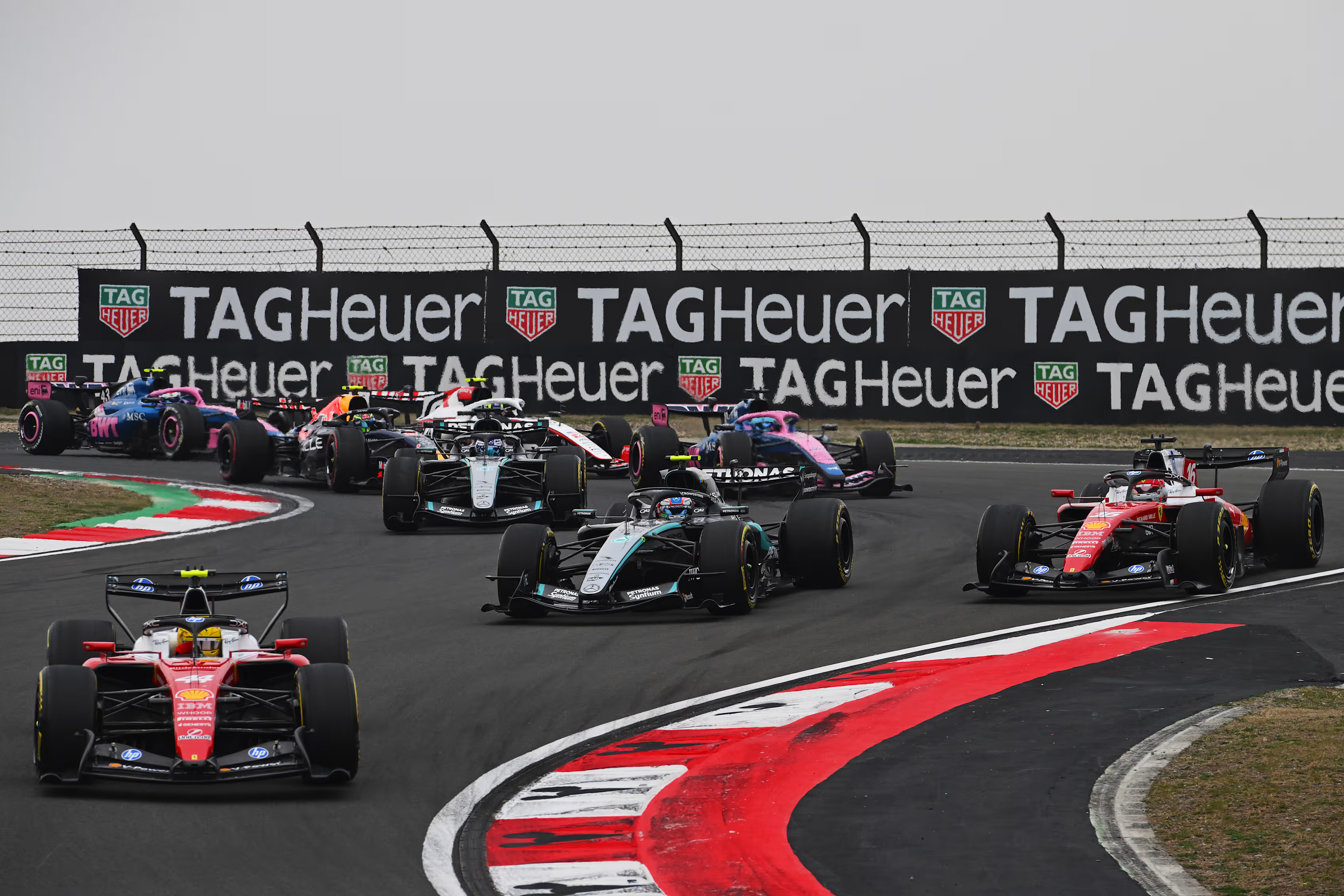
In FP1 and FP2, Charles Leclerc and Lewis Hamilton secured fifth and sixth place, respectively — solid midfield-of-the-front positions if such a category exists. Meanwhile, the Mercedes and McLaren were setting the pace, seemingly more comfortable with Suzuka’s high-speed demands.
Meanwhile, Ferrari gathered ‘numerous data points’, which is always reassuring, assuming those data points eventually lead to faster times.
Aston Martin F1 News: Breakthrough found to fix Newey’s disaster car for Honda’s home race
Hamilton’s verdict: not bad, not great
For Lewis Hamilton, the day fell squarely into the “could be worse, should be better” category.
“It was a somewhat difficult day,” he admitted, which might qualify as the understatement of the afternoon.
The SF-26 isn’t fundamentally flawed, he explained; it simply lacks outright pace. Add to that a balance that’s “not quite where we’d like it to be” and the result is a car that performs impeccably until the stopwatch is involved.
Hamilton’s best lap time of 1:30.980 left him just under a second off the pace. In most contexts, that’s negligible. In Formula 1, however, it’s an eternity, long enough to brew an espresso, reflect on life choices and still miss pole position.
MORE NEWS – Verstappen vs. the Press: Giles Richards Speaks Out After Suzuka Clash
Leclerc echoes the concern
On the other side of the garage, Charles Leclerc offered a similar diplomatic assessment. Yes, the race pace looks “quite good”. Yes, there’s “potential”. However, he also acknowledged the “gap to the leaders” that remains a significant challenge.
Leclerc’s best time of 1:30.846 put him slightly ahead of his teammate, but in the same position: competitive, but not threatening. Encouraging, but not inspiring. Sort of, meh.
The Monegasque driver emphasised that qualifying is the key focus because starting further up the grid is one of the few reliable ways to appear faster than you actually are.
MORE F1 NEWS – Stroll makes big Aston Martin admission ahead of the Japanese Grand Prix
The Overnight Miracle Shift
As is tradition, Ferrari’s engineers are now preparing for the sacred overnight ritual that is the all-nighter. Somewhere in the Suzuka paddock, laptops are open, coffee is flowing and a group of highly intelligent individuals are trying to persuade physics to be a little more cooperative by Saturday morning.
The team insists there is ‘work to be done in all areas’, which, while comprehensive, leaves room for interpretation. Aerodynamics? Likely. Setup? Certainly. Existential pace deficit? Possibly.
Qualifying holds the key, as usual
As we head into Saturday, the objective is clear: to unlock performance, find balance and close the gap to the front-runners. It’s simple in theory but notoriously complicated in practice.
Suzuka, with its sweeping high-speed corners, is unforgiving when a car lacks precision. Right now, Ferrari’s SF-26 is teetering on the edge between “almost there” and “not quite enough”.
Nevertheless, if there’s one thing Ferrari excels at, it’s maintaining optimism under pressure. By FP3 and qualifying, the narrative may yet shift. Or, at the very least, it will be rephrased with even greater elegance.
In Formula 1, as Ferrari has demonstrated once again, it’s not just about chasing speed; it’s also about mastering the art of explaining why it hasn’t quite arrived yet.
MORE F1 NEWS – “Verstappen to Mercedes”: F1 icon makes headlines
Would you like to see more TJ13 Formula 1 coverage? Add us to your favourites list on Google to receive trusted F1 news.
NEXT ARTICLE – FIA to urgently address farcical 2026 F1 regulations
As much as the teams, drivers and F1 broadcasters tell the fans the racing is great in 2026, there is a massive problem with the all new F1 racing this year. Yes the race starts have been filled with drama, as the Ferrari’s with their small designed turbo’s launch off the line ahead of the Mercedes cars, but once the sugar rush fades the spectacle becomes mundane.
The problem is with the all new hybrid powertrains which manufacturers like Honda and Audi insisted must have a 50/50 power split between the battery and the internal combustion engines (ICE). Basically, the amount of power demanded from the battery has been set too high and so the cars a running out of charge and slowing down in strange locations.
Back in the summer of 2023, the then Red Bull Racing team boss, Christian Horner, claimed that simulations performed in Milton Keynes had revealed this state of affairs. He described the incoming cars as “Frankenstein monsters” which would need to merely use the ICE as a power generator at times.
Christian Horner predicted the F1 energy management crisis
At the time he was mocked by Toto Wolff who claimed Horner’s “complaints” stemmed from the fact the Red Bull Powertrain programme in its infancy was not fairing well. Yet hey presto, Horner was right and Charles Leclerc’s qualifying lap in China is all the proof anyone needs that radical changes are needed from the FIA.
The Ferrari driver is one of the finest qualifiers amongst the current crop of F1 competitors. The 28 year old Monegasque has 27 pole positions to his name although his win rate of just 8 Grand Prix is an indictment on how Ferrari have built their previous cars.
During Sprint qualifying in China, Leclerc suffered a slide at the rear of his SF-26. This is nothing unusual given the drivers leave it all out there on track in an effort to claim pole position. Yet Charles’ response to the slide set in motion a host of automatic algorithm defined electrical procedures which to cut a long story short left him well down on electrical power for the long back straight.
In effect, the computer decided it was time to deploy full power after Leclerc’s response of lifting for the slide. But through turn 10/11 in Shanghai, this is not the most efficient place for that deployment to take place. So it was nothing to do with Leclerc that his SF-26 had less electrical power on the back straight than his previous run. Its all in the algorithm…CONTINUE READING THIS ARTICLE

Craig Alderson is Senior Editor at TJ13, where Craig oversees newsroom operations and coordinates editorial output across the site. With a background in online sports reporting and motorsport magazine editing, he plays a key role in maintaining consistency, speed, and accuracy in TJ13’s coverage.
During race weekends, Craig acts as desk lead, directing contributors, prioritising breaking stories, and ensuring timely publication across a fast-moving news cycle.
Craig’s work focuses heavily on real-time developments in the paddock, including team updates, regulatory decisions, and emerging controversies. This role requires a detailed understanding of Formula 1’s operational flow, from practice sessions through to race-day strategy and post-race fallout.
With experience managing editorial teams, Craig ensures that TJ13 delivers structured, reliable coverage while maintaining the site’s distinctive voice.
Craig has a particular interest in how information moves within the paddock environment, and how rapidly developing stories can be accurately translated into clear, accessible reporting for readers.
