
Only four races have been held under Formula 1’s new 2026 regulations, yet the sport’s leadership has already begun debating another dramatic engine revolution. Despite the introduction of electrified hybrid power units and sustainable fuels this season, there is growing support for a potential return to V8 engines as early as 2030.
This topic came to the fore during the Miami Grand Prix weekend, when Mohammed Ben Sulayem, the president of the FIA, openly confirmed that a return to simpler, louder V8 engines is now being seriously considered and will, in fact, be pushed through with or without manufacturer backing. What initially seemed like a nostalgic idea is quickly evolving into a genuine strategic conversation involving manufacturers, teams, and the FIA itself.
Current regulations would allow the FIA to mandate a new engine direction from 2031 onwards without requiring unanimous approval from manufacturers. However, there is now clear interest in accelerating the process by one year, with the aim of introducing a revised formula in 2030.
The reasons behind Formula 1’s change of heart
The growing support for V8 engines reflects wider shifts across the global automotive industry. When the current power unit regulations were designed several years ago, manufacturers believed that fully electric road cars would rapidly dominate the market.
This expectation has since cooled significantly.
FIA single-seater director Nikolas Tombazis explained that the assumptions behind the current regulations no longer fully align with the challenges manufacturers face today.
“When we discussed the regulations, the companies involved told us they would never produce a new combustion engine again,” he told The Athletic. “They claimed they wanted to gradually phase out combustion engines and switch to electric power by a certain date, but that clearly didn’t happen.”
He added, “That’s not to underestimate the importance of electrification globally, but it hasn’t happened to the extent that was predicted.”
This change in the automotive market has opened the door to a simpler engine formula based on sustainable fuels and reduced hybrid complexity. For many in Formula 1, this is appealing both emotionally and practically.
One of the biggest complaints surrounding modern F1 cars is their increasing weight. The large battery systems required for the current hybrid architecture have contributed heavily to this problem since the V6 turbo-hybrid era began in 2014.
A return to V8 engines could significantly reduce the weight of cars overall while also lowering costs and simplifying engine development. Crucially, FIA officials believe that sustainable fuels could allow Formula 1 to maintain its environmental credibility without extreme electrification.
Would you like to see more TJ13 Formula 1 coverage? Add us to your favourites list on Google to receive trusted F1 news.
The sound factor remains impossible to ignore
Beyond the technical arguments, there is also a growing recognition that Formula 1 lost part of its identity when the distinctive V8 engines disappeared over a decade ago.
Current hybrid engines are often criticised for lacking the emotional impact that once defined the sport’s atmosphere. Tombazis acknowledged that the sound element is important for both fans and Formula 1 as a spectacle.
“These engines evoke a certain level of emotion in a lot of people,” he said.
The debate has also gained traction because Formula 1 is currently enjoying record global popularity, particularly following the championship’s major commercial expansion in recent years. While newer audiences have embraced the modern era, many long-time fans continue to view the current engine formula as overly complicated and disconnected from the sport’s historic identity.
Toto Wolff backs V8s — with a modern twist
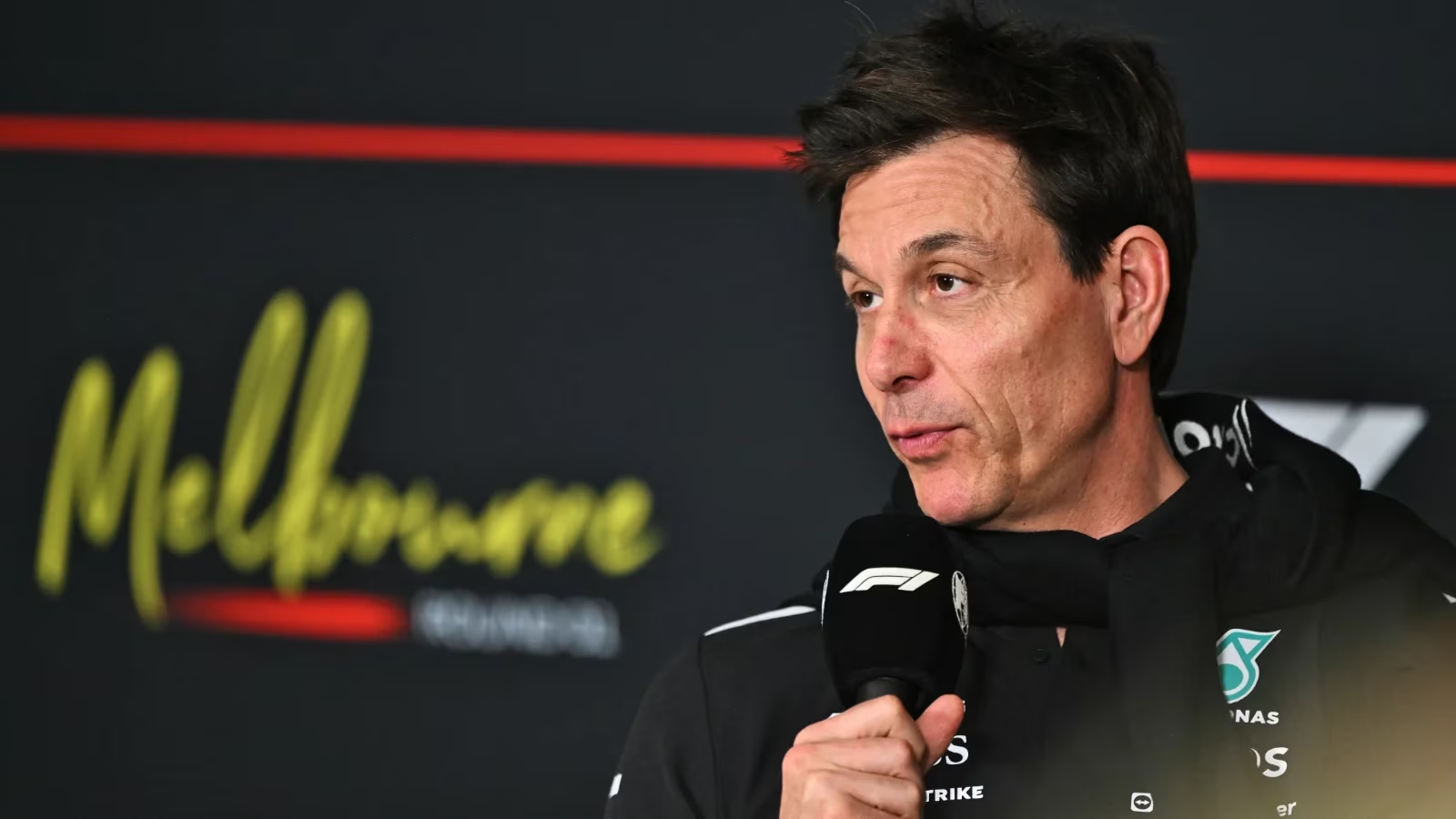
One of the most notable supporters of the discussion is Toto Wolff, whose Mercedes team dominated the hybrid era, yet still recognises the value of revisiting V8 technology.
“We love V8s; we have great memories associated with those units,” Wolff said during the Miami weekend.
“From our point of view, it’s a pure Mercedes engine, capable of very high revs.”
However, Wolff also warned against Formula 1 moving entirely away from electrification. Instead, the Mercedes boss proposed a future concept combining a powerful combustion engine with a simplified yet significant electric component.
“If we went to 100% combustion, we might look a bit ridiculous in 2030 or 2031,” he explained.
“Instead, we could think of something simpler but more powerful, perhaps extracting 800 horsepower from the combustion engine and adding another 400 or more through electric power.”
His comments highlight the delicate balance that Formula 1 now faces in preserving its technological relevance while delivering the emotional spectacle that many feel the sport has lost.
Ford and Cadillac also support the idea
These discussions are particularly important for manufacturers who joined Formula 1 because of the current engine rules, including Audi and Honda.
However, there is also strong support emerging from American manufacturers preparing for Formula 1’s future.
General Motors, through its Cadillac project, is set to become an F1 engine supplier in 2029. A rapid switch away from the current V6 hybrid architecture would dramatically alter these plans.
Nevertheless, Mark Reuss, president of GM, has indicated that the company would embrace the change if Formula 1 were to commit to it.
“We respect the investments that have been made, but if F1 and the FIA decide to go with the V8, we will be ready,” Reuss told the Detroit News.
Within the Ford Motor Company, enthusiasm is similarly strong. Ford Performance boss Mark Rushbrook openly admitted that the company would welcome a return to naturally aspirated V8 engines.
“We produce a lot of naturally aspirated V8s, so we’d love to see a return to this architecture,” he said.
The next few months are expected to be pivotal as the FIA, Formula 1 and manufacturers begin to determine what the next generation of engines will look like. What was once a nostalgic fantasy is rapidly evolving into one of the most important strategic decisions for the future of Formula 1.
Would you like to see more TJ13 Formula 1 coverage? Add us to your favourites list on Google to receive trusted F1 news.

Thiago Treze is a Brazilian motorsport writer at TJ13 with a background in sports journalism and broadcast media, alongside an academic foundation in engineering with a focus on Computational Fluid Dynamics (CFD). This combination of technical knowledge and editorial experience allows Thiago to approach Formula 1 from both a performance and narrative perspective.
At TJ13, Treze covers driver performance, career developments, and key storylines across the Formula 1 grid, while also analysing the technical factors that influence competitiveness. This includes aerodynamic development trends, simulation-driven design approaches, and the engineering decisions that shape race weekend outcomes.
His reporting bridges the gap between human performance and machine development, helping readers understand how driver execution and technical innovation interact in modern Formula 1. Coverage often connects on-track events with the underlying engineering philosophies that define each team’s approach.
With a global perspective shaped by both journalism and technical study, Thiago also focuses on Formula 1’s international reach and the different ways the sport is experienced across regions.
Treze has a particular interest in how Computational Fluid Dynamics and aerodynamic modelling contribute to car performance, offering accessible explanations of complex technical concepts within Formula 1.

I’m sure Ferrari also backs MBS in the end, since they’re the only manufacturer that’s been competing in F1 since the beginning, so they wouldn’t leave over any technical regulations.
Audi & Honda are the only question marks.
Toto’s suggestion of 400 hp as the total electrical power output would be excessive, though.
More reasonably, at least half of that, & even better, 100 from the electrical side, combined with 900 as the total ICE output, which would mean 90/10 ratio split, i.e., even more towards ICE than over the last 12 seasons with the 80/20 split.
The overall weight would definitely decrease with the removal of all hybrid components around the ICE, except the battery (which would be considerably smaller), i.e., the opposite of 2013 to 2014.
A powertrain type with minimal electrical influence wouldn’t necessarily need to be a V8, as it could just as well be a V6 or even V4, not to mention the V8 wouldn’t necessarily be the same 2.4L type as in 2006-2013.