

A Crazy comparison as owner admits: F1 races are more lucrative than the Dolphins’ season – In the world of global sport, few assets are considered as financially powerful as an NFL franchise. However, a surprising claim from Stephen Ross has sparked debate about whether a single Formula 1 event could earn more than an entire American football season.
According to Forbes, the Miami Dolphins were valued at $7.5 billion in August 2025, with projected annual revenues of $656 million. On paper, that places the franchise among the elite money-makers in world sport. However, Ross suggests that another asset in his portfolio, Formula 1, may be even more lucrative.

The Miami Grand Prix boom
Ross is the main owner and operator of the Miami Grand Prix, held annually since 2022 around the Hard Rock Stadium, home to the Dolphins. He indicated that the three-day race weekend can rival, and potentially exceed, the revenues generated by his NFL team over the course of a full season.
Speaking to Andrew Ross Sorkin on CNBC’s Squawk Box, Ross stopped short of making a direct financial comparison, but strongly hinted at the scale of Formula 1’s impact: “F1 has been great so far,” he said, before adding a key detail: “We have more spectators at one F1 race over three days than we have sold season tickets for the Dolphins.”
This highlights the explosive growth of Formula 1 in the United States, where race weekends have become events that blend sport, entertainment and high-end hospitality. Premium ticket packages, corporate suites and sponsorship deals can generate extraordinary revenues over a short period.
Horner update: Aston Martin team boss role turned down by two individuals
Attendance figures tell a different story
However, upon closer examination, Ross’s comments raise questions. While the spectacle of Formula 1 is undeniable, the raw attendance figures paint a more nuanced picture.
According to GP Destinations, the 2025 Miami Grand Prix attracted a record 275,000 spectators across its three-day weekend. By contrast, the Dolphins recorded a total season attendance of 604,106 during the 2025 NFL campaign, according to ESPN.
Although Ross referenced season ticket holders rather than total attendance, it is likely that the Dolphins’ season ticket base exceeds the number of fans attending a single Formula 1 event. This discrepancy suggests that, while Formula 1 may generate more buzz and intensity, American football still commands consistent, large-scale support over a longer calendar.
MORE F1 NEWS – Aston Martin: ‘Shifting the deckchairs….’
Revenue: short-term spike vs long-term stability
The financial comparison becomes even more complex when revenue structures are considered. NFL teams benefit from a highly lucrative shared revenue model, with each franchise receiving a significant portion of centrally generated income. This includes substantial television rights deals and merchandising through the league’s unified platform.
In 2025, for example, each NFL team reportedly earned around $432.6 million from this shared pool alone, providing a stable and predictable financial foundation regardless of individual team performance.
Formula 1 events, on the other hand, operate on a different model. A race like the one in Miami generates intense, short-term revenue through ticket sales, VIP experiences, local sponsorships and tourism. Over a single weekend, the concentration of spending can be enormous, potentially explaining Ross’s enthusiasm.
McLaren crisis deepens: China Disaster Sparks Fresh Fears Oscar Piastri Could Walk Away
A tale of two business models
Ultimately, it is not straightforward to compare a single Formula 1 race to an entire NFL season. The Dolphins represent a long-term, steady revenue stream, supported by one of the world’s most powerful leagues. By contrast, the Miami Grand Prix is a high-impact, short-duration event capable of generating exceptional returns in a matter of days.
Ross’s comments highlight just how valuable Formula 1 has become, particularly in emerging markets such as the United States. While the NFL remains the gold standard for consistent profitability, F1’s ability to deliver substantial revenue spikes in a short space of time is attracting attention, even among seasoned sports investors.
The truth probably lies somewhere in between: the Dolphins may win over the long haul, but for one spectacular weekend, Formula 1 can rival America’s biggest sporting machine.
MORE NEWS – Whistle Blower at Aston Martin: Factory Mood Turns Sour as Newey Steps Back from View
Would you like to see more TJ13 Formula 1 coverage? Add us to your favourites list on Google to receive trusted F1 news.
NEXT ARTICLE – Formula One 2026: Entertainment or Sport?
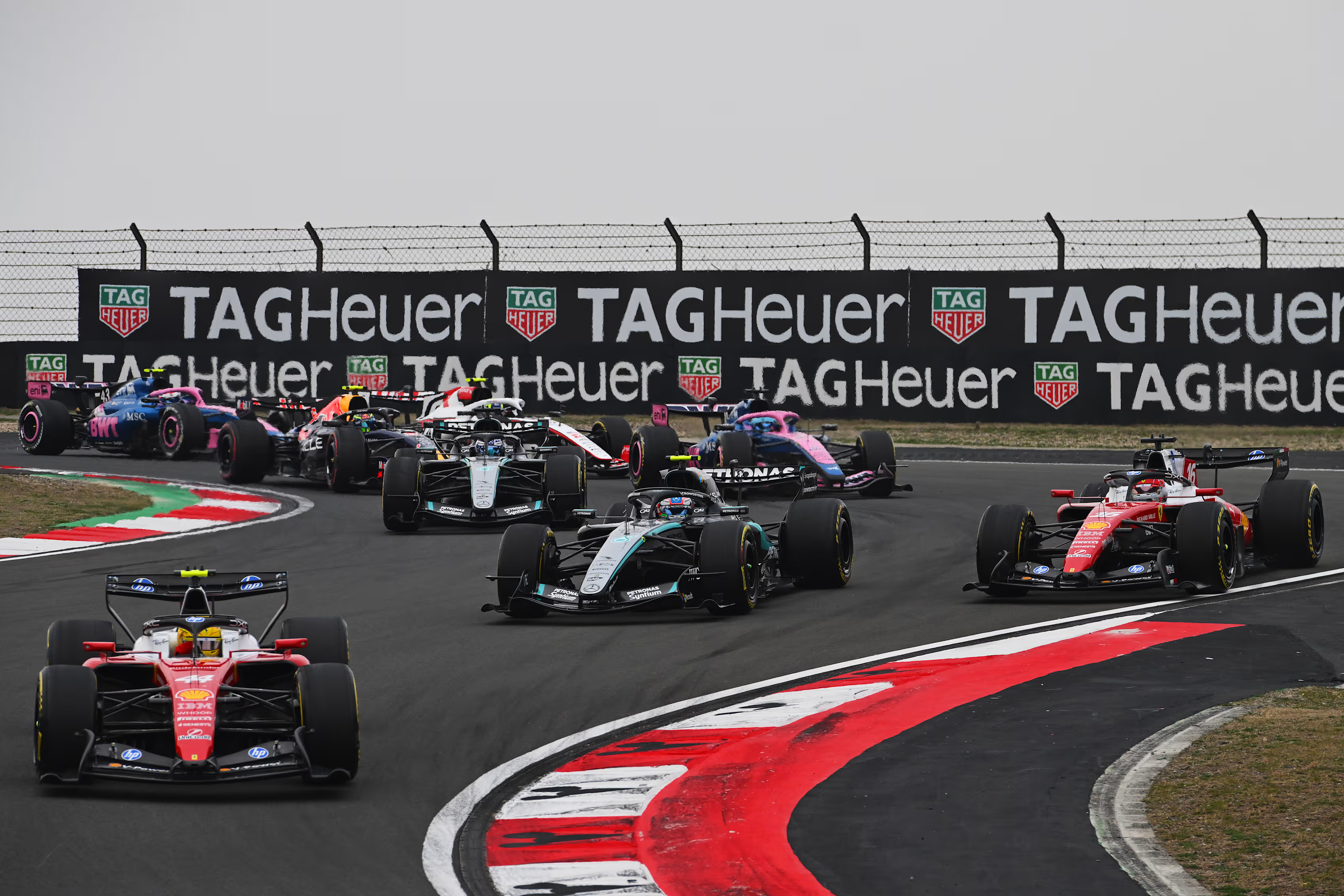
Two race weekends down and the all new Formula One 2026 regulations have indeed had the biggest impact on the sport since its inception. As happened last time the engine rules were radically changed in 2014, it is Mercedes who have turned out on top. That said, Ferrari too have done a decent job as they sit second behind the silver arrows in the constructors’ championship.
For the rest of the field, the picture is not so rosy. If we tot up the points scored by the other nine constructors they total just four more than the Scuderia have accumulated across two races weekends.
Of course, it was expected there would be big winners and losers but presently the championships look to be a race between Ferrari and Mercedes, with the latter looking the stronger of the two.
FIA pause rule changes before Japan
The Sprint weekend in China happens to have settled some of the nerves up and down the paddock, as the expected emergency rule changes before Japan in less than two weeks time have been put on hold. Concerns remain that the disparity of performance between a car out of electrical power and one using its electrical boost systems are creating huge speed differentials which could result in a massive accident.
Then there’s the unwanted spectacle of drivers ‘going slow, to go fast’ in qualifying and the much criticised need to ‘lift and coast’ when in previous generations the cars would be flat out approaching a corner.
Unsurprisingly, Mercedes boss Toto Wolff believes on the whole the new regulations are working well, but given his drivers have won all three races to date, why would he say otherwise? “Qualifying flat-out would be nice. But when you look at the fans and the…CONTINUE READING THIS STORY

Alex Stanton is a Formula 1 journalist at TJ13 with a focus on the financial and commercial dynamics that underpin the sport. Alex contributes reporting and analysis on team ownership structures, sponsorship trends, and the evolving business model of Formula 1.
At TJ13, Alex covers topics including manufacturer investment, cost cap implications, and the strategic direction of teams navigating an increasingly complex financial environment. Alex’s work often examines how commercial decisions translate into on-track performance and long-term competitiveness.
With a strong interest in the intersection of sport and business, Alex provides context around Formula 1’s global growth, including media rights, expansion markets, and manufacturer influence.
Alex’s reporting aims to explain the financial realities behind headline stories, helping readers understand how money, governance, and strategy shape the competitive order in Formula 1.
