

Fresh whispers in the paddock suggest that Williams Racing may be facing a far bigger technical challenge than they have admitted, with their internal weight-reduction programme, reportedly nicknamed ‘Operation Bikini’, now significantly behind schedule.
Information circulating among industry insiders and being widely discussed in online F1 communities points to a startling figure: the Grove-based squad may be as much as 28 kilograms above the minimum weight limit. If accurate, this would make the current Williams challenger one of the heaviest cars on the grid by a substantial margin.

Six races instead of three
According to the rumours, the original plan inside Williams was relatively straightforward. Engineers had targeted the opening three races of the season to gradually introduce lighter components and structural revisions that would bring the car close to the FIA weight limit.
However, as development progressed, the scale of the problem reportedly became clearer.
Rather than three events, the team now expects the programme to take closer to six races before meaningful progress is achieved.
This suggests that the excess mass is not coming from a single component or easily replaceable element. Instead, the weight appears to be distributed across multiple areas of the car, which typically requires more complex redesigns. For a team still rebuilding under the leadership of team principal James Vowles, this situation highlights just how challenging optimising a modern F1 car can be.
Why 28 kg matters
In Formula 1 terms, 28 kilograms is a significant amount. Performance modelling, which is widely used across the sport, suggests that every 10 kg costs roughly three to four tenths of a second per lap, depending on the characteristics of the circuit.
If these estimates are applied to the Williams situation, the car could be losing close to a second per lap purely due to excess weight.
This has led some observers to believe that the car’s underlying design might actually be more competitive than its current results suggest.
Indeed, there is speculation that Alex Albon and Carlos Sainz Jr could be fighting much closer to the front of the midfield if the car reaches its intended weight target.
The SoyMotor leak may have been right?
The rumoured figure also aligns closely with pre-season reports from the Spanish media early last month that the car was 20–30 kg overweight. At the time, these reports were widely dismissed after Williams publicly stated a reference weight of around 772.5 kg.
However, some engineers point out that such figures are often reference values rather than the actual operational mass, meaning they can obscure the full picture once fluids, cooling systems, and race-specific components are taken into account.
If the new estimates prove accurate, the initial leaks may have been much closer to the truth than many realised.
MORE NEWS – Christian Horner to Aston Martin F1 as Newey fails as team principal
A strange contrast: overweight yet competitive?
Ironically, this has created one of the more curious narratives of the early season. Despite carrying a large weight penalty, Williams has not looked entirely uncompetitive compared to other midfield teams.
This raises the tantalising possibility that: If Williams can successfully remove the weight, the car’s true performance level could be significantly stronger than the current results suggest.

The real challenge ahead
The biggest question is whether such a dramatic weight reduction is feasible within the current chassis architecture.
Historically, teams have designed their cars to be as close to the minimum weight as possible from the outset. Large excesses typically indicate deeper structural compromises, sometimes linked to crash-test reinforcement, cooling packaging or last-minute design revisions.
For context, Red Bull Racing’s weight reduction of around 8 kg during the 2022 season helped them achieve the dominant form that ultimately defined that championship campaign.
However, trimming 28 kg is a far more daunting engineering task. If the rumours circulating in the paddock are true, ‘Operation Bikini’ may be less of a quick weight-loss programme and more of a long-term rebuild of the car’s DNA.
Would you like to see more TJ13 Formula 1 coverage? Add us to your favourites list on Google to receive trusted F1 news.
Williams already knows the technical solution, allegedly
Despite the scale of the problem, insiders say the engineering team at Grove already knows exactly how to fix it.
“It’s not complicated to bring the weight down,” Vowles said Sunday in Australia. “What I have in my inbox today are all the technical steps to not only bring it down, but to get it well below the minimum. We have that knowledge.”
According to comments made by team principal James Vowles, the technical pathway to reducing the weight of the FW48 has been mapped out in detail.
Vowles has reportedly indicated that the solutions are documented internally, suggesting that the engineers could not only remove the excess weight, but also bring the car comfortably below the regulatory minimum.
In other words, the issue is not a lack of engineering knowledge. Instead, the challenge lies in how and when those solutions can be implemented.
The budget cap complication
In the pre-budget cap era, a team facing this sort of problem would simply redesign and replace large numbers of components immediately. However, modern Formula 1 operates under strict financial regulations, meaning that the cost of every component change must be considered.
Williams therefore cannot rebuild the FW48 overnight.
Instead, the team is integrating weight-saving measures into planned upgrade cycles and scheduled component replacements. Parts approaching the end of their operational life will be redesigned to reduce weight when they are replaced.
This approach enables the team to remain within the cost cap while gradually reducing the car’s weight.
This also explains why the recovery process could span multiple races rather than involving a single dramatic upgrade package.
MORE NEWS – Verstappen put on notice by Red Bull rookie: ‘I am not letting him pass’
Carbon fibre: the hidden complication
One of the most complex aspects of the situation involves the materials used in the construction of modern Formula 1 cars.
Unlike metal components, carbon fibre structures rarely show visible signs of fatigue before failure. Teams therefore rely on X-ray scanning, ultrasound inspections and predictive modelling to determine how long parts can safely remain in service.
Replacing components too early wastes valuable budget. If they are replaced too late, however, the risk of structural failure increases dramatically.
This balancing act is why Williams is taking a cautious approach, waiting until certain parts naturally reach the end of their lifespan before introducing lighter versions.
Would you like to see more TJ13 Formula 1 coverage? Add us to your favourites list on Google to receive trusted F1 news.
Weight is spread across the entire car
The structure of the weight problem also suggests that there is no single ‘heavy’ component responsible.
Instead, engineers believe the excess mass comes from small increases in weight across many parts of the car, such as slightly thicker carbon laminates, additional reinforcement in key structures and conservative design decisions taken during development.
Individually, these changes might only add a few hundred grams. Collectively, however, they may have added more than twenty kilograms.
Therefore, solving the problem requires a holistic redesign of dozens of components, rather than simply replacing one part.
Why weight is becoming even more critical
The issue also has strategic implications that extend beyond the current season. Under evolving power unit strategies and energy deployment systems, weight influences more than just cornering performance.
A heavier car brakes differently, which affects the energy that can be recovered by the hybrid system. Less recovered energy means less electrical power is available on the straights, creating a chain reaction that affects the entire lap.
Therefore, the FW48’s weight penalty affects not only mechanical performance, but also energy management and deployment efficiency.
F1 NEWS – FIA’s late homologation date sees Mercedes leading their F1 customers on
Reliability setbacks and missing data
Williams’ struggles in Australia were further complicated by reliability issues. When Carlos Sainz’s car stalled in the pit lane during practice, the team lost valuable track time and data.
This prevented a full comparison between Williams and other teams using the same Mercedes power unit. With only one car running competitive laps, the engineers had far less information to analyse, particularly with regard to hybrid energy strategies.
These missing data points made it more difficult to understand the full extent of the car’s performance deficit. The calculations are clear: remove the weight and optimise the aerodynamics, and the FW48 could be transformed.
The only question now is whether the phased approach forced by the budget cap will deliver results quickly enough.
READ MORE – Honda fight back: ‘Aston Martin F1 are part of the problem’
NEXT ARTICLE – 2026 Australian GP: Exciting or Whacky races as perilous dangers become apparent
Probably the most debated change in technical and sporting regulations in the history of Formula One finally was born into reality in Melbourne on Sunday 8th March. On the way to the grid, local hero Oscar Piastri slammed his McLaren car into the wall as an apparent torque spike took control of the MCL40.
The Australian was to take no further part in the days action. Previously in qualifying on his first flying lap, the driver considered a generational talent and maestro of car control, Max Verstappen suffered a similar fate sending his RB22 skipping across the gravel trap at turn one and into the barrier.
Max would start the Grand Prix down in in 20th place. The all new 2026 F1 cars have enormous amounts of torque available at the push of a button to the drivers, delivered from the hybrid powertrains which now sport 50% electrical power output alongside the internal combustion engines (ICE).
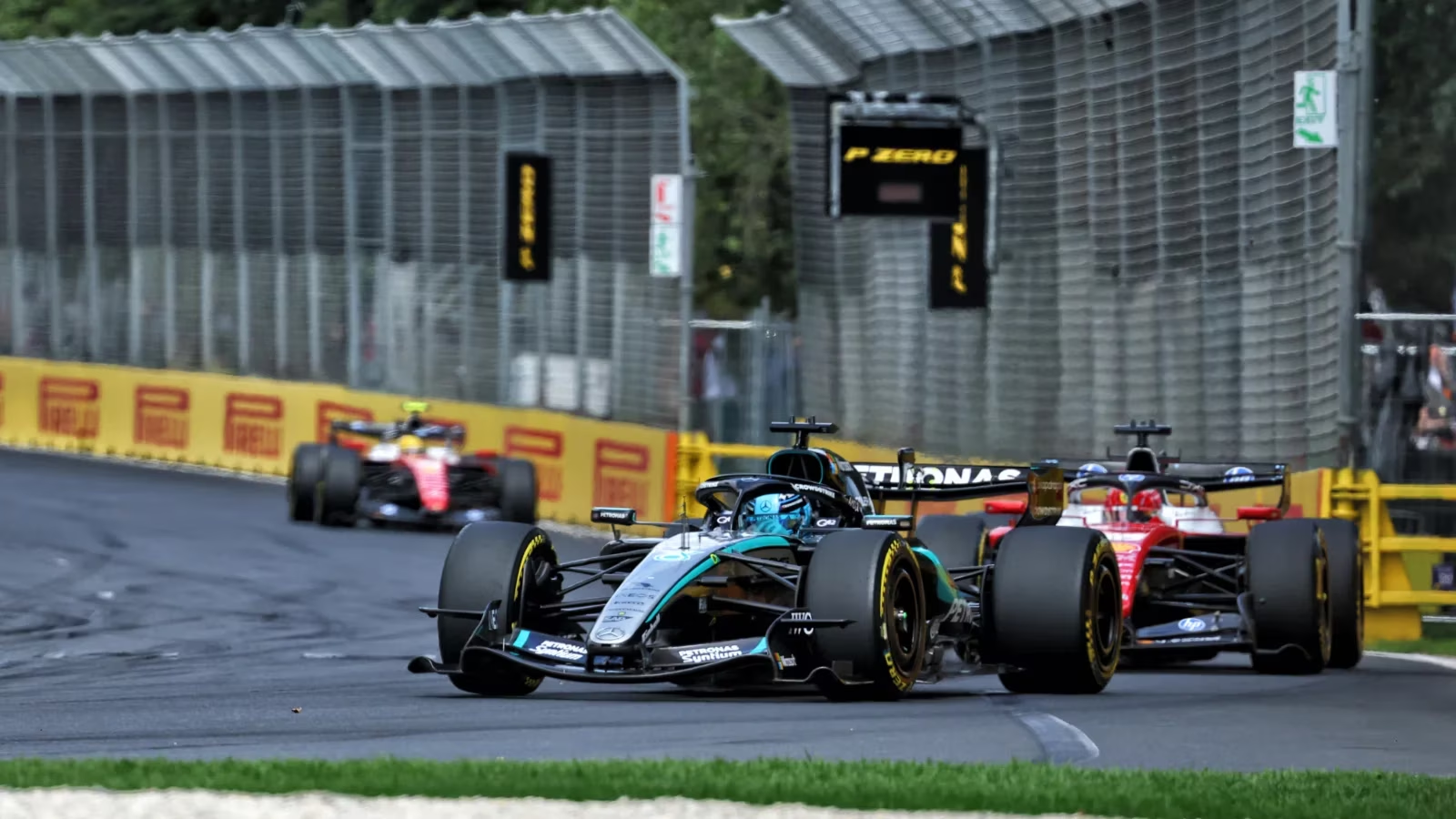
New cars, new rules, new kind of F1 racing
Torque from the electric motors unlike from the ICE is instant and uncontrolled will spin up the wheels at the rear of the car, leaving the driver helpless to control what follows. Add into the mix that the 2026 cars have lost a huge amount of downforce and ride on tyres which have a smaller contact patch meaning less grip.
Throughout the weekend, F1 analysts and broadcasters were marvelling at the fact the F1 cars were no longer on rails and that the drivers were being forced to wrestle control of their machines. Another improvement to the spectacle was the fact that the new aerodynamics and powertrains were allowing the cars to follow more closely without the driver behind destroying his tyres.
At the start of the race, George Russell on pole position reported his battery pack appeared empty and with the lights going out almost instantaneously he and a number of drivers were caught by surprise. Charle Leclerc in his fast starting Ferrari weaved between Hadjar ahead and then Russell to…CONTINUE TO READ THIS ARTICLE

The Judge, a nom de plume of an experienced F1 journalist and site founder with long-standing sources across the paddock. With over 30 years of experience in Formula 1 as an insider journalist, I have built trusted connections across the paddock, from race engineers and mechanics to senior team figures. At The Judge 13, I and a handful of trusted colleagues share exclusive Formula 1 news, expert analysis and behind-the-scenes stories you will not find in mainstream motorsport media.

Craig Alderson is Senior Editor at TJ13, where Craig oversees newsroom operations and coordinates editorial output across the site. With a background in online sports reporting and motorsport magazine editing, he plays a key role in maintaining consistency, speed, and accuracy in TJ13’s coverage.
During race weekends, Craig acts as desk lead, directing contributors, prioritising breaking stories, and ensuring timely publication across a fast-moving news cycle.
Craig’s work focuses heavily on real-time developments in the paddock, including team updates, regulatory decisions, and emerging controversies. This role requires a detailed understanding of Formula 1’s operational flow, from practice sessions through to race-day strategy and post-race fallout.
With experience managing editorial teams, Craig ensures that TJ13 delivers structured, reliable coverage while maintaining the site’s distinctive voice.
Craig has a particular interest in how information moves within the paddock environment, and how rapidly developing stories can be accurately translated into clear, accessible reporting for readers.
