


Ferrari team principal Frédéric Vasseur believes that Lewis Hamilton’s challenging first season with the team says as much about the team as it does about the driver. After a challenging first year together, Vasseur has provided an honest evaluation of Hamilton’s difficulties in a Ferrari, emphasising that the responsibility does not lie solely with the seven-time world champion.
Rumours about Hamilton’s future have intensified following his most challenging season in Formula 1, but former driver Romain Grosjean has dismissed retirement talk, backing Hamilton to continue into the new era in 2026. Meanwhile, Vasseur is focused on turning a painful learning year into long-term progress.

A reality check for Ferrari’s biggest signing
Hamilton’s arrival at Ferrari was one of the most hotly anticipated moves in modern Formula 1, but the reality fell far short of expectations. For the first time in his career, he completed an entire season without a single Grand Prix podium finish, achieving only a sprint race victory in China as a rare highlight.
He finished sixth in the drivers’ standings, narrowly behind his teammate, Charles Leclerc. However, the raw numbers painted a harsher picture: Leclerc outscored Hamilton by 86 points and achieved seven podium finishes, highlighting how far the Briton was from feeling at home in the SF-25, particularly in the second half of the year.
Former Drivers Mock Lewis Hamilton Harshly
Vasseur: “We need to improve together”
Rather than isolating Hamilton’s performance, Vasseur stressed that Ferrari must shoulder its share of the blame, perhaps a considerable admission considering the historical ruthlessness of the Ferrari top brass when dealing with failing team bosses.
“We need to improve our collaboration with Lewis,” Vasseur told Corriere dello Sport.
“He needs to learn how to get the most out of the car. At the same time, we need to better understand exactly what he needs.”
The message was clear: Ferrari did not just hire a champion; it also inherited the responsibility of adapting its systems around him.
Vasseur successor breaks silence on leadership talk
Ferrari boss holds Hamilton accountable for some failings
While Vasseur acknowledged that Hamilton’s transition was far more complex than many had anticipated, he did also point the finger at the British driver for some degree of accountability for the poor 2025 effort. After two decades of driving Mercedes-powered cars for British-based teams, Hamilton was suddenly immersed in a completely different environment, and this was a big factor that Hamilton failed to adjust to in Vassuer’s eyes.
‘The switch to Italy isn’t about food or weather,” Vasseur explained. “It’s the relationships within the team, the software, the components, everything is different. If you haven’t fully adapted, you lose hundredths of a second everywhere.”
Those tiny margins, multiplied across a lap and a season, proved costly. While Leclerc thrived in a system he knew well, Hamilton often appeared disengaged, finding it hard to produce consistent performances in a car that never quite suited him.
Kimi Antonelli blames Mercedes for his mid summer 2025 slump
2026 is a reset, not an exit
Despite the disappointing results, Vasseur remains confident that Ferrari is laying the groundwork for a stronger future. The upcoming 2026 regulation overhaul offers a clean slate, not just technically, but operationally too.
“There were also positive aspects,” Vasseur insisted. ‘Good pit stops, clever strategies and reliability. These aspects are a solid foundation for the future.’
Rather than signalling a decline, Hamilton’s challenging debut may ultimately reveal Ferrari’s own adaptation issues and force the Scuderia to evolve. If that happens, 2025 could be remembered not as the beginning of the end, but as an uncomfortable starting point for something far more competitive.
Schumacher Slams Hamilton, Roasts Rosberg, Praises Verstappen & Norris After 2025 F1 Season
Were the results really as disastrous as they seem?
Hamilton’s debut season in red makes for uncomfortable reading on paper. No wins, pole positions or Grand Prix podiums is uncharted territory for a driver of his calibre, and the internal numbers against Charles Leclerc are stark. Leclerc comfortably won all the qualifying and race head-to-heads, and Hamilton was consistently around two-tenths of a second per lap slower on average, firmly placing him in the role of second driver, a situation Ferrari had not envisaged when signing him.
The contrast is even sharper when compared directly to Carlos Sainz’s final season, with the Spaniard having been far closer to Leclerc in both qualifying and race trim.
However, raw statistics only tell part of the story. Hamilton arrived at Ferrari with no prior experience of its systems, software or internal processes, whereas both Leclerc and Sainz had years of continuity behind them.
History suggests that adaptation time remains crucial in modern Formula 1. Sainz himself was significantly slower than Leclerc in his first Ferrari season, but he steadily closed the gap thereafter. While Hamilton’s 2025 numbers are undeniably underwhelming, Ferrari believes they reflect a steep learning curve rather than an irreversible decline.
2026 will be the ultimate test of such a belief.
Ferrari Fires History Making Driver: The Dream Finally Over?
NEXT ARTICLE – Ex-F1 official slams 2026 powertrain design as a “camel”
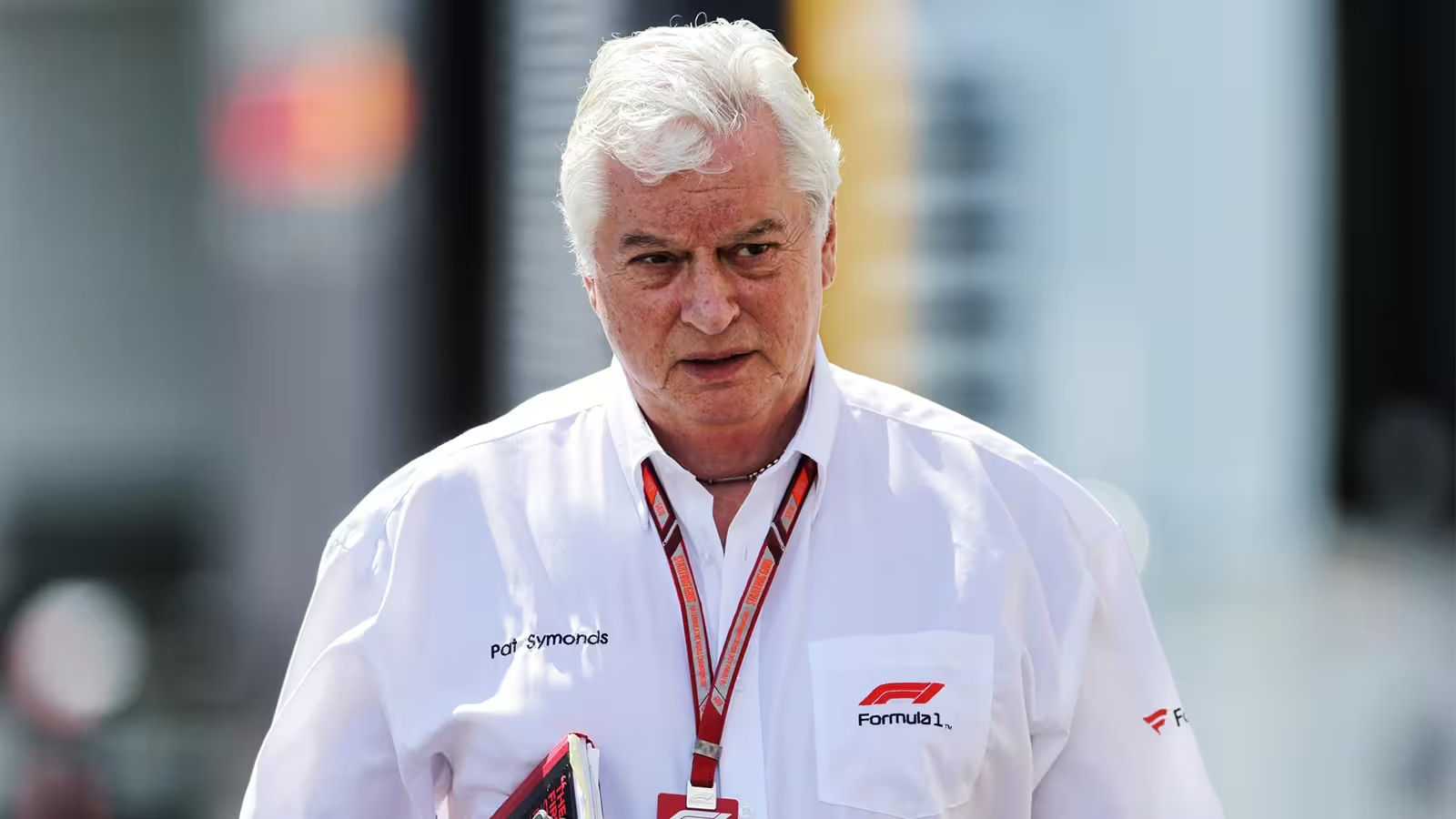
There’s an old adage which goes like this: “A camel is a horse designed by a committee.” This metaphorical notion suggests that a design or a solution created by a large and desperate group often results in a poor, inefficient or award outcome rather than one which is streamline and superior.
The conflicting input from the committee is one of compromises and conflict inherent in a committee process leading to a flawed product i.e. the camel ( functional but ungainly animal instead of a graceful, powerful racehorse.
This is the accusation now being made by one of F1’s most senior engineers of the process by which the all new 2026 Formula One power units were brought about. The current F1 powertrains were introduced back in 2014 with the expected life cycle of each era of F1 power expected to last between 5 and 7 years.
New F1 engines working party set up in 2017
Yet the V6 turbo hybrids which in their final year of 2025 broadly the same architecture now as they were in 2014 have lingered for twelve long years. How did this happen?
It all began in 2017 when the FIA set up a working party to debate the next generation of F1 power. Existing and potential manufacturers were included in the group along with senior technical engineers from each of the teams.
Given the chaos of the previous decade where manufacturers had come and gone due to the global banking crisis, the FIA were keen to broaden the base of those producing engines as a bulwark against further future withdrawals. The intention was to introduce the next era of F1 power in 2021. The proposal set to the group was to simplify the engine designs and reduce the eye watering costs and make F1 attractive to new manufacturing entrants.
However, the committee effect failed miserably to maintain this priority and inordinate and lengthy discussions then…READ MORE ON THIS STORY

Alex Stanton is a Formula 1 journalist at TJ13 with a focus on the financial and commercial dynamics that underpin the sport. Alex contributes reporting and analysis on team ownership structures, sponsorship trends, and the evolving business model of Formula 1.
At TJ13, Alex covers topics including manufacturer investment, cost cap implications, and the strategic direction of teams navigating an increasingly complex financial environment. Alex’s work often examines how commercial decisions translate into on-track performance and long-term competitiveness.
With a strong interest in the intersection of sport and business, Alex provides context around Formula 1’s global growth, including media rights, expansion markets, and manufacturer influence.
Alex’s reporting aims to explain the financial realities behind headline stories, helping readers understand how money, governance, and strategy shape the competitive order in Formula 1.
